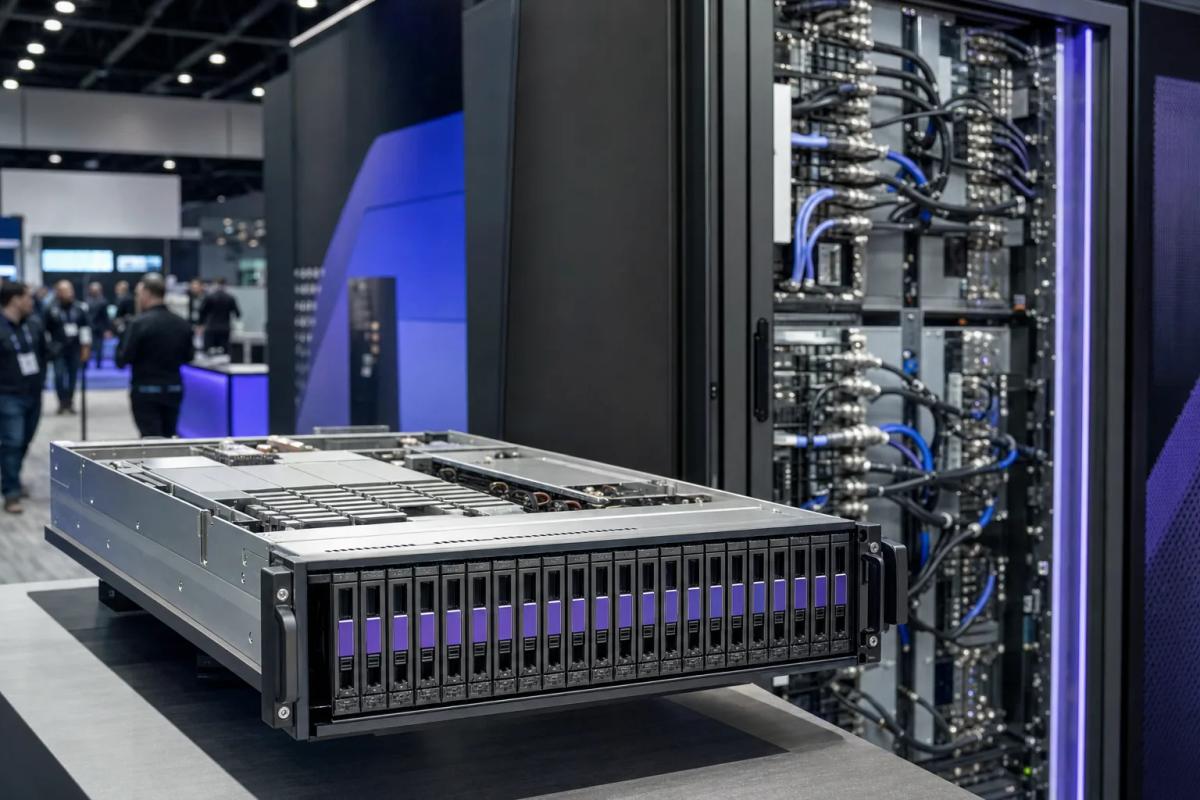
Only four SC26 products can go in a Q1 2027 RFP as deliverables: Supermicro's PCIe Gen6 all-flash servers, Phison's AI Data Platform, Google Cloud's A5X on Vera Rubin NVL72 and ASUS's NVL72 racks. The rest of what got the attention (VAST Data's Job-Level QoS, Nvidia's Vera CPU racks, Marvell's CXL 3.2 memory expanders, the Rubin HPC GPU) has a date between early 2027 and 2028. Each of those goes in the contract as a roadmap line with a GA date and a remedy, or it stays out.
The TOP500 list released at the show makes the same point from another direction. Only 27 of the 500 systems are new, a turnover of 5.4% and the lowest in the list's history. If you have been reading TOP500 churn as a proxy for how much accelerated capacity is coming onto the market, stop. The capacity is still being built, but very little of it is benchmarked in public.
What Can You Buy From SC26 Right Now?
Four products from SC26 have a shipping or availability claim behind them today, and only one of them has a dated, primary-source "now shipping" statement.
- Supermicro PCIe Gen6 all-flash storage. Supermicro's November 18 release says the first systems are "now shipping." The lead box is a 2U Petascale server on 6th Gen AMD EPYC 9006 with up to 32 E3.S NVMe drives and as much as 3.93 PB using 122 TB drives. Supermicro claims up to 100% more sequential read bandwidth than PCIe Gen5, a vendor figure with no independent test yet. More models follow as AMD ships its SP8 CPUs. The release names WEKA, VAST Data, VDURA, IBM Storage Scale, MinIO, Nutanix, Scality and Hammerspace as software partners, so if you already run WEKA NeuralMesh or VAST, you can ask for Gen6 hardware under your existing software stack.
- Phison AI Data Platform. StorageReview's SC26 roundup lists it as available now in 4-GPU and 8-GPU configurations. It is an on-premises box that pairs Phison's aiDAPTIV cache with Wren AI and TrueNAS for generative BI over local data. It suits a team that wants a sealed, sovereign analytics appliance on its own data.
- Google Cloud A5X on Vera Rubin NVL72. StorageReview lists A5X bare metal as newly available. Nvidia's October 21 post said general availability was "coming next month," with Europe to follow, and that Google plans to scale to as many as 960,000 Rubin GPUs across sites. That is a plan, so ask your account team for the regions and quota you can actually reserve.
- ASUS Vera Rubin NVL72 racks. ASUS says it is ramping volume shipments of its AI POD XA VR721-E3 (72 Rubin GPUs, 36 Vera CPUs, liquid cooled) in the fourth quarter, per StorageReview. "Ramping" describes a production rate and says nothing about when your order arrives.
Most of the other server launches on the floor came without dates. StorageReview notes that AIC "did not give availability or pricing," that MSI listed Instinct MI350P-based configurations "without model details or availability dates," and that Compal published no specifications, availability or pricing.
Which SC26 Announcements Are 2027 and 2028 Roadmap?
Four of the most discussed SC26 announcements are dated futures, and each one needs a GA date written into your contract before you plan around it.
VAST Job-Level QoS: February 2027 at the earliest. Job-Level QoS lets an administrator cap bandwidth and IOPS per scheduler job, not just per tenant or user. It carries the job identity from Slurm, PBS Pro or LSF into the storage layer, and policies change without restarting jobs. It addresses a real problem: one checkpoint storm starving every other job on a shared cluster. But Blocks & Files reports that GA is "planned" with VAST AI OS 5.6 in late January or early February 2027, and that it requires VAST NFS 4.8 or later. Kubernetes support is described as something the architecture allows, not part of the release. If your training runs are scheduled by Kubernetes rather than Slurm, this feature does not yet cover you.
Nvidia Vera CPU racks: early 2027. Nvidia's SC26 release describes a rack of 192 Vera CPUs (88 Olympus cores each), about 300 TB of memory and 1 PB of storage, that reuses the NVL72 chassis, power and cooling. Dell, HPE, Lenovo and Supermicro are "expected" to offer it "beginning in early 2027." Nvidia's performance comparisons (1.9x on an OpenFOAM benchmark) are against unnamed x86 parts.
Marvell Structera X CXL 3.2: samples in Q1 2027. The 3406 (DDR4, up to 9 TB) and 3506 (DDR5, up to 6 TB) memory expanders are expected to sample in Q1 2027, with no pricing or power figures. Sampling means engineering parts go to server makers. Production servers come after that. The DDR4 option matters if you have retired DIMMs and are watching memory prices, which is the same pressure behind the repricing of signed AI server orders.
Rubin HPC GPU: 2028. Nvidia's HPC member of the Rubin family has more than 50,000 CUDA cores and is expected in 2028. StorageReview notes that Nvidia "has not published memory capacity, FP64 throughput, power, or system configurations." Those are the figures a buyer would need to compare it with anything.
Why Does the TOP500 No Longer Track AI Capacity?
The November 2026 list barely moved, and a likely reason is that the largest AI clusters are rarely submitted, so the list now misses much of the AI build-out.
The facts from the 68th edition: the Top 10 is unchanged since June. China's LineShine at Shenzhen holds No. 1 at 2.198 exaflops HPL, ahead of El Capitan at 1.809. Aggregate HPL across all 500 systems rose 4.4% to 19.57 exaflops. The No. 500 entry point is 2.857 petaflops. Accelerated systems went from 275 to 291. The highest new entry is KISTI's Hangang at No. 12, and ORNL's Lux, built for AI research on more than 4,000 AMD Instinct MI355X GPUs, debuts at No. 14. AMD now powers 202 systems, about 40% of the list, according to Tom's Hardware.
StorageNewsletter's write-up connects the low turnover to growth that "has indeed shifted toward AI factories." It cites an Epoch AI estimate that five US hyperscalers held about 71% of global AI compute at the end of 2025. That link is StorageNewsletter's own inference rather than a TOP500 finding, but it fits what the list cannot see. Submitting means running HPL on a machine that is earning money training or serving models, and the operators building the largest clusters have no reason to do it.
The strongest counterargument is that the TOP500 was never a procurement tool, and that is fair. But capacity planners have quoted it as a supply signal for years. If you track GPU supply, use what Nvidia says about neocloud commitments and what your cloud will reserve in writing. The gap between installed and energized chips also tells you more than a benchmark list.
What to Do Before 2027 Budgets Lock
The work for the next few weeks is sorting your SC26 notes into "buy" and "roadmap," and making every roadmap item carry a date and a consequence.
This Week:
- Go through your SC26 notes and vendor follow-ups and mark each product "shipping" or "roadmap" using the dates above. Anything in the second group comes out of the Q1 RFP as a deliverable.
- If you run VAST with Slurm, PBS Pro or LSF, ask your VAST team for the AI OS 5.6 date in writing and check that your clients run VAST NFS 4.8 or later. If you schedule with Kubernetes, ask when job-level policies will cover you, and get the answer as a date.
This Month:
- For any NVL72 capacity (A5X or an ASUS rack), get the region, the quota and the delivery week into the order. Neither a ramp nor a planned scale-out commits anyone to a delivery week. The same discipline applies to reserved versus spot GPU terms.
- If you are refreshing storage for a GPU cluster, ask your current software vendor whether it supports Gen6 hardware like Supermicro's Petascale box, then benchmark on your own checkpoint pattern. The GPU cluster storage comparison and the 8-hour inference soak test give you a test plan.
Before Budget Lock:
- Put Vera CPU racks, CXL 3.2 memory expansion and Rubin HPC in the 2027 plan as dated options with no committed spend. Revisit each when it ships, or for Marvell, when there is a price.
- Write a remedy into any contract that depends on a 2027 feature: a credit, a right to exit or a price hold if GA slips past the stated quarter.
- Take TOP500 movement out of your capacity-planning deck and replace it with your own reservations and your providers' written delivery dates.
The Bottom Line
SC26 followed the pattern of GTC Berlin in October. Shipping products made up a small part of the floor, and the attention went to things due in 2027 or later. That is normal for a show where vendors reveal roadmaps. The cost lands on a buyer who signs as if the roadmap had already shipped. Gen6 flash and NVL72 capacity are real this quarter. Job-level storage QoS, Vera CPU racks, CXL 3.2 and Rubin HPC are dates on a slide until a vendor commits to them in a contract.
Ask VAST for the 5.6 date in writing before you size next year's shared cluster around it.
Continue Reading
- Pick DDN EXAScaler for a GPU Cluster You Own
- Your Dell AI Server Order Could Cost 45% More at Delivery
- Your Nvidia Neocloud Reservation Leaves Build Risk With You
- WEKA and NAND Research Set an 8-Hour Inference Test
- Nvidia Unveils DSX POD and OpenShell at GTC Berlin
- NetApp to Acquire PEAK:AIO to Scale AI Storage in ONTAP