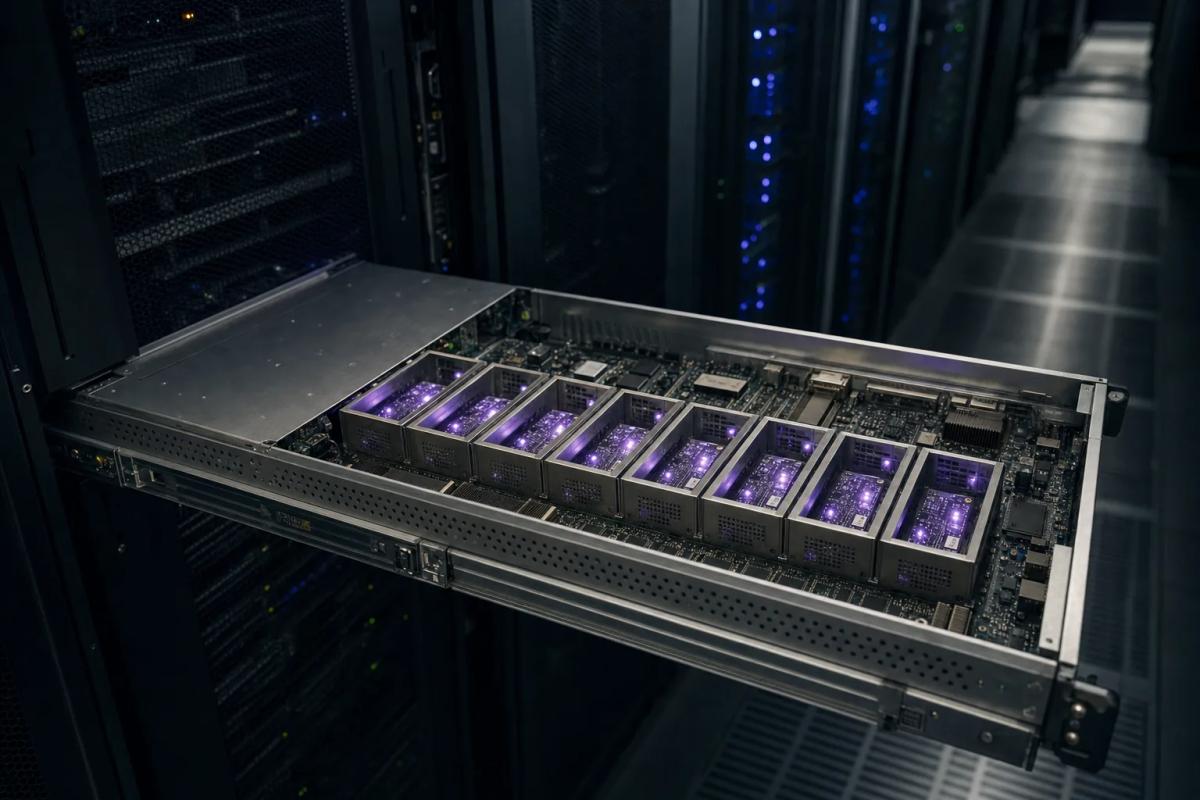
If you already run EKS and your agents execute code they wrote themselves, you can now put each of those pods in its own hardware-isolated VM and pay only for the EC2 capacity underneath. AWS launched Nitro Sandboxes on November 9, 2026 for EKS pods, ECS tasks and standalone EC2 VMs, in all commercial regions, "at no additional charge." That turns a hosted sandbox contract into a build-vs-buy question for most CPU-only agent workloads. The workloads that still need a vendor are the ones that want GPUs, pause and resume, or sub-second starts without a warm pool, and you will have to tighten IAM yourself, because the sandbox leaves the pod's role exactly as it was.
A Nitro Sandbox is a lightweight virtual machine, run by the Nitro hypervisor on the parent EC2 instance, that holds one pod or task and gives it its own kernel. On EKS you opt in per pod: the EKS user guide says you set runtimeClassName to isolated-sandbox or confidential-sandbox in the pod spec. The cluster must run Kubernetes 1.36 or later.
What AWS Actually Shipped on November 9
AWS shipped one isolation primitive with three front doors. EKS gets it as a RuntimeClass, ECS gets it through ECS Managed Instances as "isolated and confidential tasks," and EC2 gets it raw, so you can bring your own AMI and virtual machine monitor. The launch post names Amazon Linux and Firecracker as natively supported, and says Pod Identity, VPC CNI, EBS, EFS, S3 and CloudWatch "all work out of the box."
There are two modes, and the difference matters to a security review:
- Isolated mode (
isolated-sandbox): the parent instance is trusted and the guest is not. This is the mode for agent-generated code, where your concern is the code breaking out to the node or its neighbours. - Confidential mode (
confidential-sandbox): the parent instance is untrusted and the guest is the trust boundary. Per the EKS docs, KMS releases secrets only after attestation, keyed onkms:RecipientAttestation:PCR17andPCR8:ServiceNameconditions, and each pod needs a generated Cedar policy.
The architecture underneath is not new. Cloud Native Now's November 17 report notes that the Nitro virtualization architecture dates back to 2017, and quotes AWS security director Mark Ryland on its goal "to minimize the amount of information that the hypervisor even has access to in the first place." The same piece points out the structural difference from Kata Containers: a Kata VM inside a virtualized worker needs nested virtualization, while a Nitro Sandbox runs as a sibling of the parent EC2 instance.
How Much Cheaper Is It Than E2B or Daytona?
At list prices, a fully packed Nitro node runs a 2 vCPU, 4 GiB sandbox for between a third and a half of what the hosted vendors charge per busy hour, depending on how far you oversubscribe CPU. The hosted side is easy to price. E2B bills $0.000014 per vCPU-second and $0.0000045 per GiB-second, and Daytona lists $0.0504 per vCPU-hour and $0.0162 per GiB-hour. Both come to about $0.17 for one 2 vCPU, 4 GiB sandbox busy for an hour.
Qovery's comparison, checked on November 10, 2026, puts the same workload on EKS at "about $0.05 to $0.07," based on an m7g.2xlarge at $0.3264 an hour on demand in us-east-1 holding five or six sandboxes. Qovery sells a platform that runs on your own cloud, so read that as an interested party's arithmetic. The inputs are public, but five or six 2 vCPU sandboxes on an 8 vCPU node only fit because AWS lets you oversubscribe vCPUs up to 5x; memory is never overcommitted. Without oversubscription the node holds four, which puts each at about $0.08 an hour.
Three things the per-hour figure leaves out:
- Idle nodes. Qovery's figure assumes full nodes and excludes the EKS control plane ($0.10 an hour per cluster). A hosted sandbox bills per second and drops to zero. Your node pool does not, unless you run Auto Mode or a tight autoscaler. If your agent traffic is bursty, the gap narrows fast.
- Plan fees, which run the other way. E2B's Pro tier is $150 a month plus usage, with 100 concurrent sandboxes and 24-hour sessions, and its Enterprise usage carries a $3,000 monthly minimum, per its pricing page. Nitro Sandboxes have no seat or concurrency fee. Density is capped instead: the EC2 guide allows up to 5 sandboxes per vCPU and at most 896 per parent instance.
- The Graviton assumption. Qovery priced a Graviton node. On Intel and AMD instances with SMT, the EKS considerations page says compute available to sandboxed pods "is bounded by physical cores, roughly half the advertised vCPUs," and advises requesting CPU in multiples of two. Run the same math on an m7i and you get about half the effective compute for the money.
Memory is usually the binding constraint. Qovery reports a 256 MiB overhead per pod in isolated mode and 512 MiB in confidential mode. The AWS documentation pages checked for this piece on November 29, 2026 do not state a total; the considerations page says each unique container image in a pod reserves 16 MiB of the RuntimeClass overhead, and pods over 1 GiB get usable memory about 1 to 2 percent below their request. Budget the Qovery figure until you measure your own.
Where It Falls Short of a Hosted Sandbox
Nitro Sandboxes cover CPU code execution well and leave four gaps a hosted vendor still fills. All four are in AWS's own documentation.
The first gap is GPUs. The considerations page is blunt: GPU and device passthrough are not supported at launch, because the sandbox runs on Firecracker, which cannot pass host devices into the guest. Daytona lists H100s at $2.47 an hour on its pricing page. If your agents fine-tune, render or run local inference inside the sandbox, keep that workload where it is.
The second is state. The same page lists "the absence of GPU passthrough, snapshot and restore, and live migration" for the EC2 primitive. A sandbox lives and dies with its pod. A coding agent that parks a half-built environment overnight and resumes it in the morning needs E2B's pause feature, or you rebuild state from a volume each time. In-place CPU and memory resize is also unsupported.
The third is start time. AWS's warm-pool blueprint measured a cold sandboxed pod at 3.2 to 3.7 seconds from create to Ready, against 0.8 to 0.9 seconds for an ordinary pod, on a node that was already up with the image pulled. Claiming a pre-booted sandbox from a warm pool took 0.8 seconds. Daytona advertises "Sub 90ms sandbox creation." For a chat agent that spins up a sandbox per user turn, the difference is visible to the user; for a batch data agent it is noise.
The fourth is the platform floor. Kubernetes 1.36 or later is required. Managed and self-managed node groups need Nitro Enclaves enabled in the launch template, because "without Nitro Enclaves enabled, the node never advertises sandbox capacity," per the isolated setup guide. Auto Mode will not provision sandbox nodes on FIPS AMIs, GPU or Neuron AMIs, or multi-NUMA types, and r5a, r5ad and m5ad are unavailable at launch. hostNetwork: true pods fail to start, and a single EBS volume cannot be shared across pods.
Why the Sandbox Does Not Shrink the Blast Radius
A Nitro Sandbox keeps generated code off the node's kernel, and the AWS credentials you hand that code work exactly as they did before. The credentials page says pods in Nitro Sandboxes get AWS credentials through EKS Pod Identity "the same way as pods on standard nodes," for the role tied to the pod's service account.
So an agent pod running a model's code with a service account that can write to your data lake can still write to your data lake, from inside a perfectly isolated VM. The sandbox closes one path: IMDS inside an EKS sandbox is an IMDSv2-only surrogate serving five metadata paths, so the code cannot lift the node's instance role. On raw EC2, the EC2 guide warns that a sandbox behind NAT can reach the parent's IMDS and read its IAM credentials, so that path is yours to block.
The controls that help are ordinary ones. Give code-execution pods their own service account with no role, or a role scoped to one bucket prefix. Setting the sandbox.amazonaws.com/network-isolated annotation to "true" makes Pod Identity credentials unavailable entirely. The default throttles (4,096 simultaneous outbound connections per IP family, 100 DNS queries per second) cap a runaway job but are not an egress policy. Write the egress allowlist yourself.
Build or Keep Buying?
Move CPU-only agent code execution onto Nitro Sandboxes if you already run EKS 1.36 or ECS Managed Instances, your sandbox traffic is steady enough to keep nodes busy, and data residency or an AWS spend commitment already argues for keeping execution in your account. Keep a hosted sandbox for GPU work, for pause and resume, and for interactive agents where a 0.8 second warm claim is still too slow. Qovery's own recommendation lands in the same place, and many teams will run both: a hosted sandbox for the fast inner loop and Nitro for jobs that touch private data.
The strongest case for staying put is the platform team's time. E2B or Daytona gives you an SDK, session management and a dashboard. Nitro gives you a RuntimeClass, and the warm pool, the session API and the cleanup job are yours to build and own. If you have no platform engineer with spare capacity, $0.17 an hour is cheap. We compared the hosted options on idle-time billing in October, and that analysis still decides the hosted side. Google's answer, Agent Substrate on GKE, shares the no-GPU limit, so a multi-cloud shop does not escape it by switching providers.
This Week:
- Check your EKS cluster versions. Anything below 1.36 is an upgrade project before it is a sandbox project, so get it on the platform roadmap now.
- Pull last month's E2B, Daytona or Modal invoice and split it by GPU, paused-session and plain CPU usage. Only the CPU slice can move.
This Month:
- Stand up one Auto Mode node pool on Graviton, deploy AWS's warm-pool blueprint, and run a week of your real agent jobs through it. Measure start time, pods per node and memory headroom against the 256 MiB overhead estimate.
- Have your security lead review the service accounts those pods use. Strip them to the minimum role, or set
network-isolatedwhere the code needs no AWS access at all.
Before Renewal:
- If the CPU slice is more than half your sandbox bill and the pilot held up, renegotiate the hosted contract down to the GPU and pause workloads, or drop to a usage tier with no plan fee.
The Bottom Line
Hardware-isolated containers used to be the thing you bought because you could not build them. Kata and gVisor made the build possible but left you to run it, and hosted sandboxes took that work off your hands for a per-second fee. AWS has now made the isolation itself free on capacity you already pay for, which moves the vendor's value to everything around it: fast starts, pause, GPUs and the tooling. Price your hosted contract against those features. Then check which service account your agent pods run under before you move a single one.
Continue Reading
- E2B vs Modal vs Daytona: Idle Time Sets Sandbox Bills
- Agent Substrate on GKE Drops Database and MCP Connections at Suspend
- AWS Makes AgentCore V2 Default as Startup Tokens Can Repeat
- Codex Runs Stdio MCP Servers Outside Its Sandbox by Default
- Baseten Acquires Blaxel to Add Sandboxes for AI Agents
- Agent Authorization: Standing Privilege Is the Whole Problem