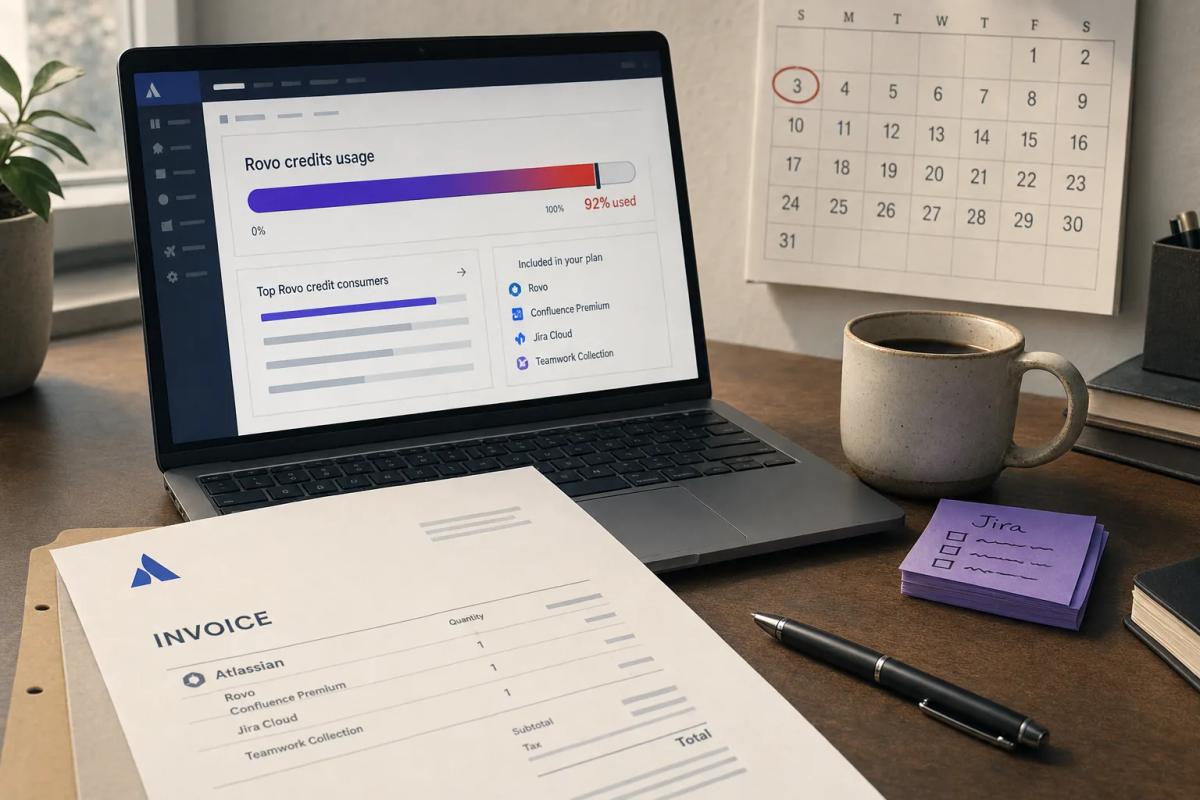
If you budgeted Rovo as a free feature of your Jira and Confluence Premium seats, your first metered invoice arrives after December 3, 2026, and it draws on one pool shared by the whole company. Atlassian's Rovo credits page says pay-as-you-go billing starts that day at a list price of $0.01 per credit ($10 per 1,000), with pay-as-you-go "enabled by default." A 500-seat org on Jira and Confluence Premium gets 70,000 included credits a month. At the usage levels modelled below, that org pays nothing in a light month, about $720 in a typical one, and about $5,580 in a heavy one.
The verdict: keep Rovo, and set a monthly pay-as-you-go limit before December 3 rather than switching pay-as-you-go off or buying usage packs blind. Pull Atlassian's usage export first, size the limit from your own numbers, and move to the Teamwork Collection only if two months of billing show you living above the pool. Glean is the weakest buy here for a company whose knowledge already sits in Jira and Confluence, because Rovo Search costs no credits at all.
Prices below were checked on each vendor's live page on November 26, 2026, except Microsoft's, whose pages timed out that day; its figures are as listed on November 16, 2026.
| Option | Price unit (checked Nov 26, 2026) | 500 seats, typical month | Who should not pick it |
|---|---|---|---|
| Atlassian Rovo on Jira + Confluence Premium, pay as you go | 70 credits per user per app per month, pooled; $0.01 per credit over | about $720 in overage | Orgs that will leave pay-as-you-go uncapped and Deep Research open to everyone |
| Rovo via Teamwork Collection Premium | 700 credits per user per month, pooled; same $0.01 overage | $0 in overage; the collection seat is a quote | Teams that use Rovo for quick answers only |
| Microsoft 365 Copilot | $30 per user per month, paid yearly; agents on Copilot Credits | $15,000 in seats | Companies whose tickets and specs live in Jira and Confluence |
| Notion AI (Notion Business) | $20 per seat per month, 1,500 Standard + 500 Select credits per seat | $10,000 in seats | Anyone who is keeping Confluence |
| Glean | No published price | Quote only | Atlassian-centric orgs |
How Many Rovo Credits Does Each Plan Include?
Every paid Jira, Confluence, Service Collection and Teamwork Collection cloud subscription includes a monthly Rovo credit allowance per user, and the allowances from each app add together. A Rovo credit is Atlassian's metering unit for AI work: each chat message or agent invocation deducts a set or variable number of them from your organization's pool.
Per Atlassian's allowance table, checked November 26, 2026:
| Offering | Standard | Premium | Enterprise |
|---|---|---|---|
| Jira | 25 | 70 | 150 |
| Confluence | 25 | 70 | 150 |
| Jira Product Discovery | 25 | 70 | 150 |
| Service Collection | 250 | 700 | 1,500 |
| Teamwork Collection | 250 | 700 | 1,500 |
Atlassian's own example on that page is 100 Confluence Premium plus 100 Jira Premium users, which yields 14,000 credits a month. Allowances reset monthly on your usage billing date, and unused credits do not roll over. The organization admin must be on a verified business domain to enable Rovo at all.
Two meters sit outside this pool, and budget owners miss both. Rovo Dev uses separate Rovo Dev credits that "can only be used for Rovo Dev features like Rovo Dev CLI," and Rovo Dev "will stop working until your usage resets" when they run out. Jira Automation gets its own usage billing from the same date, priced at $0.50 per 1,000 extra steps according to Breeze's summary of the 2026 changes (Breeze sells a competing tool). TechRepublic's September 3 report covers both meters going live on December 3.
Seat prices also moved this autumn. Breeze reports Jira Premium at $19.60 per user per month for 1 to 100 users from October 13, 2026, up from $18.30. Atlassian's pricing page would not render for us on November 26, so confirm the number on your own quote.
What Does Each Rovo Action Cost in Credits?
A basic Rovo action costs a flat 10 credits, and everything Atlassian calls premium costs a variable amount it does not publish as a fixed number. That split is the whole budgeting problem.
Here is what each figure rests on:
| Action | Credits | Source |
|---|---|---|
| Rovo Search, Definitions, Summaries | 0 | Atlassian |
| Rovo Chat quick answer, basic agent (no model selection) | 10 per billable event | Atlassian |
| Enriched Teamwork Graph API or tool call | mostly 1 to 10 per call | Atlassian |
| Typical prompt that draws on enriched Teamwork Graph calls | 10 to 25 in total | Atlassian's licensing FAQ, as quoted by Sentra (a competing vendor); we could not render the FAQ to confirm it |
| Think deeper, advanced agents, Agents in Jira, Jira Coding Agent | variable | Atlassian |
| Deep Research | about 100 per request | a user, in Atlassian's public tracker (ROVO-866, May 13, 2026) |
The Deep Research figure is the one to treat with care. It comes from a user's feature request, and it predates the pricing Atlassian applies to all usage from August 31, 2026. Atlassian's Deep Research page says only that the mode "consumes Rovo credits" and can take up to 15 minutes to answer. We use 100 in the estimate below because nothing better is published.
Think deeper costs more than you will see in the prompt box, for two reasons. Per Atlassian's reasoning-mode comparison, "Rovo will activate think deeper mode automatically if it detects a multi-layered or open-ended prompt," so a user who never picks it can still trigger it; Deep Research, by contrast, "must always be explicitly selected." And agents configured for Think deeper get a 50-step loop limit against 10 for quick answers; Atlassian's agent reasoning page warns that autonomous or high-volume agent tasks "can quickly consume credits." ROVO-866 also notes credits are "consumed silently after a prompt is submitted," with no estimate shown first.
Users notice the arithmetic first. A community thread is titled with it: 70 Premium credits at 10 per chat is seven chats per user per month, before pooling.
How Does Org-Level Pooling Drain the Allowance?
All of your organization's Rovo allowances combine into one shared pool, and any user can spend it. Atlassian's page says "power users can consume more credits while light users can consume less," and per-user allocation is listed as "coming soon," which means it is not available today.
That design is generous to the median user and dangerous at the tail. In a 500-seat Premium org with 70,000 pooled credits, 70 people running ten Deep Research requests each in a month spend the entire pool by themselves if the 100-credit figure holds. Everyone else then either bills at $0.01 a credit or, if you have capped spend, finds Rovo paused.
Code review is another quiet drain. Atlassian's Code Reviewer page says "each review uses a variable number of credits," rising with PR size, run frequency and repository size. The default is manual trigger only. If a team switches it to run on every pull request, it draws from the same pool as Confluence chat.
What Will a 500-Seat Premium Org Pay?
At the usage levels below, a 500-seat org on Jira Premium plus Confluence Premium pays $0 in a light month, about $720 in a typical month and about $5,580 in a heavy one. The workload is defined so you can swap in your own numbers: 500 users holding both apps, a 70,000-credit pool, 22 working days, overage at $0.01.
| Scenario | Assumptions | Credits used | Overage | Monthly bill |
|---|---|---|---|---|
| Light | 200 active users, 13 quick answers a month at 10 credits | 26,000 | 0 | $0 |
| Typical | 300 active users, one prompt per working day at 20 credits; 50 users run two Deep Research requests | 142,000 | 72,000 | $720 |
| Heavy | 400 active users, three prompts per working day at 20 credits; 100 users run ten Deep Research requests | 628,000 | 558,000 | $5,580 |
The assumptions are ours, not Atlassian's. Twenty credits sits inside the 10 to 25 range for a typical prompt; agents and Think deeper can run higher, so treat the heavy case as a floor for an org that has rolled out agents in Jira.
Three variations change the answer. If you hold only Jira Premium, the pool halves to 35,000 and the typical month costs about $1,070. On the Teamwork Collection Premium allowance of 700 credits per user, the pool is 350,000: the typical month is covered, and the heavy month drops to about $2,780 in overage before the collection's own seat price, which you need from your Atlassian quote. Spread across 500 seats, the heavy case is about $11 per user per month, well under a $30 Copilot seat.
Usage packs are the last lever. Atlassian's usage pack page lists Rovo packs from 2,000 to 10,000,000 credits a month, and unused pack allowance "does not roll over." Atlassian's Rovo credits page mentions "volume discounts for annual credit packs" without publishing the rate. Buy a pack only once you know your steady-state overage, or you pay for credits that expire.
Which Admin Controls Actually Cap Rovo Spend?
The monthly pay-as-you-go limit is the control that caps spend; alerts only tell you after the fact. Per Manage pay as you go for a meter, organization and billing admins set it under Billing and subscriptions, then Subscriptions, then the Rovo credits meter, then "Update limit." Once you reach the limit, "no pay-as-you-go usage can be incurred, and metered features may be limited."
What pauses depends on the setting:
- With pay-as-you-go on and a limit set, metered features "continue to work without interruption" until the cap, after which "no pay-as-you-go usage can be incurred, and metered features may be limited."
- With pay-as-you-go off, "billable interactions pause until the credit allowance resets or more credits are purchased" as soon as the included pool is spent. Free features such as Rovo Search keep working.
- If you set the limit below what you have already used, your organization "won't be able to use metered features until usage resets."
Admins and billing admins get notifications at 80% and 100% of the allowance, and can disable pay-as-you-go at any time. TechRepublic adds that with extra usage disabled, work already in progress can finish when the pool runs dry.
Check the setting in your own tenant rather than trusting the default. Atlassian's October 15 KB article says that if the menu shows "Enable extra usage," overage is currently off, and if it shows "Disable extra usage," overage is on. That reading conflicts with the main page's "enabled by default," so look before December 3.
No page we found lets an admin restrict Deep Research by user or group. Until per-user allocation ships, the spending limit is the only hard ceiling.
How Do Copilot, Notion AI and Glean Compare on Price?
Every alternative costs more than Rovo overage at these volumes, because each one charges a seat on top of the Atlassian seats you already pay for. They are worth considering only if they replace something.
Microsoft 365 Copilot lists at $30 per user per month, paid yearly, which is $15,000 a month for 500 users. Agent usage outside licensed users bills on Copilot Credits, at $200 a month for a 25,000-credit pack or on a pay-as-you-go meter per Microsoft's Copilot Studio pricing page (as of November 16, 2026). Copilot makes sense if your company already lives in Outlook, Teams and SharePoint and Jira is one source among many. Don't buy it to reason over Jira tickets; Rovo reads that data natively and costs less.
Notion AI comes inside Notion Business at $20 per seat per month, with 1,500 Standard and 500 Select AI credits per seat per month; extra Notion credits can be bought, at a price the page does not list. That is a generous allowance, and it only helps if your documents move to Notion. A team that keeps Confluence pays twice for the same wiki. Notion's agents are on our Notion Agents page.
Glean publishes no price; its pricing page offers only "Get a demo." It is the loser for an Atlassian-centric company. You would pay a quoted per-seat fee for permission-aware search across Jira and Confluence, which Rovo already does at zero credits. Glean earns its quote when your knowledge is spread across dozens of SaaS apps with Atlassian as a minority, which we compared in Glean Alternatives 2026. See also our Glean page.
What Should You Do Before December 3?
The decision that predicts regret is whether you set a limit from data or from a guess. Atlassian publishes per-action credit counts for basic work but most teams have no usage baseline before billing starts, so the first job is to get one.
This Week:
- Open Atlassian Administration, then Usage, then Meters, then Rovo credits, and select "Export data." Per Atlassian, the CSV covers up to three months or the first million events and lists feature, user, agent, timestamp and credits; the download link expires after 24 hours.
- Sort the export by user and by feature. Find out what share of credits Deep Research, Think deeper and agents account for, and how many users drive the top half of usage.
- Check whether the Rovo credits menu shows "Enable" or "Disable extra usage," and record which state you are in.
Before December 3:
- Set a monthly pay-as-you-go limit equal to your projected overage plus a margin. Using the table above, a 500-seat Premium org with typical usage would start around $1,000.
- Tell the heaviest users what Deep Research costs and that the pool is shared. There is no per-user cap yet, so the conversation is the control.
- Confirm Code Reviewer is still on manual trigger in every repository.
After Two Billing Cycles:
- If overage is steady and above a few thousand dollars a month, price the Teamwork Collection's 700-credit allowance against it, and ask your account team for the annual credit pack discount in writing.
- If overage is near zero, lower the limit and leave pay-as-you-go on so nobody gets cut off mid-quarter.
The Bottom Line
Rovo is cheap at the median and has one shared pool with no per-user cap. Its heaviest actions are the ones with no published price.
Export the usage CSV this week and set the limit from it before December 3.
Continue Reading
- Atlassian Says Rovo Sends Data to Third-Party LLMs by Default
- Glean Alternatives 2026: Copilot, Rovo, Onyx and Quick Compared
- Your Copilot Studio Chat Could Cost $7.84 on a Reasoning Model
- True Cost of a Copilot Seat: The Licence Is the Floor
- Agentic AI Pricing: Don't Buy Consumption Without a Cap
- Your Agentforce Bill Depends on How Many Actions an Agent Takes
- Fixed Budgets, Flexible AI: Atlassian's Answer to $27B in Overprovisioned Licenses