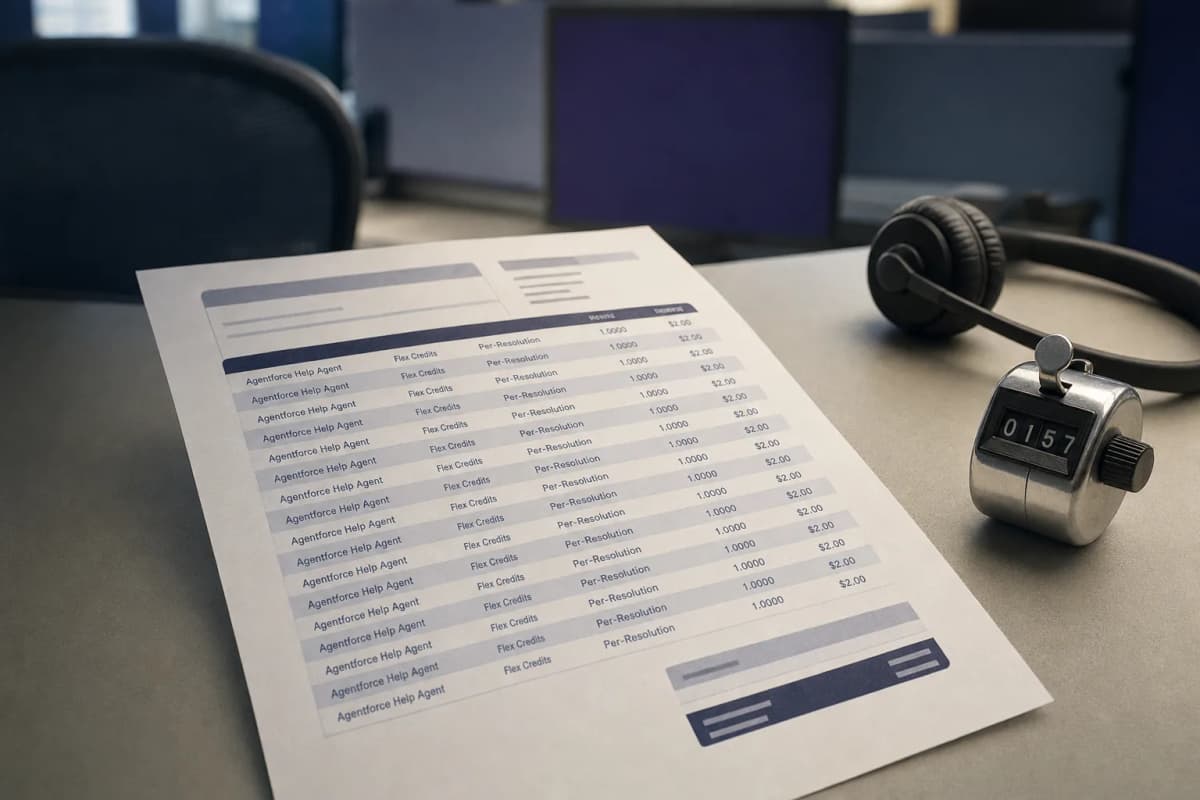
Agentforce Flex Credits bill every action an agent takes, at $0.10 each, so an agent that needs 20 steps to close a chat costs twenty times as much as one that needs a single step. If you budgeted on conversations, your estimate is wrong in whichever direction your agent's design pushes it. For a service agent resolving 60% of chats on its own, buy Flex Credits when it averages under about 12 actions per chat, switch to Help Agent's $2-per-resolution meter above that if the packaged agent fits your use case, and do not buy the $2-per-conversation SKU at all.
All prices below are from Salesforce's Agentforce pricing page, Microsoft's Copilot Studio pricing page and Zendesk's pricing page, checked October 30, 2026, list price in USD.
| Meter | List price (Oct 30, 2026) | Cost per resolved case at 3 / 8 / 20 actions per chat | Who it suits | Who should not buy it |
|---|---|---|---|---|
| Agentforce Flex Credits (chat) | $500 per 100,000 credits; 20 credits ($0.10) per action | $0.50 / $1.33 / $3.33 | Most Salesforce orgs; agents with short action chains | Anyone who needs a hard spend cap, or runs 20+ step agents |
| Agentforce Flex Credits (voice) | 30 credits ($0.15) per voice action | $0.75 / $2.00 / $5.00 | Short, scripted voice flows | Voice agents above about 13 actions per call |
| Agentforce Conversations | $2 per conversation | $3.33 / $3.33 / $3.33 | Almost nobody new | Everyone starting today. This is the loser. |
| Agentforce Help Agent resolutions | $2 per resolution (400 credits) | $2.00 / $2.00 / $2.00 | Service teams whose cases fit the prepackaged agent | Teams needing heavy custom logic, or under 1,000 resolutions a pack |
| Microsoft Copilot Studio | $200 per 25,000 Copilot Credits a month; agent action 5 credits | $0.25 / $0.59 / $1.39 (non-reasoning model) | Microsoft-first shops building their own agents | Salesforce-centric service orgs that would run a second agent stack |
| Zendesk AI agents | $1.50 per automated resolution committed, $2.00 pay-as-you-go | $1.50 / $1.50 / $1.50 (committed) | Service desks already on Zendesk Suite | Anyone not already paying for Zendesk seats |
The workload behind every number in that table: a customer-facing service agent handling 10,000 chat conversations a month, 60% (6,000) resolved without a human, at three action counts per conversation. Cost per resolved case is the monthly bill divided by 6,000, because Flex Credits, Conversations and Copilot Studio all charge for the 4,000 conversations that ended with a human anyway.
What Salesforce Actually Charges for Agentforce
Salesforce sells Agentforce on four meters, and you can only run some of them together. A Flex Credit is Salesforce's prepaid unit of AI consumption; the August 18, 2026 rate card sets how many credits each kind of usage burns. Its current multipliers:
- A standard or custom Agentforce action costs 20 credits in production and 16 in a sandbox. At $500 per 100,000 credits that is $0.10 and $0.08.
- An Agentforce voice action costs 30 credits in production ($0.15) and 24 in a sandbox. A footnote says "for certain customers" a separate Agentforce Voice Minutes usage type applies instead.
- Prompts on Salesforce-enabled models, for Agentforce 1 and Agentforce for Sales, Service and Industries customers, cost 2 credits for a basic prompt, 4 for standard and 16 for advanced. These are billed "in addition to" action credits.
- A Help Agent resolution costs 400 credits ($2) in production and 0 in a sandbox.
The pricing page defines an action as "a specific function that an AI agent executes on the platform," with updating a record, answering a product inquiry or executing a custom prompt or flow among its examples. That is the unit you are buying, and it is the number almost nobody knows for their own agent before signing.
Salesforce introduced the per-action model in its May 15, 2025 announcement, alongside a Flex Agreement that lets customers convert user licences into Flex Credits and back. The $2 conversation SKU predates it and is still on the pricing page, which says Conversations "are optimized for external facing customer agents." The two cannot share an org: moving to Flex Credits means swapping all of your existing Conversation SKUs.
The Help Agent meter is newer. Salesforce announced Help Agent, a prepackaged service agent, with pay-per-resolution pricing on June 25, 2026, and CIO reported that a resolution counts when the question does not need a human escalation. Actions within one 10-minute call window, or one chat window, count as a single resolution however many questions the agent answers. Escalations, abandoned sessions and an explicit "I didn't get my answer" are not billed. Resolutions are pre-purchased in packs with a 1,000 minimum, per the same report.
Which Per-User Add-Ons and Editions Include Flex Credits?
Only the bundled editions include credits; the per-user add-ons buy unmetered seats instead. The pricing page lists, as of October 30, 2026:
| Licence | List price | What it includes |
|---|---|---|
| Agentforce add-on (Sales, Service, Field Service, Operations) | $125 per user per month | Flat-fee employee agent use for that user |
| Agentforce Industries add-on | $150 per user per month | Same, for industry clouds |
| Agentforce User License | $5 per user per month | Access for every employee to limited CRM objects; usage is metered and needs Flex Credits |
| Agentforce Coworker User License | $50 per user per month | Coworker searches and 30 MB of indexing per user per month |
| Max edition | From $550 per user per month | The Agentforce add-on plus 2.75M Flex Credits per org per year |
| Salesforce Foundations | $0 | A starter bundle of Flex Credits, number not stated by Salesforce |
The Sales Cloud pricing page lists Core at $195, Advanced at $395 and Max at $550 per user per month, billed annually, and its comparison table shows allowances of 500K, 1M and 2.75M Flex Credits per org. The Flex Agreement announcement described the per-user add-ons as "unmetered employee-facing agent usage."
Two numbers decide which licence an internal team should take. The $125 add-on beats the $5 licence plus Flex Credits once a user triggers more than 1,200 actions a month ($120 difference divided by $0.10), which is about 55 actions every working day across 22 days. Very few sales reps do that; a service rep with an agent working every case might. And the 2.75M credits in Max are per org, worth $13,750 a year at list, or about 137,500 standard actions. Spread across 100 Max seats, that is roughly $11 of agent usage per user per month inside a $550 seat. Judge Max on what else the edition includes; its credits add about $11 a seat.
Worked Example: Cost per Resolved Case at 3, 8 and 20 Actions
At 60% autonomous resolution, Flex Credits cost less per resolved case than Help Agent's $2 until the agent averages 12 actions per chat; past that, per-resolution pricing wins. The arithmetic for the stated workload (10,000 chats, 6,000 resolved, list prices from the pricing page on October 30, 2026):
| Actions per conversation | Flex Credits, chat (monthly) | Flex Credits, voice (monthly) | Conversations at $2 | Help Agent at $2 per resolution |
|---|---|---|---|---|
| 3 (order status lookup) | $3,000 | $4,500 | $20,000 | $12,000 |
| 8 (case triage with record updates) | $8,000 | $12,000 | $20,000 | $12,000 |
| 20 (multi-step returns or rebooking) | $20,000 | $30,000 | $20,000 | $12,000 |
Three break-evens fall out of Salesforce's own rates:
- Flex Credits against Conversations: 20 actions per chat, about 13 per voice call. Below those, Flex Credits are cheaper. Above them, a flat $2 conversation is cheaper than Flex Credits.
- Flex Credits against Help Agent: 20 times your resolution rate. At 60% resolution that is 12 actions. At 40% it drops to 8, because Flex Credits charge for every failed conversation and Help Agent charges for none.
- Conversations against Help Agent: never. Both are $2, and one of them only bills when the customer's problem is solved.
That is why the per-conversation SKU is the loser. It charges full price for greetings, misroutes and conversations a human finishes, and it locks the org out of Flex Credits until every Conversation SKU is swapped.
The voice column shows the second trap. Salesforce's own pricing page example 5, a reservation change over Agentforce Voice, uses four voice actions (120 credits). Voice agents that verify identity, look up a booking and confirm a change reach that count fast, and a voice agent at 13 actions costs as much per call as a $2 conversation.
How Agentforce Compares With Copilot Studio and Zendesk
Microsoft Copilot Studio is cheaper per step on paper, and Zendesk is the simplest to forecast; neither is a reason for a Salesforce service org to move its agent.
Copilot Studio sells Copilot Credits at $200 a month for 25,000, or $0.008 a credit, with up to 20% off for up-front Commit Units. Microsoft's billing rates page charges 1 credit for a classic answer, 2 for a generative answer and 5 for an agent action, which it defines to include triggers, deep reasoning and topic transitions. Modelling each conversation as N agent actions plus two generative answers gives $0.15, $0.35 and $0.83 per chat at 3, 8 and 20 actions. The catch is in the same document: a reasoning model adds 10 credits per 1,000 uncached tokens, counted across every model call the agent makes to answer one message. A turn that processes 10,000 fresh tokens adds $0.80, which can erase the price gap on its own. Copilot Studio also disables custom agents when a tenant hits 125% of prepaid capacity, which protects the budget and stops the service. Employee-facing use by Microsoft 365 Copilot licensed users is billed at no charge.
Zendesk bills $1.50 per automated resolution committed or $2.00 pay-as-you-go on Support Team, Suite Team and Suite Professional, with 5 to 10 resolutions per agent seat included. Since May 18, 2026, Zendesk's resolution tiers charge only for a "verified resolution," where an LLM check confirms the request was resolved; assisted escalations and contained-but-unverified conversations draw nothing. That definition is stricter than Help Agent's as reported. It only helps if your cases already live in Zendesk.
If you run Service Cloud, the realistic choice is among Salesforce's own meters. The comparison tells you what to push on in the negotiation: Zendesk's $1.50 committed rate and its verified-resolution test are a reasonable benchmark for Help Agent pricing on a large pack.
How to Count Actions in a Pilot Before You Commit
Run the pilot on Flex Credits, read actions per conversation from Digital Wallet, and use the 90th percentile rather than the average for your budget. Digital Wallet is Salesforce's free consumption tracker, and its product page says it reports near real-time usage "down to the agent, action, and channel level."
- Build the pilot in a sandbox, knowing it is not free. Actions cost 16 credits there under the rate card, which applies the sandbox multiplier to scratch orgs too. Help Agent resolutions cost 0 in a sandbox, so you can test that agent's resolution rate for free.
- Run real traffic for two weeks. Scripted test questions take the happy path and undercount. A practitioner guide from October 2026 recommends a controlled two-week scope before setting thresholds.
- Pull three numbers per topic: actions per conversation at the median and at the 90th percentile, and the share of conversations that ended with a human. The resolution rate is the input that decides between Flex Credits and Help Agent.
- Count prompt credits separately. Standard prompts at 4 credits and advanced prompts at 16 bill on top of the action that ran them, so an agent that calls a prompt template on every turn costs more than its action count shows.
- Set Digital Wallet alerts at 50%, 80% and 100% of the monthly figure. Those alerts notify; nothing on Salesforce's page describes a hard stop, and the practitioner guide above says plainly that they do not halt spending. A runaway loop keeps billing until a person turns the agent off.
Then multiply the 90th percentile action count by your forecast volume. The tail is where the bill comes from: one returns flow that loops on a failed lookup can do the damage of a hundred order-status checks.
Contract Terms: Expiry, Overage and True-Up
The terms that cost money are no rollover, an undefined overage rate, and multipliers Salesforce can change mid-term. From the pricing page and rate card, as of October 30, 2026:
- The rate card says credits "must be used before the Order End Date" on the order form, and "no rollover will be permitted." Over-buying is a straight loss.
- "There is no overage penalty." Usage past entitlement bills at your contracted rate, monthly in arrears, so the rate you negotiate for the committed block is also your overage rate. Get it written down.
- There are three buying models: Pre-Purchase (pay up front, draw down), PayGo (monthly in arrears, no commitment) and Pre-Commit (commit a baseline with no up-front payment, true-up at term end if usage falls short). The page says Pre-Commit is "widely available later this year."
- "Usage types, tiers, and associated multipliers may be updated from time to time," and changes to tiers "will be treated as multiplier changes." Without a lock, the 20-credit action can change during your term.
UpperEdge's analysis of the Flex Credits launch recommends defining "actions" in the contract, pricing overage up front and negotiating volume discounts as consumption grows. Its follow-up on Help Agent treats the $2 rate and the 1,000-resolution pack as "a starting point for negotiation," and asks for written examples of what is and is not a resolution, plus recourse if the billed resolution rate does not match what your team sees.
Which Figures in Third-Party Guides Are Wrong?
Several numbers circulating in consultant guides do not appear on Salesforce's own pages, and one of Salesforce's own examples contradicts its rate. Verified against Salesforce's pages on October 30, 2026:
| Claim | Status |
|---|---|
| $0.10 per action, 20 credits, $500 per 100,000 | Verified on the pricing page and rate card |
| Voice action 30 credits; sandbox 16 / 24 | Verified on the rate card |
| Help Agent resolution 400 credits ($2) | Verified on the rate card |
| 1,000-resolution minimum pack for Help Agent | Reported by CIO; not on the pricing page |
| Foundations includes 200,000 free Flex Credits (agencyQ) | Not verified. Salesforce's pricing calculator says only "a bundle of flex credits" |
| An action over 10,000 tokens bills as multiple actions | Not on the rate card. Salesforce states it in its Agentforce Coworker (beta) billing documentation; third-party guides apply it to all agents |
| Pricing page example 5: 120 credits = $0.15 per call | Inconsistent. 120 credits at $500 per 100,000 is $0.60; the page's $180 monthly total matches $0.60 |
The token rule matters most for retrieval-heavy agents, where a single knowledge search can carry a long context. If it applies to your agents, an action that pulls large knowledge chunks costs two or three times its listed price. Ask your account executive to confirm in writing whether the 10,000-token threshold applies to your SKUs.
What Changes the Answer
Three inputs move the recommendation: your resolution rate, your 90th percentile action count, and whether Help Agent's packaged scope fits your cases.
- With a resolution rate below 50%, Help Agent's advantage grows, because Flex Credits keep billing for the failures. Prefer per-resolution if the agent fits.
- Returns, rebooking and claims flows that chain lookups, policy checks and record writes can pass 20 actions. Flex Credits are then the most expensive Salesforce meter for chat.
- For a mostly voice workload, the break-even against $2 drops to about 13 actions, and the Voice Minutes usage type may apply to your contract instead. Get the voice rate quoted separately.
- Employee-facing agents are a seat decision. Compare the $125 add-on against the $5 licence plus Flex Credits at your measured actions per user, using the 1,200-action break-even.
Teams already moving off seat pricing can read our broader agentic pricing comparison, which covers outcome pricing across vendors.
This Week:
- Pull last month's chat and voice volumes and the share your human agents closed, so you have a resolution-rate baseline.
- Ask your Salesforce account team for the current rate card, whether the Voice Minutes usage type applies to you, and whether the 10,000-token rule applies to your SKUs.
This Month:
- Run a two-week Flex Credits pilot on one topic, then pull median and 90th percentile actions per conversation from Digital Wallet.
- Test Help Agent in a sandbox, where resolutions cost 0 credits, and record its resolution rate on the same topic.
Before Signing:
- Lock the action multiplier for the full term, write the overage rate into the order form, and size the committed block to the pilot's median, not its 90th percentile, since unused credits expire.
- If you hold Conversation SKUs, plan the swap to Flex Credits or Help Agent at renewal; there is no workload where $2 per conversation beats both.
The Bottom Line
Agentforce pricing rewards a short action chain, which makes agent design a budget decision. The same pattern hit cloud spending a decade ago, when chatty microservices turned per-request API pricing into a line item finance noticed. At $0.10 an action, removing three redundant lookups from a flow that runs 10,000 times a month saves $3,000 a month at list. Measure actions per conversation in your own org, divide by your resolution rate, and pick the meter from that number.
Continue Reading
- Agentic AI Pricing: Don't Buy Consumption Without a Cap
- Best AI Contact Center Platforms: Containment Isn't Resolution
- AI Bundles Push Microsoft, Google and Salesforce to Raise Prices
- True Cost of a Copilot Seat: The Licence Is the Floor
- PayPal's AI Agents Resolved 24M Contacts as Support Costs Fell 3%
- SalesBleed Turned a Public Web Form Into an Agentforce Data Leak