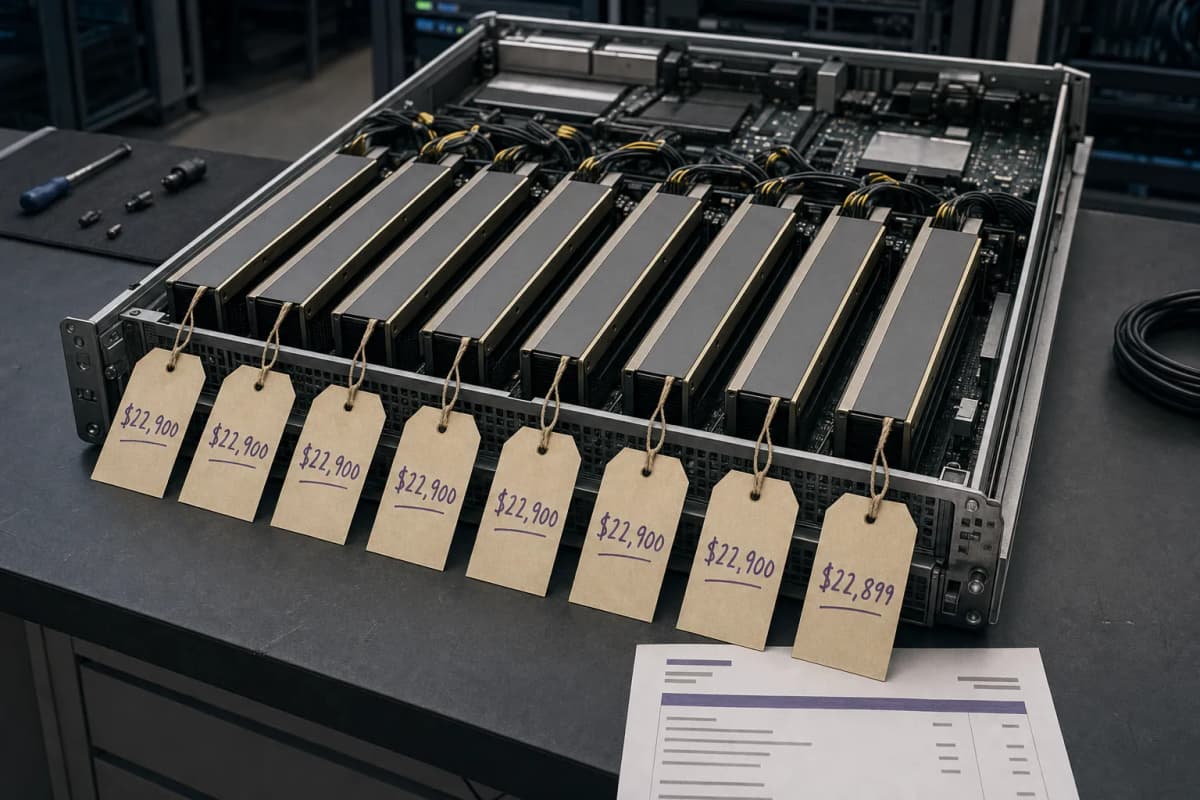
For on-prem inference on bare metal, run vLLM (or SGLang) yourself and skip the NVIDIA AI Enterprise licence. If you need a vendor on the hook for the runtime, buy Red Hat AI Inference. Pay NVIDIA's $4,500 per GPU per year (list price, checked on NVIDIA's licensing guide on October 29, 2026) only where it is effectively mandatory: vGPU for Compute, NIM containers serving real users, or a server whose GPUs already ship with the licence. On a 32-GPU cluster that fee is $144,000 a year for software whose core engines are Apache 2.0, and NVIDIA's own NIM release notes report some NIM profiles delivering 30% to 59% lower throughput than open-source vLLM.
| vLLM / SGLang (DIY) | Red Hat AI Inference | NVIDIA AI Enterprise | Ubuntu Pro (Canonical) | Amazon Bedrock Custom Model Import | |
|---|---|---|---|---|---|
| Verdict | Default if you have a platform team | Default if you need a support contract | Loser for bare-metal inference; mandatory for vGPU | OS support only, cheap add-on | Pick it if you would rather not own GPUs at all |
| Software price (checked 2026-10-29) | $0, Apache 2.0 | Contact sales | $4,500/GPU/yr; $13,500/GPU for 3 yrs; $22,500/GPU perpetual; $1/GPU/hr on cloud marketplaces | $500 to $3,400 per machine per year | Per model copy, per Custom Model Unit, per minute |
| Unit of charge | None | Subscription, quoted | Per GPU | Per machine | Per running model copy |
| 32-GPU cluster (4 x 8-GPU servers), per year | $0 software, plus your engineers | Quote | $144,000 | $13,600 at 24/7 Full support | No hardware; usage-billed |
| Accelerators | NVIDIA, AMD, Intel, TPU and more | "Any hardware accelerator" (vendor claim) | NVIDIA only | Any | AWS-managed |
| Who should NOT pick it | Teams with nobody on call for a CVE | Shops with no RHEL or OpenShift skills | Mixed-accelerator fleets; anyone paying per GPU for containers they could build | Anyone expecting it to support vLLM itself | Anyone with residency rules or GPUs already bought |
The workload throughout this comparison: four 8-GPU servers (32 GPUs) serving open-weight models on premises, three-year planning horizon, US list prices.
What Does NVIDIA AI Enterprise Cost Per GPU?
NVIDIA AI Enterprise costs $4,500 per GPU for a one-year subscription at list price, and every multi-year option is a multiple of that. NVIDIA's licensing guide pricing page, checked October 29, 2026, lists:
| Term (self-managed, per GPU) | List price | EDU / Inception price |
|---|---|---|
| 1 year | $4,500 | $1,125 |
| 2 years | $9,000 | $2,250 |
| 3 years | $13,500 | $3,375 |
| 4 years | $18,000 | $4,500 |
| 5 years | $18,000 | $4,500 |
| Perpetual, with 5 years of support | $22,500 | $5,625 |
Two things in that table matter more than the headline. There is no discount until year five, which NVIDIA describes as five years for the price of four. And the perpetual licence costs more than the five-year subscription; you pay $4,500 extra for the right to keep running software after its support ends.
The cloud option is consumption-priced: $1 per GPU per hour on the AWS, Azure, Google Cloud and Oracle marketplaces, plus the instance itself, with support "limited to 3 calls" per the same page. Run the arithmetic before you choose it. At 8,760 hours a year, a GPU running around the clock costs $8,760 a year on the marketplace meter, almost double the $4,500 subscription. The two break even at 4,500 hours, roughly 51% utilisation. Below that, pay by the hour. Above it, the annual licence is cheaper, if you need the licence at all.
At our 32-GPU workload: $144,000 for one year, $432,000 for three years, $576,000 for five, or $720,000 perpetual. Ask your reseller for a discount off those numbers; NVIDIA sells self-managed licences through its partner network.
Jensen Huang floated a figure of about $2,000 per GPU a year for NVIDIA's agent software at GTC Berlin on October 22, 2026. No product, price list or start date came with it, so do not budget against it.
What Does the Licence Actually Buy?
The licence buys three things: production rights to NIM containers, NVIDIA support with a four-hour initial response, and patched, long-term-maintained builds of NVIDIA's stack. Per NVIDIA's licensing page, Business Standard support includes 24x7 case filing and a 4-hour initial response, with "access to all maintenance releases, defect resolutions, and security patches" for selected components and long-term branch maintenance of up to three years. Business Critical support and a Technical Account Manager cost extra, and the pricing page lists no price for either.
NIM is the part most buyers are paying for. A NIM is a container that packages a model with an inference engine and picks an optimised "profile" for your GPU. The engine underneath is often open source. NVIDIA's NIM for LLMs 1.15 release notes say, in release 1.15.0 for models of 49B parameters and up, "We recommend using the vLLM backend for optimal performance", and list known issues including "~30% throughput degradation compared to OSS vLLM" on a TensorRT-LLM profile for Llama 3.1 8B on B200, "~50% throughput degradation compared to OSS vLLM for all ISL/OSL" on an H200 NVL profile, and "59% average throughput degradation compared to OSS vLLM" for a Nemotron Super 49B profile on GB200.
Those are known-issue entries for specific profiles, and NVIDIA also notes a 70B profile where "performance is better than OSS vLLM". The steel-man for NIM is real: it saves you choosing quantisation, parallelism and engine flags per GPU, and a team that has never tuned vLLM will often get a faster first deployment from NIM. What the release notes rule out is the assumption that the licence buys performance you cannot get from the open-source engine. Benchmark both on your prompts and check which profile NIM loaded.
Which Free Engines Replace NIM?
vLLM is the default replacement, SGLang is the strong second, and TensorRT-LLM is the open-source NVIDIA engine for teams that want NVIDIA's kernels without NVIDIA's container. All three are Apache 2.0.
- vLLM is Apache 2.0 on GitHub, with support for "NVIDIA GPUs, AMD GPUs, Intel GPUs, and x86/ARM/PowerPC CPUs" plus plugins for Google TPUs, Intel Gaudi, Huawei Ascend and others. That hardware list is the strategic argument: your serving layer stops being tied to one silicon vendor's licence. We compared the three engines head to head in vLLM vs TensorRT-LLM vs SGLang and defaulted to vLLM.
- SGLang is Apache 2.0 and competitive on prefix-heavy and agentic workloads. Its multi-tenant risks are real; Cloudflare's GLM-5.3 incident ran on it (our writeup).
- TensorRT-LLM is Apache 2.0 at the project level, but read the LICENSE file before your lawyer does: code in the
ltx2visual-generation directory is under the LTX-2 Community License, which requires a paid commercial licence for entities with $10 million or more in annual revenue. For LLM serving you will not touch that directory. Your open-source review still has to note it.
NVIDIA also gives NIM away for non-production use. NVIDIA Developer Program members get a "license to use your self-hosted NIM for research, application development, and experimentation on up to 16 GPUs", per NVIDIA's NIM FAQ. Production is defined as "any use of NIM for purposes other than development, testing, research or evaluation", including "any non-testing activity including activity serving real end-users." An internal chatbot your staff use counts. Prototype on free NIM if you like, but decide before launch whether you are paying for it or porting to vLLM, because the port gets harder after the launch.
For Kubernetes orchestration on top of the engine, KServe and llm-d are both open source; see KServe and llm-d vs Ray Serve.
Who Sells Support for the Free Stack?
Red Hat sells a supported vLLM; Canonical sells a supported OS underneath it; the hyperscalers sell the whole thing as a metered service. Only the first replaces what NVIDIA AI Enterprise covers for inference.
Red Hat AI Inference is built on vLLM and llm-d, and Red Hat's product page says it offers "the flexibility to scale across the hybrid cloud with the model and accelerator of your choice." No price is published; the page sends you to sales, and "A subscription may be required for some services." This is the option for a buyer whose procurement rules require a support contract on anything in production. Red Hat extended it to managed Kubernetes starting with CoreWeave and Azure, where the full llm-d stack ships as a technology preview, so check which pieces of your deployment are actually under the GA support terms. Who should not pick it: a team with no RHEL or OpenShift skills, which will buy a platform to get a runtime. IBM went the other way and built its air-gapped coding agent on OpenShift (our analysis).
Canonical prices per machine. Its Ubuntu Pro pricing page lists $500 per physical server per year for the subscription, $1,775 with 24/7 Infra support and $3,400 with 24/7 Full support, so our four servers cost $13,600 a year at the top tier. Canonical announced in September 2025 that it will distribute the CUDA toolkit in Ubuntu's own repositories. Neither page says Ubuntu Pro support covers vLLM, and the pricing page's AI section names Kubeflow and MLflow. Buy Ubuntu Pro for the OS and driver layer. Do not buy it expecting someone to answer when vLLM's engine hangs.
Hyperscaler-managed inference removes the licence question along with the hardware. Amazon Bedrock Custom Model Import bills by the number of running model copies times Custom Model Units per copy times a per-CMU-per-minute rate, in 5-minute windows from the first successful inference call. That suits spiky load. It does not suit a buyer who already owns 32 GPUs, and our self-hosted vs API break-even analysis found managed endpoints beat self-hosted gpt-oss-120b on cost.
When Is NVIDIA AI Enterprise Effectively Mandatory?
You need the licence in four situations: vGPU for Compute, production NIM, GPUs or DGX systems that already include it, and contracts that name it. In each, the alternatives above do not apply.
- vGPU for Compute. If you slice GPUs across VMs with NVIDIA's vGPU, the licence is enforced in the guest driver. NVIDIA's vGPU licensing page says an unlicensed VM gets a 20-minute grace period, then "compute performance reduced to an idle level until a valid license is acquired." There is no open-source vGPU. If your platform team runs inference inside VMware or another hypervisor with vGPU, budget the licence, or move inference to bare-metal Kubernetes with MIG or whole-GPU scheduling (see Run:ai vs Kueue vs Slurm).
- NIM serving real users. Per the FAQ above, production NIM requires the licence. If your application team built on NIM, the switching cost is a port to vLLM plus a re-benchmark.
- Licences that came with the hardware. NVIDIA's licensing page says "Each NVIDIA H100 PCIe or NVL Tensor Core GPU includes a five-year NVIDIA AI Enterprise subscription", lists five years with the H200 NVL and three with the A800 40GB Active, and says the licence "is included in the NVIDIA DGX software bundle" for Hopper-based DGX systems. Activate what you own. Note what is missing: the SXM boards in a typical 8-GPU HGX server are not on that list, and for Blackwell-based DGX systems the licences "need to be purchased separately." A DGX H100 customer moving to DGX B200 gets a new software line item.
- A contract that names it. Some certified-system and enterprise agreements specify NVIDIA AI Enterprise as the supported stack. Read your support terms before you swap the runtime.
What Does Running the Free Stack Really Cost?
The free stack costs engineer time, and on a 32-GPU cluster that time is cheaper than the licence only if you already have a platform team. The patch load is measurable. vLLM's GitHub security advisories list at least ten advisories published in October 2026 alone (October 6, 20 and 27), including a High-severity Ghostscript remote code execution path through untrusted image inputs (our coverage). Someone has to read each one, decide whether your configuration is exposed, rebuild the image, re-run your eval and load test, and roll it out. Our estimate is a few days a month for a single runtime and model family, more if you serve several.
Put a number on it. The US Bureau of Labor Statistics puts the median software developer wage at $135,980 (May 2025). A half-time engineer at that wage is about $68,000 a year in base pay, with benefits and overhead on top. Against $144,000 a year in licences for 32 GPUs, DIY still wins on cash under most loaded-cost assumptions, but by less than the "$0 vs $144,000" table suggests.
Three more facts favour the free stack:
- The licence does not remove that labour. NVIDIA patches its containers; you still run the cluster, the drivers, the model rollouts and the evals. You save the CVE triage on the runtime, not the platform team.
- The licence scales with GPUs and the labour does not. At 32 GPUs the licence is $144,000. At 128 it is $576,000 a year, and your patching effort for one runtime is roughly the same.
- Red Hat is the middle option. If the real problem is that nobody on staff can own vLLM CVEs, a supported vLLM addresses exactly that without a per-GPU NVIDIA fee. Get the quote and compare it to the half-engineer.
The case where the licence wins: a small GPU footprint (8 to 16 GPUs) with no platform engineers, an all-NVIDIA fleet, and an application team that wants NIM's pre-tuned profiles. There, $36,000 to $72,000 a year is less than the hire you would otherwise need.
How Should You Decide?
Decide on three facts you can check this week: how many of your GPUs already carry a bundled licence, whether you use vGPU, and who on staff will own runtime CVEs. Those predict regret better than any benchmark.
This Week:
- Inventory your GPUs by SKU. Count H100 PCIe/NVL, H200 NVL and Hopper DGX units; those licences are already paid for. Count SXM HGX and Blackwell DGX units; those are the ones a renewal quote will cover.
- Ask your virtualisation team whether any inference runs on vGPU. If yes, that capacity needs the licence regardless of what you decide elsewhere.
This Month:
- Run the same model on NIM and on open-source vLLM on one node, at your real input and output lengths and at concurrency of 100 or more. Record which NIM profile loaded.
- Get a Red Hat AI Inference quote for the same 32 GPUs and put it next to NVIDIA's $144,000 and your half-engineer number.
Before Renewal:
- Price the renewal at the GPU count you will have in two years, not today. The per-GPU fee is the line that grows.
- If you keep NVIDIA AI Enterprise, license only the GPUs that need it (vGPU hosts, NIM production) and run the rest on vLLM.
The Bottom Line
NVIDIA AI Enterprise resembles an enterprise Linux subscription: a support contract wrapped around open-source engines, sold per unit of hardware. Most enterprises buy enterprise Linux where a certification or contract requires it and run free distributions elsewhere, and GPU inference is heading for the same split. The unit is what makes NVIDIA's version expensive. It charges per GPU, so one 8-GPU HGX server carries eight licences, $36,000 a year at list.
The loser here is paying $4,500 per GPU per year for bare-metal LLM serving on an all-SXM fleet you could run on vLLM. Start the GPU inventory before the renewal quote arrives.
Continue Reading
- vLLM vs TensorRT-LLM vs SGLang: Default to vLLM
- Best Air-Gapped LLM Stack: Apache Weights on vLLM Beat NVIDIA's Fee
- KServe and llm-d Beat Ray Serve for Kubernetes Teams
- Together AI and Bedrock beat self-hosted gpt-oss-120b on cost
- Run:ai vs Kubernetes vs Slurm: Static Quotas Strand Your GPUs
- GPU Hour Pricing: A $3.44 Rate Cost $68.80 to Use