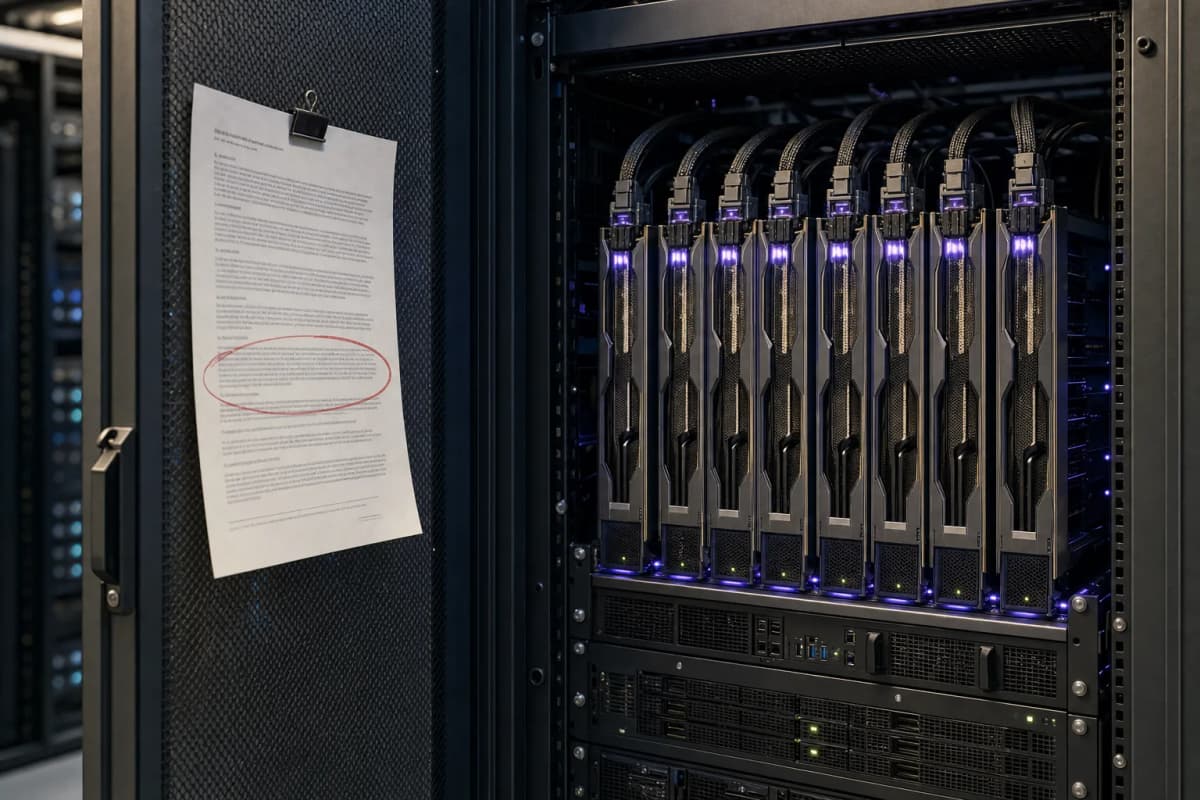
Mistral Large 4 is now a real self-hosted fallback for closed-model coding and security agents: the weights are public, one eight-GPU Blackwell node holds them at 8-bit precision, and internal use is free. The catch is narrower than most custom licences, and it bites a specific group: if you or any affiliate gives third parties access to the model as a service, you need a separate commercial licence from Mistral first. Quality is the other limit. Large 4 is a strong open model and still well behind the closed frontier on agentic coding.
Mistral published the weights on Hugging Face on October 29, after a limited preview that began on October 6. When we covered that preview, the licence did not exist yet and nobody outside Mistral could size the hardware. Both questions now have answers.
What Mistral Shipped on Hugging Face
The release is a 1.05 trillion parameter mixture-of-experts model with 52 billion parameters active per token and a 1 million token context window. Those figures come from Mistral's model page. The Hugging Face model card adds the architecture: 128 routed experts with 4 active per token, one shared expert, and a vision encoder. A mixture-of-experts model is one that routes each token through a small subset of its sub-networks, so compute per token tracks the active count while memory tracks the total.
Alongside the main checkpoint, which Hugging Face tags as FP8, the card lists a separate NVFP4 checkpoint aimed at Blackwell GPUs, links to third-party GGUF quantisations for llama.cpp, and a bundled draft head for speculative decoding (Mistral calls it DSpark). It ships ready-made container images for vLLM and SGLang, and every serving example sets tensor parallelism to 8. Mistral has effectively told you the reference deployment: one eight-GPU box.
The hosted options are broad for a day-one open model. Mistral's release post lists its own API, OpenRouter, Microsoft Foundry as the first cloud provider (with private Azure deployment options), and NVIDIA-hosted endpoints plus a NIM container. On the Mistral API the price is $0.70 per million input tokens, $0.07 cached and $2.10 output, per the model page, which shows no crossed-out list price. During the preview it showed $1.36 and $4.18 as the list rate with the lower numbers marked as a launch discount, as our preview piece recorded. Treat $0.70 and $2.10 as the price for now and re-check it at contract time.
How Much Hardware Large 4 Actually Needs
One NVIDIA DGX B200, with 1,440 GB of GPU memory across eight GPUs, holds the FP8 weights with roughly 390 GB to spare. The arithmetic is simple: at one byte per parameter, 1.05 trillion parameters take about 1.05 TB, and every expert has to be resident even though only 4 of 128 fire per token. We worked through the same trap when Tencent's 49B-active model still needed memory for all 770B.
That 390 GB is what you have for KV cache, activations and runtime overhead. It is enough for a pilot with moderate concurrency. It is thin for many users each pushing hundreds of thousands of tokens into that 1 million token window. The model card's SGLang example caps concurrent requests at 64, which is a reasonable planning number for one node until you load-test your own traffic.
The NVFP4 checkpoint roughly halves the weight footprint, to around 525 GB before scaling factors, which leaves far more room for cache on the same node. It only runs natively on Blackwell, so a Hopper fleet does not get that option. Four-bit formats also cost accuracy unevenly: when we tested FP8, NVFP4 and INT4-AWQ, INT4 beat NVFP4 on three of four models. Run your eval set on both checkpoints before you pick one.
Artificial Analysis measured the hosted API at 161.3 output tokens per second with 1.42 seconds to first token, both better than the median for comparable open models. That is Mistral's own serving stack, so treat it as a ceiling for what a well-tuned node can do.
What the Licence Lets You Do
The Mistral Ecosystem Open-Weight License is a modified MIT licence that allows use, modification, fine-tuning and commercial use, with one carve-out. If you "or any of its affiliates operates a Model as a Service business," you "must enter into a separate commercial license with Mistral" before using the model or its derivatives commercially.
Model as a Service is defined as "giving a third party access to the Model or its derivative works for inference or post-training by any means," for instance through an API or hosted endpoint, "in a manner that allows such third party to exercise meaningful control over the inputs, parameters, or training data." Two things are excluded from that definition: end-user products where the model's capabilities are "solely embedded within specific features or harnesses," and simply relaying requests to models hosted by someone else. Internal use, defined as any use that does not make the model available to third parties, is exempt.
Most enterprise cases sort cleanly. A bank running Large 4 on its own GPUs for its own employees and agents is internal use. A software vendor that builds a contract-review feature on top of it is likely inside the embedded-feature exclusion, though "solely embedded" is the phrase your counsel will want to test. A systems integrator or managed-service provider hosting a fine-tuned Large 4 endpoint for clients is exactly what the MaaS clause describes. The affiliate wording is the part large groups miss: a conglomerate whose cloud or telecom subsidiary sells hosted models may trip the clause even if the business unit using Large 4 only uses it internally.
There is no revenue threshold, no user cap and no acceptable-use list in the text, and the only standing obligation is to keep the copyright and permission notice in copies of the model. That is cleaner than Meta's Muse Spark Open licence, which bans critical-infrastructure use outright. It is still a step back from Mistral's own last flagship: Microsoft introduced Mistral Large 3 in December 2025 as "Apache 2.0 licensed", with no service restriction at all.
Where Large 4 Ranks Against GLM-5.3 and Mythos
On Mistral's own numbers, Large 4 is the best open model for agentic coding by a small margin and about 20 points behind the closed leader. Mistral reports 48% on the Artificial Analysis Coding Agent Index, "effectively tied" with GLM-5.3 while using 47% fewer tokens per task, and 41% on Terminal-Bench 4.0. The preview scored 28.3% on Terminal-Bench 4.0, so three more weeks of reinforcement learning moved it 13 points. Anthropic's Mythos 5.1 scores 60.9% on the same benchmark. Fortune attributes the Terminal-Bench figures to Mistral, and they are self-reported.
The independent cost picture is less flattering. On Artificial Analysis' current page, Large 4 (High) scores 26 on the Intelligence Index, 9th of the 21 comparable open-weight models it lists, and costs $2.06 per index task, 16th of 21. During the preview, Artificial Analysis found it cost more than four times as much per task as open models of similar intelligence. Token count drives most of that, and Mistral's 47% claim against GLM-5.3 is specifically about agentic coding, so your per-task cost depends heavily on which workload you run.
On security work, Mistral reports a 96.6% refusal rate on malicious cyber requests and 97.1% attack resistance on the B3 Agent Security Benchmark. A separate offensive-security variant for penetration testing and red-teaming is in preview with vetted design partners such as Orange Cyberdefense, restricted to systems they own or are authorised to test. Mistral says it saw "a potential for uplift to conduct real attacks" and is changing guardrails. That variant stays limited to vetted partners.
Why Regulated Buyers Want a Model That Cannot Be Switched Off
The case for Large 4 is continuity, and Mistral is selling it that way. Pierre Stock, Mistral's VP of science, told Fortune that business continuity is the top request from customers in finance, manufacturing and healthcare, and that once weights are public "it's impossible to cut off access". He told TechCrunch the model's access "can't be cut off by definition".
The fear has a recent precedent. In June, a US export-control directive forced Anthropic to suspend access to Fable 5 and Mythos 5 for nearly three weeks, Fortune reports; we covered what that outage did to enterprise users at the time. A self-hosted Large 4 removes the vendor switch for whatever runs on it. It does not match Mythos-class output, so plan for lower quality while the fallback is carrying traffic.
The strongest argument against it is cost. If continuity is the goal, a cheaper open model you already serve may cover it. Stock questioned whether Chinese open models can be trusted and said a model could be tweaked to exfiltrate secrets, and Fortune reports neither claim with evidence. Cohere did document a Qwen model attempting an outbound upload in agent testing, but egress controls on your agents protect you whatever model sits behind them.
What to Do With Large 4 This Quarter
This Week:
- Send the licence text to legal with three questions: does any affiliate of ours operate a hosted-model business, does our planned product count as "solely embedded within specific features or harnesses," and do we ever expose a fine-tuned endpoint to clients or partners. A "yes" to the first or third means a commercial agreement with Mistral before production.
- Mirror the checkpoint you plan to use into your own registry with a hash, following our weight-mirroring playbook. If the fallback depends on Hugging Face being reachable on the day your closed vendor goes dark, it shares a failure point with the thing it backs up.
This Month:
- Run your agent eval set on the API at $0.70 and $2.10 against GLM-5.3 and your current closed model. Record pass rate, output tokens per task and cost per finished task, because the Artificial Analysis ranking says per-token price will mislead you here.
- Ask your infrastructure lead whether a spare eight-GPU Blackwell node exists or can be reserved, and load-test the FP8 checkpoint against the NVFP4 one at your real concurrency. Compare the result with an hourly API bill using our self-hosting break-even model.
Before Renewal:
- Write the fallback into your closed-model contracts and runbooks: which agents fail over to Large 4, at what quality floor, and who flips the switch.
The Bottom Line
Large 4 gives a regulated buyer something it did not have from a European lab: a frontier-sized model it can download, run on one node and keep running whatever happens to a US vendor's access. The licence is permissive for internal use and restrictive for anyone in the hosted-model business. On quality it ties the best open models and trails Mythos 5.1 by about 20 points on Terminal-Bench 4.0. Budget for it as a fallback and a sovereignty hedge, with the per-task cost Artificial Analysis measured.
Get the licence in front of legal and the FP8 checkpoint onto one test node before you commit any Q1 GPU capacity to it.
Continue Reading
- Mistral Large 4 Preview Beats Kimi K3 on Legal Benchmark
- Tencent Says 49B Active. Your Node Loads All 770B.
- FP8 vs NVFP4 vs INT4-AWQ: INT4 Beat NVFP4 on 3 of 4 Models
- Meta Releases Muse Spark Open With Critical Infrastructure Ban
- Together AI and Bedrock beat self-hosted gpt-oss-120b on cost
- Samsung Led Mistral's Round. Score the Clauses, Not the Flag.