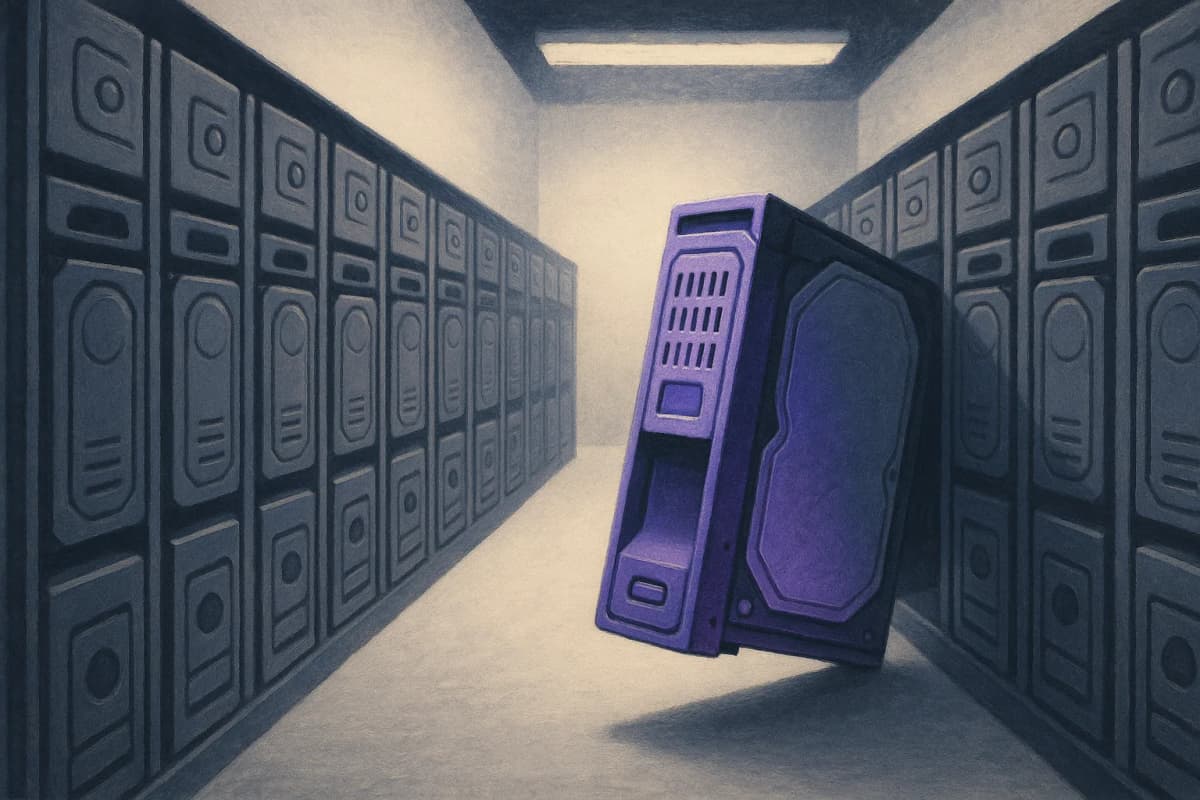
Your open-weight strategy has a single point of failure, and it is not a model. It is the intermediary you download the weights from. Hugging Face has been talking to banks about a sale at $13 billion or more, and almost every enterprise's relationship with it is a click-through nobody signed. Those terms of service let the company hand your agreement to "a successor or any other entity or person without obtaining your prior written consent," cut off access "with or without notice," and rewrite the terms on ten days' posting. Mirror what you actually depend on now, while it is voluntary and cheap.
The reporting is early. No deal, no named bidder, and neither Hugging Face nor its advisers have commented. That is precisely the window in which continuity work costs a sprint instead of a quarter.
What the Terms You Never Signed Actually Say
The agreement governing your model downloads is a click-through dated September 15, 2022, and it was written for a research community, not for a build pipeline. Unless your legal team negotiated a separate order form, this is the whole of your relationship with Hugging Face. Read the four clauses that matter, all from the same terms of service page:
- Assignment. "We may assign or transfer all or part of our rights and obligations under these Terms to an affiliate, successor or any other entity or person without obtaining your prior written consent." A buyer inherits you. You are not consulted, and there is no notice obligation attached to the transfer.
- Termination. "We reserve the right to suspend or terminate your access to the Services anytime with or without cause, and at our own discretion, with or without notice."
- Modification. "Changes will be effective 10 days following posting on the Website." Ten days is shorter than most enterprise change-advisory cycles.
- Liability. Aggregate liability "will not exceed the amount that you paid us during the 12-month period immediately preceding the last claim (or $50 if relating to a free service)."
Run that last one against your actual spend. Hugging Face's pricing is $9/month for PRO, $20/month per user for Team, and $50/month per user for Enterprise. A 40-seat Team organization pays $9,600 across twelve months, so $9,600 is the ceiling on everything — an outage, a deleted repository, a build that cannot reproduce. If your ML engineers are pulling weights on free accounts, which most do, the number is fifty dollars.
There is a second gap worth naming. The Enterprise Hub page sells SSO, audit logs, SCIM, US or EU storage regions and priority support — and states no uptime SLA percentage at all. You can pay $50 per user per month and still have no contractual availability commitment to point at.
This is a different shape of problem from the vendor contracts we have covered all month. When Nvidia hired Poolside's engineers, the question was which clause in a negotiated agreement fired. When Stripe bought OpenRouter, the question was whether a data-retention toggle survives a change of control. Here there is no negotiated agreement to read. There is a checkbox.
The Hub Goes Down on Ordinary Tuesdays
You do not need an acquisition to lose access to your weights. The ordinary failure modes are already in the log, and they are the ones your pipeline should be designed against.
Start with availability. The Hugging Face status page records a "Hub unavailable" incident on July 15, 2026 lasting 2 hours and 11 minutes, taking down the Hub, Git hosting and serving, and Jobs together — followed on August 6, 2026 by an AWS CDN error-rate incident in Singapore that ran degraded for 8 hours. Any build that resolves model files at container-start time was down for those windows.
Then access. Hugging Face's own gated-models documentation carries a warning most teams have never read: "The model authors have complete control over model access. In particular, they can decide at any time to block your access to the model without prior notice, regardless of approval mechanism or if your request has already been approved." That is not a hypothetical for the models enterprises actually run — meta-llama/Llama-3.3-70B-Instruct is gated today, greeting you with "You need to agree to share your contact information to access this model." The same docs describe extra_gated_eu_disallowed: true, a single line of model-card YAML that blocks European users by IP address. A publisher can strand your Frankfurt cluster without ever contacting you.
Then throughput. The published rate limits are measured over 5-minute fixed windows: an anonymous IP gets 500 API and 3,000 resolver requests, a free user 1,000 and 5,000, an Enterprise organization 6,000 and 50,000. Critically, "for organizations, rate limits are applied individually to each member, not shared among members" — which means a caching proxy or CI runner authenticating as one service account gets one member's quota, no matter how large the org. Teams that front the Hub with Artifactory have a date they may have already missed: Hugging Face's own enterprise guide says every "Hugging Face" repository created before Artifactory 7.111.1 had to migrate to the new "Machine Learning" layout, that after June 2026 "the legacy Hugging Face layout is deprecated and full functionality is no longer guaranteed," and that the migration is "one-way for practical purposes."
If you want to know how this ends when a free public registry becomes somebody's revenue line, look at containers. Docker Hub today caps unauthenticated pulls at 100 per 6 hours per IPv4 address or IPv6 /64 subnet, and 200 per 6 hours for a free authenticated account. Every engineering org that had wired docker pull straight into CI found out the hard way, on a Monday.
Pinning Is Not Mirroring. You Need Both.
Pinning means naming the exact commit hash of the model revision you tested, so a later commit to the same repository cannot silently change what your build pulls. Mirroring means holding your own byte-for-byte copy of those files, so the build still works when the source is unreachable. They solve different failures and neither substitutes for the other.
Pinning is one argument. The download guide documents revision, which accepts a branch, a tag, a pull request ref or a commit hash:
hf_hub_download(repo_id="lysandre/arxiv-nlp", filename="config.json",
                revision="877b84a8f93f2d619faa2a6e514a32beef88ab0a")
Note the constraint in the docs: "When using the commit hash, it must be the full-length hash instead of a 7-character commit hash." A tag is not a pin — tags move. main is not a pin. Only the full SHA is.
Mirroring is snapshot_download(repo_id=..., revision=<sha>), narrowed with allow_patterns and ignore_patterns so you take *.safetensors and skip the .bin, .h5 and .msgpack duplicates of the same weights. Size it first: the CLI's --dry-run flag reports how many files and how many bytes a repository would pull before you commit the bandwidth. And record the SHA-256 digest of every file you store — the Hub's Git LFS pointers already carry oid sha256: values, which is what makes a mirror verifiable rather than merely present.
The cost objection does not survive contact with the numbers. Llama 3.3 70B Instruct, a common workhorse of on-premises Llama deployments, is listed at 71B parameters at BF16 — two bytes per parameter, so roughly 140 GB of weights. At Hugging Face's own private storage rate of $18/TB/month, that copy costs about two and a half dollars a month. Object storage on your own cloud account is in the same range. You are not deciding whether to spend money. You are deciding whether to spend an afternoon.
Pinning also fixes a problem you already have. When DeepSeek swapped a model's post-training under a stable name, every eval run against it stopped being comparable — and no amount of monitoring catches that, because nothing errors. A pinned revision converts a silent change into a deliberate one. The same discipline applies to the runtime that loads those weights; if you have not fixed a version there either, start with the vLLM, TensorRT-LLM and SGLang comparison.
The License Decides Whether You May Mirror
Whether you are allowed to copy the weights is a question for the model's license, not Hugging Face's. The Hub is a distributor; the terms travel with the artifact.
For genuine Apache-2.0 and MIT weights, an internal copy is uncontroversial and always was. Custom and community licenses are where teams get caught — and "open weights" tells you nothing about which you have. Sometimes the answer is easy: recent Nemotron releases ship under OpenMDW-1.1, a permissive license whose only redistribution condition is that a copy of the agreement and the original notices travel with the files. Sometimes it is not: DeepSeek-V3's weights carry a bespoke model agreement even though its code repository is MIT. You cannot tell the two apart from the phrase "open weights." The Llama 4 Community License requires that anyone distributing Llama Materials "provide a copy of this Agreement with any such Llama Materials," "prominently display 'Built with Llama' on a related website, user interface, blogpost, about page, or product documentation," and retain a Notice text file reading "Llama 4 is licensed under the Llama 4 Community License, Copyright © Meta Platforms, Inc. All Rights Reserved." It also requires a separate license from Meta if your products exceeded 700 million monthly active users on the version's release date.
The line that matters operationally: a cache your own build agents read from is one thing; a registry your subsidiaries, joint ventures and outsourced delivery partners pull from starts to look like distribution. Decide which one you are building before you build it, and write the answer down. The same question decides whether a model with an unclear provenance chain belongs in the mirror at all — which is the argument behind the concentration of enterprise workloads on Chinese open-weight models.
The Case for Doing Nothing
Here is the strongest version of the other side, because it is genuinely strong.
Nothing has happened. There is no signed deal, no named bidder, and no comment from the company. Hugging Face has raised roughly $400 million over its life with about half of it still unspent as of November 2025, and CEO Clem Delangue has said the company is "close to profitability" and has "a long-term responsibility" to the community sharing models on the platform. More persuasively, this is a company that has already turned down control once: it rejected a $500 million Nvidia investment at a $7 billion valuation because it did not want "a single dominant investor to sway decisions." That is not the behavior of a firm rushing to the exit. And any acquirer paying $13 billion is buying a network of three million public models and around a million datasets whose value depends entirely on people continuing to trust it — breaking the free tier would be the fastest way to destroy the asset.
All of that is fair. None of it changes the answer, for one reason: the work is worth doing even if no deal ever happens. Pinned revisions make your evals reproducible. A local mirror makes your builds survive a two-hour Hub outage and an eight-hour CDN incident, both of which happened in the last six weeks. It removes your dependency on a rate limit you do not control. The sale is not the reason to do this — it is the deadline that gets it funded.
Your Weight Continuity Plan, With Dates
This Week:
- Produce the list. Grep your repositories, Dockerfiles, Helm charts and notebooks for
from_pretrained,hf_hub_download,snapshot_downloadandhf download. Every distinctrepo_idis a third-party dependency you are currently treating as infrastructure. - Mark the gated ones. For each repo, record whether it requires an access request. Those are the ones a publisher can revoke without notice, and they are also the ones your mirror cannot silently re-acquire.
- Pin everything to a full commit SHA. Not
main, not a tag. Fail the build if arepo_idappears without arevision. This is a one-line lint rule and it is the highest-value hour in the plan.
This Month:
- Stand up the mirror.
snapshot_downloadat the pinned revision,allow_patterns="*.safetensors", into object storage or an Artifactory/Nexus remote you already run. Store the SHA-256 of each file alongside it. Budget roughly 140 GB per 70B model at BF16. - Run one build with the Hub unreachable. Block
huggingface.coat the egress proxy in a staging environment and see what fails. This is the only test that tells you whether you mirrored the weights but still resolve the tokenizer, the config, or a dataset at runtime. - Write the license column. For each mirrored model: license name, whether internal caching is permitted, whether your mirror's readers count as redistribution, and what notice text has to travel with it.
Before Renewal:
- Ask for a signed agreement, not a plan upgrade. If you are on Team or Enterprise, request a mutually executed order form with a termination-for-convenience notice period, an assignment clause requiring notice on a change of control, and a stated SLA. Whether you get it tells you something either way.
- Set the liability cap against the exposure. A $50 or $9,600 ceiling is a decision, not an accident — make your risk function acknowledge it in writing rather than discover it during an incident.
The Bottom Line
Every generation of enterprise software has learned this same lesson from a different registry. Maven Central taught it, npm taught it after the left-pad unpublish, Docker Hub taught it when free pulls got a meter. In each case the intermediary was free, indispensable and unremarkable right up to the moment the terms changed — and the teams that recovered fastest were the ones already running a proxy with the artifacts on their own disks. Model weights are the same class of dependency, arriving in a decade that has watched vendors change hands fast enough that a product wind-down date can land three weeks after the deal and inference credits can reprice before it even closes.
You went open-weight to stop renting your intelligence from one company. Finish the job: the weights are only yours if you have a copy.
Continue Reading
- Nvidia Hired 109 Poolside Engineers. No Clause Fired.
- Stripe Bought OpenRouter. A Toggle Is Not a Contract.
- DeepSeek Swapped the Model. Your Eval Didn't Notice.
- vLLM vs TensorRT-LLM vs SGLang: Default to vLLM
- 7 OpenAI Alternatives. Only 3 Clear a Sovereignty Rule.
- Self-Host the Vector DB for Residency. Not for the Bill.
- 46% of Your AI Now Runs on Chinese Models
- Best Air-Gapped LLM Stack: Apache Weights on vLLM Beat NVIDIA's Fee