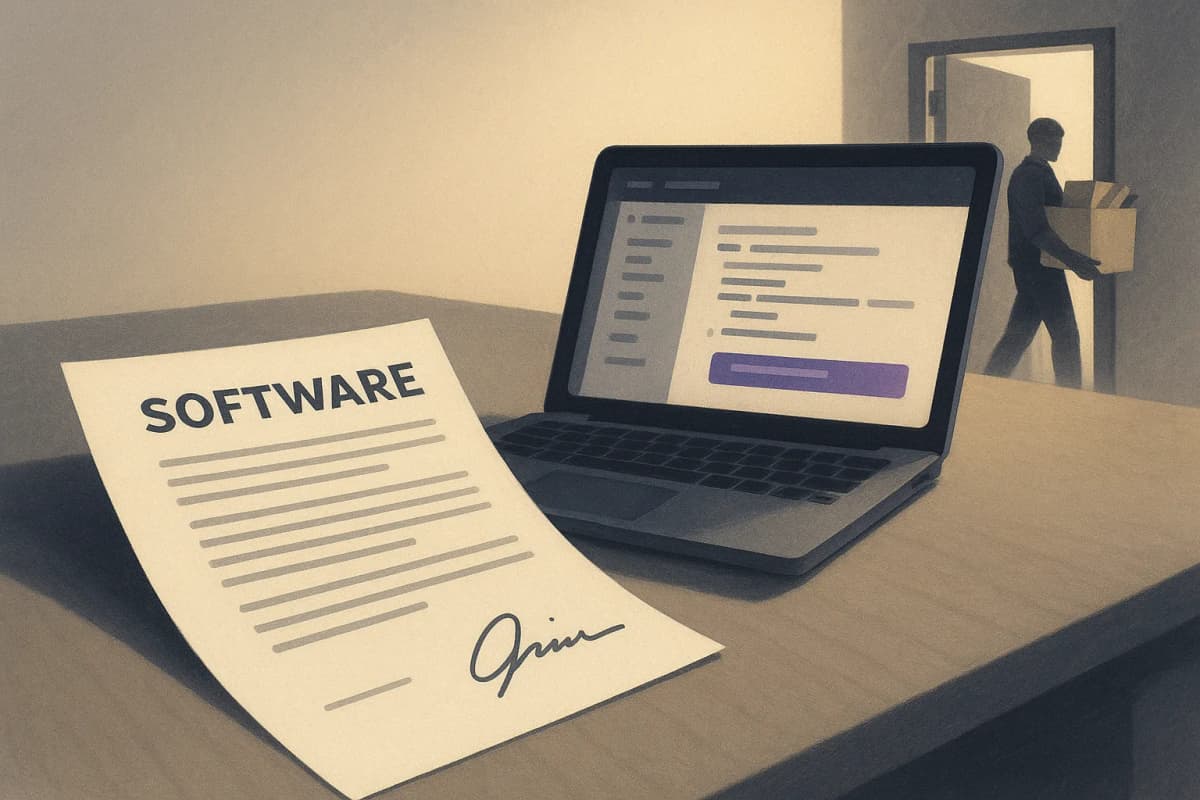
If your engineers run on Augment Code, the product you rely on now belongs to Harness, and nothing published so far says what happens to the contract you signed with Augment. Harness bought selected assets (Cosmos, the Auggie CLI and the Code Context Engine) plus the team that built them. It did not buy the company. Until someone puts continuity terms in writing, treat your Augment renewal as an open negotiation, and judge Cosmos on what it does today, because the feature that justifies the deal has no ship date.
Harness announced the deal on October 8, 2026. Cosmos becomes the "Harness Cosmos Software Factory Agent," the Augment team joins Harness, and the price was not disclosed. Augment CEO Matt McClernan's own post the same day describes the transaction as a sale of "select assets," thanks customers for "trusting us with your most critical development workflows," and says nothing about subscriptions, credits, support or data.
What Did Harness Actually Buy From Augment Code?
Harness bought products, technology and people, and left the corporate entity behind. The Harness press release lists the assets as Cosmos, the Auggie CLI products, the Code Context Engine and "related technology," with the team behind them moving to Harness. SiliconANGLE names the seller as Augment Code Computing Inc., and SD Times notes that the deal "does not appear to include the entire Augment Code company."
For a buyer, that matters because your order form names Augment Code as the counterparty. In an asset purchase, customer contracts move only if they are assigned, and neither company has said whether yours was.
Here is what each asset does:
- Cosmos is a multi-agent platform. When a ticket is assigned or a bug is reported, a fleet of agents plans the change, writes code and tests, and opens a pull request, each agent in its own isolated VM. Engineers approve the design and do the final merge. Prebuilt "Experts" cover pull-request authoring, deep review and fixing failed checks.
- The Auggie CLI puts Augment's agent and context engine in an engineer's terminal, interactively or inside any part of the build stack.
- The Code Context Engine keeps what Harness calls a live map of the codebase so agent changes fit the existing code.
Augment came out of stealth in April 2024 with $252 million raised at a post-money valuation near $977 million. An undisclosed asset sale two and a half years later suggests the standalone path did not hold.
What Happens to Existing Augment Customers?
Nobody has said, and Harness's own track record shows it knows how to say it. On the record, the only customer statement is CEO Jyoti Bansal's line to SiliconANGLE that customers "will get a choice" to keep their coding tools, adopt Harness Cosmos, or use both. That describes Harness's product strategy and leaves your Augment contract unaddressed.
Compare Harness's June 2 announcement of its Codecov acquisition from Sentry. That release says Harness and Sentry "are committed to ensuring continuity for Codecov users," and promises to keep the Codecov brand and free access for open source projects. Four months later, the Augment release carries no equivalent sentence.
The gaps that matter to a contract owner, as of October 9, 2026:
- Augment's pricing page still sells Standard at $20 a month and Business at $100 a month (each up to 50 seats), measures usage in dollars, bills LLM calls at the provider's list price plus a 40% service fee, and says top-ups bought outside a paid plan expire after 12 months. It carries no notice about Harness. Prepaid usage you hold today has no stated home.
- Augment's documentation still covers setup for VS Code and JetBrains. Neither announcement names the IDE plugins, so their future is unstated.
- The Context Engine works by indexing your repositories. Augment's security page says it never trains on customer code and lists SOC 2 Type II and ISO/IEC 42001, but says nothing about deletion when a contract ends. Who now holds the index, and under whose data processing agreement, is unanswered.
- The Harness release sends new users to cosmos.augmentcode.com, which on October 9 still redirected to Augment's own login service, so the renamed product still signs users in through Augment.
To be fair to Harness, the deal closed one day ago, and transition FAQs often follow the press release by a week or two. That argues for asking now, while the answer is still being drafted.
Which Cosmos Feature Has Not Shipped Yet?
The part of Cosmos that only Harness could build is still a plan. The Harness blog post lists three things it intends to do: connect the Code Context Engine to Harness's Software Delivery Knowledge Graph so production and delivery data can shape code before it is written; send findings from testing, security scans and deployment verification back into the engineering workflow; and wire Cosmos into Harness's policy-as-code, approvals and audit trails. None of the three carries a date.
The New Stack's headline put it bluntly: "Harness bought Augment's coding agents. The best feature hasn't shipped yet."
Bansal's pitch rests on that loop. He told DevOps.com that the DevOps bottleneck "has shifted downstream" and that tools integrated across the delivery lifecycle will produce better code for a given production environment than general-purpose coding tools. That argument may be right. A coding agent that knows a service failed its last three canary deploys should write a more careful change than one that only sees the repo. But today Cosmos is Augment's product with a new name, and the Harness downstream agents (Software Delivery, Security Testing, Runtime Protection, Cost Management) are separate products you would buy separately.
So evaluate two things on their own merits. Cosmos as it exists is a multi-agent pull-request factory with GitHub, Jira and Slack integrations, model routing and budget controls. The closed loop is a roadmap item, and a roadmap item should not move a renewal decision.
What Happened the Last Time a Coding Tool Was Sold in Pieces?
The closest precedent is Windsurf in July 2025. Google hired Windsurf's CEO, a co-founder and research leaders in a $2.4 billion reverse-acquihire, and days later Devin maker Cognition bought what was left: the IP, the product, the remaining staff and a business with $82 million in ARR and at least 350 enterprise customers. Windsurf customers ended up with an owner they had not chosen.
The Augment deal differs in one useful way. The buyer took the product and the team together, so the people who know the code are still working on it, and the open risk is in the paperwork. Our coverage of Juicebox's asset purchase of Fetcher showed how an asset deal can end with the seller shutting down the old service on short notice, and the Baseten and Blaxel deal showed a "keeps running" pledge with no end date. An entity left behind after an asset sale has little reason to keep servers running for long.
What Augment Customers Should Do Now
This Week:
- Pull your Augment order form and master agreement and find the assignment and change-of-control clauses. Our guide to AI vendor exit clauses covers what standard terms usually give you (often 0 to 90 days).
- Email your Augment account contact and ask four questions in writing: is my contract being assigned to Harness, what happens to unused credits and top-ups, what happens to the IDE plugins, and which entity holds my code index after the transfer.
- Export a list of every repository connected to the Context Engine and every service token Augment holds, so you can revoke access quickly if you need to.
This Month:
- If you run Cosmos in production, ask Harness for the data processing agreement and sub-processor list that will govern it. Your security team approved Augment, not Harness.
- Run one pilot workflow (a ticket-to-pull-request flow or automated review) on Cosmos as it ships today, and score it against what you already have, such as GitHub Copilot, Cursor or Claude Code. Our harness-versus-model bake-off guide explains why the agent scaffolding can matter as much as the model.
Before Renewal:
- Do not prepay for capability that is still a roadmap item. If the Knowledge Graph integration matters to you, tie price or term to its general availability date.
- Get a written data deletion commitment for the code index if you decide not to move to Harness.
The Bottom Line
The coding-agent market is consolidating the way application security did a decade ago: point tools get folded into platforms that own the pipeline. Harness wants the coding step so its testing, security and cost agents have something upstream to feed, the same logic behind its AI engineering ROI product earlier this year. For a team that already runs Harness for CI/CD, Cosmos could become a sensible default once the integration ships. For a team that bought Augment Code on its own merits, the product continues under a new owner while the status of its contract is still unwritten.
Ask Augment whether your contract is being assigned to Harness, and get the answer in writing before your next invoice.
Continue Reading
- AI Vendor Exit Clauses: Standard Terms Give 0 to 90 Days to Get Out
- Automation Anywhere Buys Boost.ai With No Word on Its Contracts
- Fetcher Shuts Down October 16 After Juicebox Buys Its Assets
- Baseten Buys Blaxel, Whose 'Keeps Running' Pledge Has No End Date
- Cursor Alternatives That Survive Security Review Start With Copilot
- Your Bake-Off Ranked Harnesses, Not Models. Re-Run It.