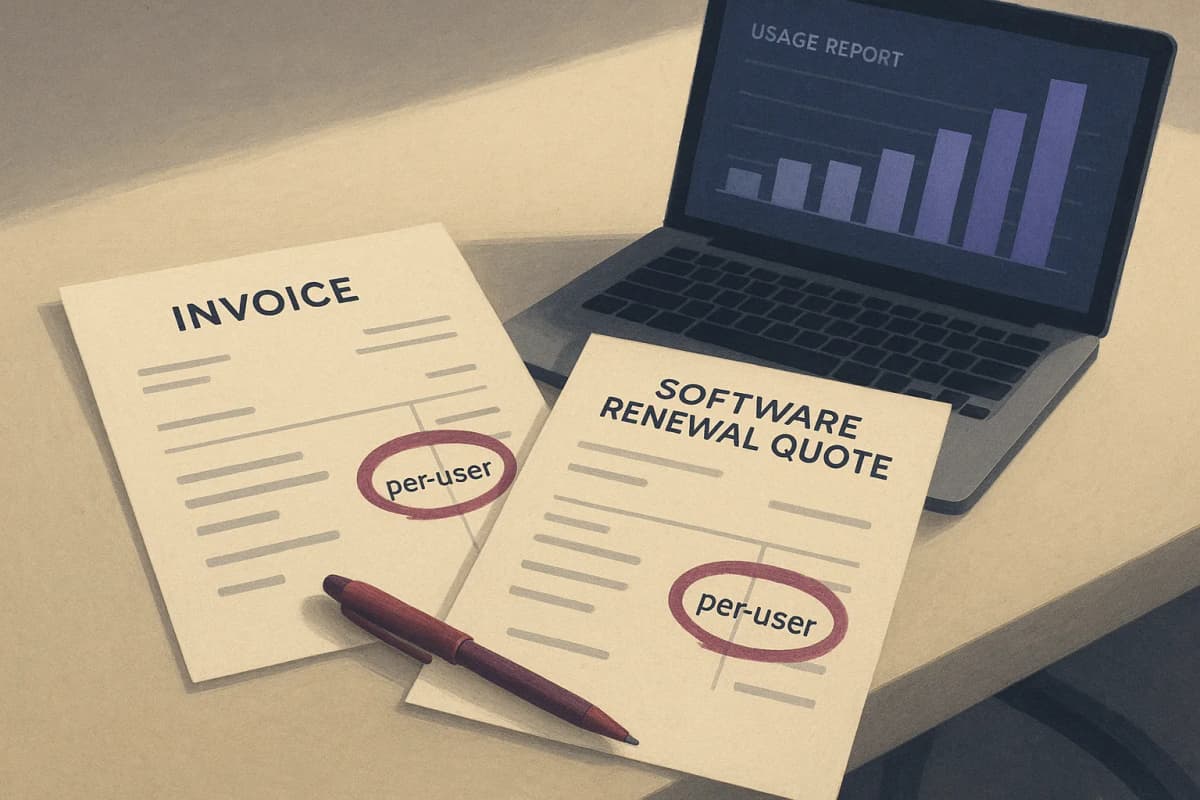
If your Microsoft 365, Google Workspace or Salesforce renewal lands this year, the price went up to pay for bundled AI that many of your seats may never use. The discount your account team offers is calculated off that new, higher list. Negotiate in absolute dollars per user against what you paid last term, move light users to cheaper tiers before you sign, and bring the vendor's own usage report for the bundled AI to the table.
Of the three, Google's bundle is the easiest to defend: Gemini came in for $2 a user on Business Standard. Salesforce's is the hardest. Its Core edition costs $20 a user a month more than Enterprise did, and the AI credits included with it are pooled per org, so at most seat counts they are worth a small fraction of the increase. Microsoft sits in between, with increases from 0% to 33% depending on the plan.
| Vendor | Change and date | List price per user/month (old → new) | AI added to the base price | When an existing customer pays it | Verdict |
|---|---|---|---|---|---|
| Microsoft 365 | Commercial reset, July 1, 2026 | Business Basic $6 → $7; Business Standard $12.50 → $14; M365 E3 $36 → $39; M365 E5 $57 → $60; F1 $2.25 → $3; F3 $8 → $10 | Copilot Chat enhancements in every plan; Security Copilot for E5. Full Copilot still separate | At the first renewal after July 1, 2026 | Middle. Fight hardest on F1/F3 and Office 365 E3 |
| Google Workspace | Gemini folded in, announced Jan 15, 2025 | Business Standard $12 → $14 (annual) | Gemini in Gmail, Docs, Meet and other apps; the old add-on is gone | March 17, 2025, or annual renewal, whichever is later | Best value if anyone uses Gemini |
| Salesforce Sales Cloud | ~6% average rise Aug 1, 2025; new editions Sept 3, 2026 | Enterprise $175 → Core $195; Unlimited $350 → Advanced $395; Agentforce 1 $550 → Max $550 | Agentforce, Slack, Tableau Next, Premier Success, 500k-2.75M Flex Credits per org per year | Legacy pricing unchanged for existing customers; the new editions apply if you move | Loser for any org that does not run Agentforce |
All prices are US list, annual commitment, checked on each vendor's pricing page or announcement on October 23, 2026. Sources are linked in the sections below.
What Did Each Vendor Actually Change?
All three vendors raised the base subscription and justified the increase with AI that is now included. The mechanics differ, and the differences decide where you have leverage.
Microsoft announced the reset on December 4, 2025, effective July 1, 2026, and pointed to Copilot Chat with "inbox and calendar awareness" and Security Copilot "coming to all Microsoft 365 E5 customers." The plan-by-plan table, per Office Watch: Business Basic $6 to $7 (+16%), Business Standard $12.50 to $14 (+12%), Business Premium flat at $22, Office 365 E1 flat at $10, Office 365 E3 $23 to $26 (+13%), Office 365 E5 $38 to $41, Microsoft 365 E3 $36 to $39, Microsoft 365 E5 $57 to $60, F1 $2.25 to $3 (+33%) and F3 $8 to $10 (+25%). MarketScale's summary puts the full range at 5% to 43%.
Full Microsoft 365 Copilot did not get cheaper for large tenants. It remains an add-on that Computerworld reports at $30 per user per month, while the SMB Copilot Business add-on launched December 1, 2025 at $21 for organizations with 300 or fewer employees.
There is a second Microsoft increase many enterprise buyers missed. From November 1, 2025, Enterprise Agreement and MPSA customers on volume Levels B through D lost their automatic level discounts on online services and now "default to Level A pricing, which matches the public Microsoft.com list price," per SHI's summary of the August 12, 2025 announcement. If you are a large EA customer renewing now, the July list increase stacks on top of that lost tier discount.
Google made the cleanest trade. Its January 15, 2025 announcement folded Gemini into Business and Enterprise plans and said a Business Standard customer who "previously paid $32 per user, per month" with the Gemini Business add-on "will pay just $14," which Google describes as $2 more than the plan without Gemini. Before the change, the add-on cost $20 for Business and $30 for Enterprise, per Computerworld. Google's live pricing page on October 23, 2026 lists Starter at $7, Standard at $14 and Plus at $22 per user per month on annual terms, with Enterprise at "contact sales." A 50% introductory offer runs from November 5, 2026 to February 5, 2027, limited to new customers and their first 20 users, so it does nothing for a renewal.
Salesforce moved twice. Its 2025 pricing update said "list prices will increase by an average of 6%" on August 1, 2025 for Enterprise and Unlimited editions of Sales Cloud, Service Cloud, Field Service and select Industries clouds, and introduced Agentforce add-ons from $125 per user per month. (Salesforce Ben covered it the day it was announced, June 18, 2025.) Then on September 3, 2026 it replaced those editions with Core at $195, Advanced at $395 and Max at $550, each bundling Agentforce, Slack, Tableau Next, Premier Success and an org-level Flex Credit pool of 500,000, 1 million or 2.75 million credits. The live Sales Cloud pricing page shows the same three prices. Against the retired editions' list prices, 2-Data's analysis puts Core at roughly 11% above Enterprise ($175) and Advanced roughly 13% above Unlimited ($350). Max matches the old Agentforce 1 price.
When Does the New Price Hit an Existing Customer?
At renewal, in all three cases. That gives you a window, and the window is where most of the money is.
Microsoft annual and multi-year customers "stay on current pricing until their next renewal after 1 July," and UC Today reports that most resellers allowed early renewal at the old rates for terms falling between July and December 2026. The same piece makes the point most buyers skip: "Locking in current pricing on seats you do not need produces no saving." If you renew early, true down first.
Google moved monthly subscriptions on March 17, 2025, and annual or fixed-term plans "at renewal date... whichever is later," per its announcement. That deadline has passed for nearly every customer, so the remaining leverage at a Workspace renewal is tier mix and term length.
Salesforce says "existing customer pricing on legacy editions remains unchanged" in its editions announcement. Read that sentence carefully. It protects the edition you are on. It does not cap the annual uplift clause in your order form, and it says nothing about what happens when you add a product that only ships in the new editions. If your account team pitches Core at renewal, the question to ask is what your current Enterprise seat count costs on a like-for-like renewal, in writing, before you discuss migrating.
How Should You Anchor the Negotiation?
Anchor on the absolute dollars per user you paid last term. The percentage off the new list is the wrong number. Vendors present renewals as a discount off list, and when the list moves up, a bigger discount can still produce a bigger bill.
A worked example with Microsoft 365 E3. Say you paid the old $36 list less 10%, or $32.40 per user per month. Your renewal quote offers 15% off the new $39 list. That is $33.15. The discount went up five points and the bill went up $0.75 a user a month, or $9,000 a year at 1,000 seats. Put last term's per-user dollar figure in the first line of your counter-proposal, and make the vendor explain every dollar above it.
To make the three vendors comparable, take one defined workload: a 1,000-employee company with 700 knowledge workers on Microsoft 365 E3, 300 frontline staff on F3, and 150 sellers on Sales Cloud Enterprise. At list price, the July reset adds $25,200 a year for the E3 seats and $7,200 for the F3 seats. The same 1,000 people on Workspace Business Standard would have absorbed $24,000 a year for Gemini. Moving the 150 sellers from Enterprise to Core adds $36,000 a year. Core's 500,000 Flex Credits are worth $2,500 at the list rate of $500 per 100,000 credits, and at 20 credits per Agentforce action that pays for about 25,000 actions a year across the whole org.
That last comparison is why Salesforce is the loser here. Slack, Tableau Next and Premier Success are real products, and if you already pay for Slack and a premium support plan separately, the bundle may net out in your favour. Salesforce does not say how it calculated its "70% more value" claim, and 2-Data flags that it is built from the list price of components a customer may not use. If you do not use Slack and do not run Agentforce, Core is a price increase with a credit pool attached.
Which Users Can Move to a Cheaper Tier?
Frontline, light and occasional users. They are where the per-seat increase is largest in percentage terms and where the bundled AI is least likely to be used.
On Microsoft, F1 rose 33% and F3 rose 25%, the steepest moves on the list. Check that those seats belong to people who need a licensed mailbox and desktop apps at all, and audit every E3 user whose measured activity looks like a frontline worker's. Frontline plans carry usage restrictions in Microsoft's licensing terms, so confirm eligibility before you move anyone. In the Business family, Business Premium held flat at $22 while Business Standard rose to $14. If you were already buying Defender or Intune add-ons on top of Standard, re-run that comparison.
On Google, the gap between Starter at $7 and Standard at $14 is now also a Gemini gap. Google's pricing page lists Gemini in Docs, Sheets, Slides, Drive, Meet and Chat as not supported on Starter, which keeps Gemini in Gmail and basic access to the Gemini app. For mail-and-calendar users, Starter is a legitimate tier that drops the AI you have measured them not using.
On Salesforce, the move is to stay put. If your org has not deployed Agentforce, there is no AI-driven reason to leave Enterprise for Core, and the legacy-edition protection is your strongest card. If a team does want agents, price the $125 Agentforce add-on for that team alone against moving every seat to Core.
What Usage Data Should You Bring?
Bring the vendor's own adoption report for the bundled AI, exported for your tenant. It is the one benchmark the account team cannot dispute, because they publish it.
For the Copilot Chat that the July reset folded into base plans, Microsoft's Copilot Chat usage report (Reports > Usage > Microsoft Copilot > Copilot Chat) covers users without a paid Copilot license. It counts a user as active once they submit at least one prompt, over 7, 28, 90 or 180 days, and its per-user table gives prompts submitted, active days and a last-activity date by app. Export it to CSV, compare the active count with your licensed headcount, and you have the share of seats where the AI uplift bought nothing. Usernames are hidden by default, so an admin has to switch on user details first.
If you also pay for Copilot seats, the separate Copilot usage report shows enabled users, active users and an active users rate, with a last-activity date for each app. Opening the Copilot pane does not count as activity there; submitting a prompt does. Sort it by last activity date before the add-on renews.
Google's Gemini reports sit under Menu > Generative AI > Gemini reports. The org-level view gives active Gemini users as a share of licensed users over 7, 28 or 90 days, and the user-level view rates each person's overall usage from High to Zero over the past 28 days. Google added feature- and app-level breakdowns in a February 2026 update. A count of Zero-usage seats is the concrete figure to put in front of a Google rep.
For outside context, Gartner's 2025 survey of 187 IT leaders found that only 5% of organizations that finished Microsoft 365 Copilot pilots were moving to larger deployments, and nearly half of 127 respondents rated the product "some value, shows promise," per TechPartner News. That survey covers paid Copilot, not the Chat features bundled into base plans, so use it as context and lead with your own tenant's numbers.
What Nobody Will Tell You About Peer Pricing
No published source tells you what comparable companies actually pay after discounts. List prices are public. Discounts are confidential terms in individual contracts, and every number above is list.
That gap gets filled by resellers, licensing consultancies and benchmarking firms offering "what peers pay" figures. Treat those with the same suspicion you apply to the vendor. A reseller earns margin on the renewal, and a consultancy selling negotiation services has a reason to tell you that you are overpaying. None of them publishes its sample. If you buy a benchmark, ask how many contracts sit behind the figure, from which quarter, and at what seat count, and discount it heavily if the answer is vague.
The figures that hold up in a negotiation are the ones you can source: last term's invoice, the vendor's published list change, and the vendor's own usage report for your tenant.
Who Should Not Take This Advice
Organizations already on Microsoft Business Premium, which held flat at $22, have little to win on the base plan, and so do E5 tenants that will use Security Copilot's included capacity. Spend the effort on the Copilot add-on line instead.
Do not drop Google users to Starter if their work lives in Docs and Sheets. Model Starter per user group against the full feature list on the pricing page, since Gemini is not the only difference between tiers.
Salesforce Core makes sense for orgs already paying separately for Slack, Premier Success and Agentforce, because the bundle can come out cheaper than the parts. Everyone else should get the legacy renewal price in writing first.
Do not renew Microsoft early until you have trued down. Early renewal locks in the old price on every seat you carry, including the ones you should have cut.
The Decision: What Predicts Regret
Three mistakes cause most of the regret at these renewals. The first is signing a percentage discount without checking absolute dollars per user, which is common and the easiest to avoid. The second is renewing every seat on the same tier, when frontline and light users carry the largest percentage increases and show the least AI use. The third is migrating editions because the vendor framed the move as simplification: Salesforce's protection for legacy pricing exists for existing customers, so use it until you have a deployed agent that needs Core.
What changes the answer: measured AI adoption. If your Copilot or Gemini report shows a majority of seats active weekly, the bundle is doing work and the fight is over price alone. If it shows most seats at zero, you have the case for a tier change and the vendor's own report to support it.
This Week: Export the Copilot usage report and the Gemini user-level report, and pull last term's invoice to compute your actual per-user price for every SKU.
This Month: Tag every seat as heavy, light or frontline from that data, and price each group on the tier below. For Salesforce, get the like-for-like legacy-edition renewal quote in writing.
Before Your Renewal Date: Send your counter-proposal with last term's per-user dollars in the first line and the usage export attached. If you renew Microsoft early, true down first.
The Bottom Line
The AI bundle made each base subscription more expensive and shifted the renewal argument to whether those AI features are worth paying for. The vendors know the answer for your tenant, because they built the report. Bring the export, and price every seat against last term's invoice.
Continue Reading
- Microsoft's New Copilot Bills Autopilot Outside the $30 Seat
- ChatGPT Enterprise Alternatives: Cap Heavy Users or Pay More
- Workday Rising 2026 Sells Agents on Credits With No Published Price
- Google's Gemini Agent Gets Its Own Mailbox Before It Gets a Price
- AWS and Azure DMA Duties Land Midway Through a 3-Year Commit
- Glean Alternatives: Price the Permission Sync, Not the Seat