If your biotech or pharma team runs Orchestra Bio's agents, your vendor became OpenAI on October 20, and nobody has told you what happens to the product, the contract or the data. OpenAI is moving Orchestra's team and technology into Rosalind, its life sciences unit, and has not said whether Orchestra stays available as a standalone product or how the deal affects existing customers. Treat that silence as a deadline. Get written answers on continuity, export and data use before your next renewal, and if you are evaluating Rosalind, assess it as a platform that will soon see your program budgets and trial timelines, a much bigger data footprint than a research model.
What OpenAI Actually Bought
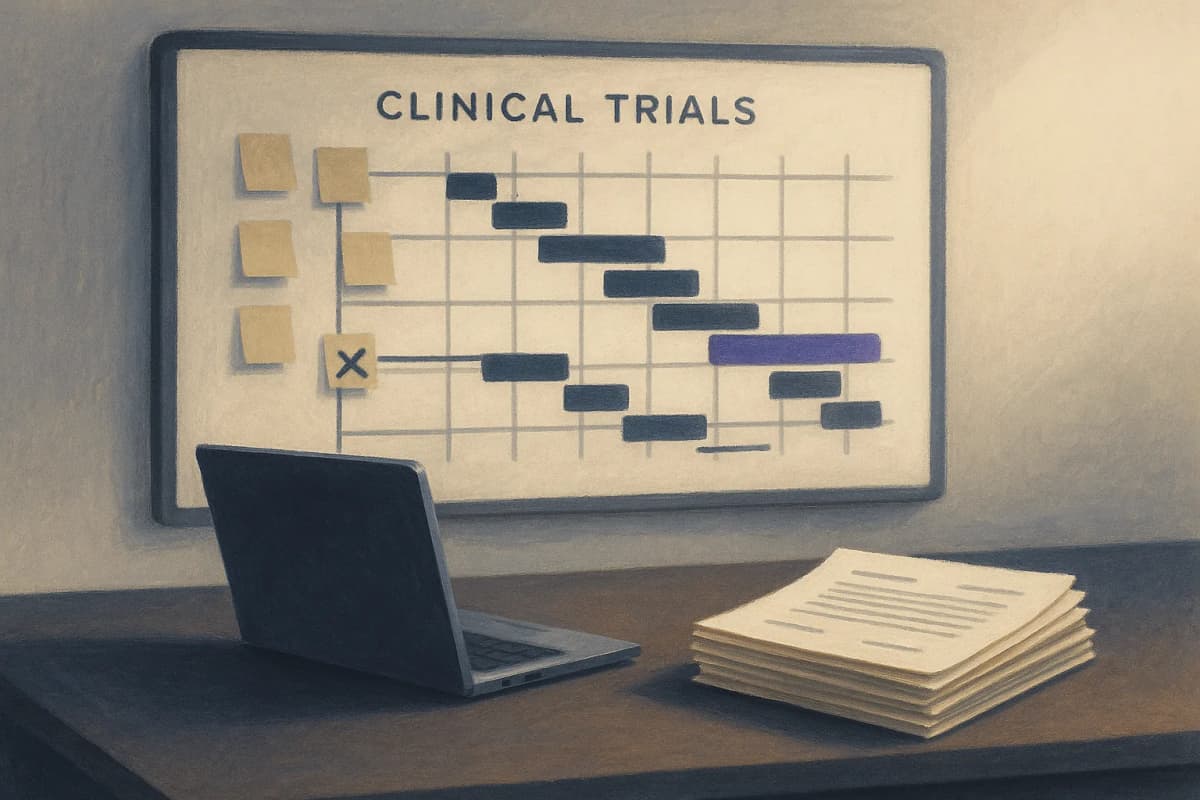
OpenAI bought a small operations software company with a working product. TechCrunch reported the deal on October 20, with terms undisclosed, and described Orchestra as a four-year-old startup whose AI agents handle operational work in drug development, such as tracking finances and resolving clinical-trial scheduling problems. SiliconANGLE puts the founding in San Francisco in 2022 and says the agents monitor studies and flag problems while people make the final decisions.
The Channel Insider write-up gives the clearest example of the work. When a failed manufacturing batch delays a trial, Orchestra's agents identify the affected activities, gather the relevant information and compare response options, a job that usually takes hours of human coordination. OpenAI says it is adding Orchestra's team and technology to Rosalind; SiliconANGLE names Ashoka Rajendra as founder and CEO.
Orchestra's own positioning was financial as much as scientific. When it came out of stealth with $20 million in August 2025, it pitched itself to biotech founders as help with "dollars and cents management and long term planning." A partner event page says the company "builds AI agents to automatically monitor progress, risks, and outcomes against scientific and financial plans," supporting decisions on funding, timelines, scenarios and program dependencies.
The investor lists in the coverage do not match. TechCrunch names Andreessen Horowitz, Atria and 8VC; SiliconANGLE names Andreessen Horowitz, 8VC and Insight Venture Management. Both put the total near $20 million.
Why Rosalind Needed an Operations Layer
Rosalind until now has been a research product, and Orchestra moves it into program operations. GPT-Rosalind launched on April 17 as a reasoning model for biology and drug discovery, in research preview for qualified US enterprise customers through a Trusted Access program, with Amgen, Moderna, Novo Nordisk and Thermo Fisher Scientific among the named partners. OpenAI widened that preview to eligible organisations worldwide in June, and SiliconANGLE says eligible organizations have been able to use it outside research preview since September. Rosalind Workbench, per Channel Insider, connects the model to scientific tools and data.
None of that touched the parts of drug development where most of the money and delay sit: vendors, budgets, study timelines, manufacturing slips and regulatory submissions. Runtime Wire describes the deal as "extending Rosalind from scientific research tools into drug-program operations." OpenAI's own line, quoted by Channel Insider, is that Rosalind should help scientists "make discoveries and manage the work needed to turn them into treatments that reach patients sooner."
The strongest case for the deal is that a model which reads assay data and a set of agents that watch the program plan belong in one system. A trial delay is a scientific problem and a budget problem at once, and today those usually sit in different tools owned by different teams. If OpenAI joins them well, a clinical operations lead gets one place to see why a milestone slipped and what it costs. That is a real product thesis, and it explains why OpenAI bought a team that already ships operations software.
What the Announcement Leaves Out
The announcement covers the strategy and skips everything an existing customer needs. AlphaSignal's summary lists the gaps: no word on standalone availability, no release schedule, no deployment options or regions, no pricing, and no published APIs, SDKs or integration timeline. SiliconANGLE adds that OpenAI gave no timeline for when Orchestra's agents will appear in its products.
Orchestra's website is now a farewell notice. It says the company is joining OpenAI to continue its mission "at an even greater scale" and thanks its customers. It names no customers and carries no product terms, security claims or data-handling commitments. If your team relied on that site for documentation or a trust page, save what you still have access to.
Rosalind's access rules matter here too. The Trusted Access program requires organizations to restrict use to approved users in managed environments, per The Decoder's launch coverage, and OpenAI has said pricing will come later. An Orchestra customer who is not already a Rosalind participant has no published path from one to the other.
The Data Question for Clinical Operations Teams
The data Orchestra's agents see is more commercially sensitive than most research data. An operations agent that tracks budgets, vendor milestones and trial schedules holds your burn rate, your CRO performance and the real date your next readout will slip to. For a public biotech, some of that is material non-public information. For a private one, it is what your next financing depends on.
Three questions follow, and you need each answer in writing:
- Does your existing data-processing agreement transfer to OpenAI unchanged, or will you be asked to accept OpenAI's terms when the product moves into Rosalind?
- Can your program data be used to train or improve Rosalind models? A research model trained partly on operations data from many sponsors is exactly the product thesis above, which is why you should not assume the answer is no.
- Where does the data live once the team moves, and under whose security controls?
If the agents touch anything inside a validated system, such as batch records or regulatory submission tracking, a change of owner and hosting is also a change your quality team has to assess. Our GxP AI validation guide explains why the vendor's validation package covers its intended use, not yours, and that gap gets wider when the vendor changes.
What Happened Last Time a Lab Bought a Bio Startup
The closest precedent is Anthropic's Coefficient Bio deal, and it ran the other way. Anthropic bought Coefficient in an all-stock deal reported at just over $400 million in April, for a team of fewer than 10 people with no publicly disclosed product or revenue. Anthropic then launched Claude Science in June, according to Channel Insider. Nobody had a Coefficient contract to worry about.
Orchestra is different because it had customers; its farewell notice thanks them, though it names none. TechCrunch frames the outcome as Orchestra "getting absorbed, rather than stomped out," the fate startups fear when a frontier lab moves into their market. Absorption is better for the founders and investors. For customers it usually means a product that keeps running while the team builds the new thing, and then a migration on the acquirer's schedule. This site has tracked the same pattern across other AI deals this month, from Anthropic's OPAQUE acqui-hire to Boomi's "for now" pledge on Elementary Data.
What to Do Before Your Next Renewal
The order matters: preserve your data first, then get the contract answers, then decide whether Rosalind earns the expanded scope.
This Week:
- Export everything Orchestra holds for you: program plans, budget models, scenario runs and the agents' alert history. Do it while the product is still running under the old team.
- Pull your Orchestra order form and check the assignment and change-of-control clauses. Our breakdown of AI vendor exit clauses shows that standard terms give between 0 and 90 days to get out, so know which end you signed.
- Email your account contact with the three data questions above and ask for a dated answer.
This Month:
- Ask OpenAI for a written continuity commitment: how long the current product runs, what notice you get before it changes, and whether pricing holds through your current term.
- Have your quality lead decide whether any Orchestra workflow touches a GxP process. If one does, open a change control now so you are not doing it in a hurry later.
Before Renewal:
- If you already use ChatGPT Enterprise or Codex for research work, map which teams would feed Rosalind both scientific and operations data, and get legal sign-off on that combined footprint before you agree to it.
- Price a fallback. Your project management, budgeting and CTMS tools still do the underlying tracking; decide how much of Orchestra's agent layer you could live without for two quarters.
The Bottom Line
Frontier labs are buying their way into regulated industries one workflow at a time, and pharma is where the data is most valuable and the switching costs are highest. In April Anthropic paid for a team. In October OpenAI paid for a team that came with customers, and those customers carry the uncertainty until OpenAI publishes terms. The comparable moment in enterprise software was the suite consolidation of the 2000s, when point tools were bought, kept alive for a while and then folded into a bigger platform on the buyer's timetable rather than the customer's. If you were an Orchestra customer when OpenAI showed up, the leverage you have is the renewal date. Our May analysis of GPT-Rosalind's benchmark claims covers what the research half of the platform does.
Send the data questions to your account contact before the end of the week.
Continue Reading
- GPT-Rosalind Beats 95% of Experts at Drug Discovery
- AI Vendor Exit Clauses: Standard Terms Give 0 to 90 Days to Get Out
- GxP AI Validation: The Vendor's Package Covers Its Use, Not Yours
- Anthropic's OPAQUE Deal Leaves Confidential AI Customers Guessing
- Agilent Buys Proscia and Gets to Pick Which Scanners Concentriq Runs
- Sopris Buys Blackford From Bayer, Silent on Its 45 AI Vendors