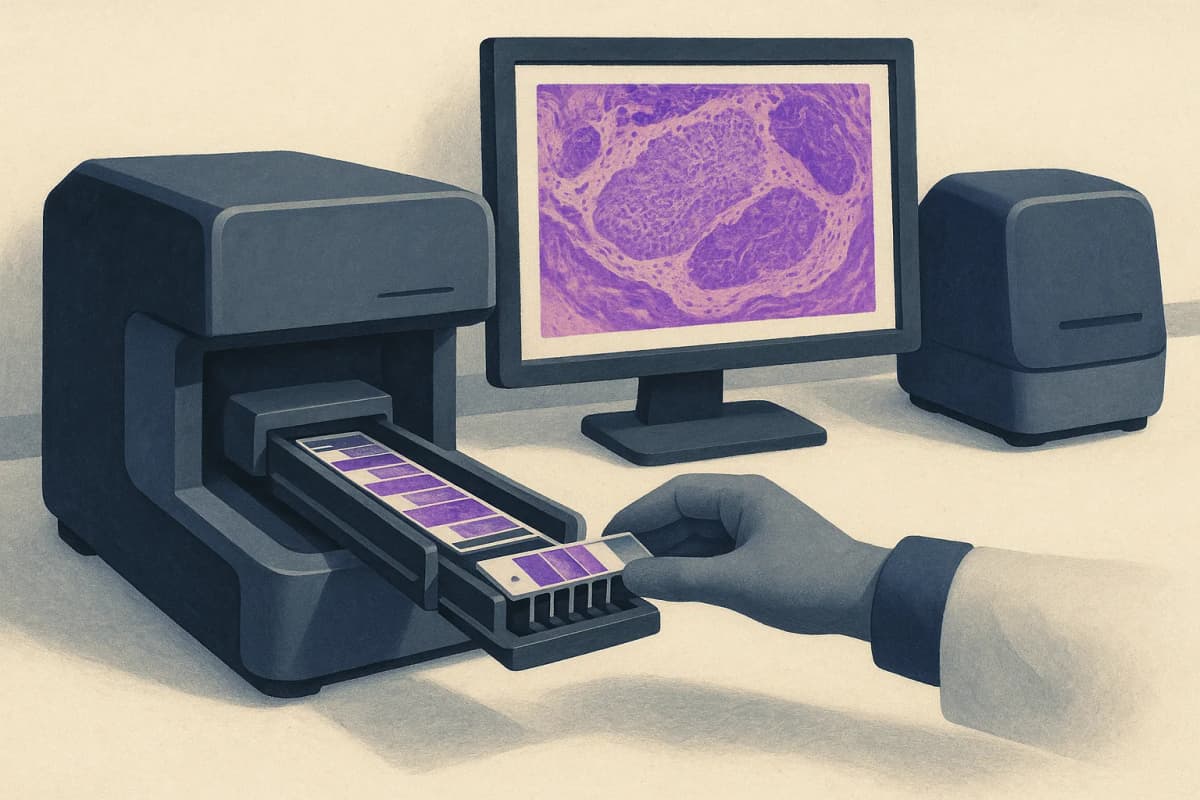
If your lab or trial team runs Proscia's Concentriq, the company that decides which scanners and AI apps it supports is about to be a company that sells its own scanner, stains and companion diagnostics. Agilent agreed on October 13 to pay $240 million in cash, plus up to $30 million in milestones, for the independent pathology image platform, with closing expected early in Agilent's fiscal 2027, which starts November 1. No published statement we could find commits Agilent to keeping rival scanners or third-party algorithms first-class after close. The leverage to get that in writing is yours until the deal closes.
Proscia says Concentriq runs in more than 4,000 laboratories, hospitals and clinics and at 16 of the top 20 pharmaceutical companies, on trailing revenue above $18 million. That is a small business by Agilent's standards and a large footprint by a pathology department's. A digital pathology image management system (IMS) is the software that ingests whole-slide images from scanners, routes them to pathologists and AI apps, and stores the result. Once a lab has signed out cases on one, replacing it means revalidating the clinical workflow.
Why Does It Matter That Agilent Sells a Scanner?
It matters because the clinical version of Concentriq only works with the scanners Proscia has cleared it for, and Proscia now has a fast way to add more that its new owner controls. Concentriq AP-Dx holds FDA 510(k) clearance for primary diagnosis. In August, Proscia won a new clearance that added Leica's Aperio GT 450 DX scanner, cloud deployment and a Predetermined Change Control Plan. A Predetermined Change Control Plan (PCCP) is an FDA-agreed protocol that lets a manufacturer make specified changes, here adding FDA-cleared scanners, image formats and displays, without filing a new 510(k) for each one.
Proscia presented that clearance as evidence of openness. Its head of quality and regulatory, Ian Cadieux, said the PCCP gives customers "confidence that Concentriq AP-Dx will continue to be an interoperable foundation," and the release talked about labs staying "unconstrained by the limits of proprietary ecosystems."
Now look at the queue. Lab Manager's compatibility table lists only two primary-diagnosis scanners as working with Concentriq AP-Dx: Hamamatsu's NanoZoomer S360MD (since February 2024) and Leica's GT 450 DX (since August 2026). Philips' IntelliSite, Leica's Aperio AT2 DX and Roche's VENTANA DP 200 and DP 600 are marked as not supported. Meanwhile Agilent launched its own S540MD slide scanner in the US on September 4, an Agilent-branded version of Hamamatsu's NanoZoomer S540MD.
The PCCP lets Proscia add scanners without a new FDA filing, and after close Agilent decides which ones get added first. The obvious first candidate is the one Agilent sells. Nothing about that is improper, and it may arrive quickly. But if your fleet is Philips or Roche glass, the question of when your scanner gets cleared on Concentriq AP-Dx is now one for a scanner vendor's product team.
What Did Agilent Actually Say About Openness?
As reported, the announcement describes Proscia's platform as vendor-agnostic, which tells you what Concentriq is today and commits Agilent to nothing after close. In the announcement, Proscia CEO David West says Agilent "shares our vision for advancing pathology through open, digital, and AI-enabled solutions." That is a statement of shared vision from the seller, not a support term. HIT Consultant calls Concentriq "an operational orchestration layer across scanners, LIS networks, and AI algorithms", and BioSpectrum's summary pairs the "vendor-agnostic" platform with Agilent's instruments and reagents.
The strategic language points somewhere else. CEO Padraig McDonnell said the deal establishes a platform "for scientific intelligence in tissue-based precision medicine". Evercore ISI told MedTech Dive that Agilent could "immediately start cross-selling Proscia's software to its existing Dako customers". HIT Consultant was blunter about the pharma side, calling Concentriq "a direct digital data conduit into 16 of the top 20 biopharmas" for Agilent.
The strongest case for Agilent runs like this. It has been Proscia's distribution partner since a 2022 agreement, it signed a co-promotion deal with Visiopharm in 2020, and Proscia's 100-plus staff become the base of a new product line at a company with $7 billion in annual sales. Agilent has every reason to keep the 4,000-site base happy. Closing Concentriq to rival scanners would shrink the installed base it is paying roughly 13 times revenue for, about 15 times with the earn-out. That argument is reasonable, and none of it is in your contract.
What Happens to Third-Party AI Apps on Concentriq?
They stay available today, under non-exclusive deals that give the platform owner room to favour its own algorithms later. Aiforia's March partnership to run its diagnostic apps inside Concentriq is explicitly non-exclusive, with Siemens Healthineers as a mutual partner. Imagene AI joined the Proscia Ready partner alliance in August to build immunohistochemistry companion diagnostic tools on the platform.
Inderes, which covers Aiforia, put the risk plainly the day after the announcement: "Over time, platform owners may have a reason to favor their own algorithms or those of their close partners." It rated that risk moderate for now, on the reasoning that labs need a broader algorithm catalogue than any single owner can build. Inderes also noted that two of Aiforia's main US platform partners now belong to diagnostics majors.
The other one is PathAI. Roche agreed on May 7 to buy PathAI for $750 million upfront plus up to $300 million in milestones, folding its AISight image management system into Roche Diagnostics with closing expected in the second half of 2026. That release says nothing about third-party algorithms or scanner support. Earlier, Tempus bought Paige in 2025 for about $81 million. If your exit plan was "move to the other neutral IMS," check whether one still exists for your workflow.
What Changes for Pharma Trial Teams?
Your trial images, annotations and model outputs will sit on a platform owned by a company that also sells companion diagnostic assays, possibly to your competitors. Proscia says its software supports translational research and trial operations at 16 of the top 20 pharmas. A pharma sponsor co-developing a companion diagnostic with a different assay vendor will want to know who at Agilent can see platform telemetry, usage data and support tickets, and whether a firewall exists between the Concentriq business and Agilent's own diagnostics development teams.
Read the current data processing terms against that question. Proscia was a software vendor with about $130 million in venture funding and no assay of its own to sell. After close it joins Agilent's Life Sciences and Diagnostics Markets Group, and the same contract governs a different counterparty. We covered the identical pattern when Sopris bought Blackford's radiology AI orchestration platform from Bayer with 45 third-party AI vendors riding on it.
What Should Labs and Pharma Teams Do Before Close?
Use the weeks before closing to put neutrality in writing, because after close you will be negotiating with Agilent's renewal desk. Agilent has said closing is expected early in a fiscal year that starts November 1; Inderes expects it around the turn of the year. Either way, the window is a matter of weeks.
This Week:
- Inventory every scanner model in your digital workflow, clinical and research, and mark which ones are on Concentriq AP-Dx's cleared list. Anything not on it is a dependency on Agilent's PCCP queue.
- Pull your Concentriq order form and master agreement and find the assignment and change-of-control clauses. Our AI vendor exit clause guide lists what standard terms usually give you, which is often nothing.
- Ask your Proscia account team, in writing, for a scanner support roadmap with dates for any scanner you run that is not yet cleared.
This Month:
- Request a contract amendment covering four things: continued support for every scanner you use today for the full term; continued availability of each third-party AI app you license through Concentriq, at no new platform fee; whole-slide image and annotation export in an open format such as DICOM, at no charge, on termination; and a price cap on renewal.
- Pharma sponsors: add a confidentiality schedule that bars use of your trial images, metadata and usage data by Agilent's diagnostics development teams, and names who is on each side of the wall.
- Ask Aiforia, Imagene or whichever algorithm vendor you use whether their Concentriq integration agreement survives a change of control, and how much notice they get if it ends.
Before Renewal:
- Keep a second image management system validated for at least one workflow. Our GxP validation guide explains why the vendor's validation package will not cover your use of a replacement.
- If you run Roche scanners and were waiting for Concentriq support, price the alternative now, knowing that AISight belongs to Roche once its PathAI deal closes.
The Bottom Line
Neutral pathology software is ending up inside companies that sell the equipment around it. Roche will own AISight alongside its VENTANA scanners once the PathAI deal closes, Tempus owns Paige, and Agilent will own Concentriq alongside the S540MD and its Dako customer base. We have tracked the same move in other categories this year: Schneider's PTC deal came with an openness pledge but no terms, and Mark43 offered ForceMetrics customers one sentence on cross-vendor support. In both, the buyer called the product open and left customers to negotiate the terms. Agilent has so far called Concentriq vendor-agnostic and published no commitment we could find on how long it stays that way.
Get your scanner list and the export clause into the contract before the deal closes, which could be any time after November 1.
Continue Reading
- Sopris Buys Blackford From Bayer, Silent on Its 45 AI Vendors
- AI Vendor Exit Clauses: Standard Terms Give 0 to 90 Days to Get Out
- GxP AI Validation: The Vendor's Package Covers Its Use, Not Yours
- Lung Cancer AI: Chart Data Held Up. Scans and Slides Didn't.
- MRO Bought Vyne Medical. Ask Who Runs Trace's HITRUST Controls.
- Inworld Buys Ultravox and Upgrades Only Its Own Voices