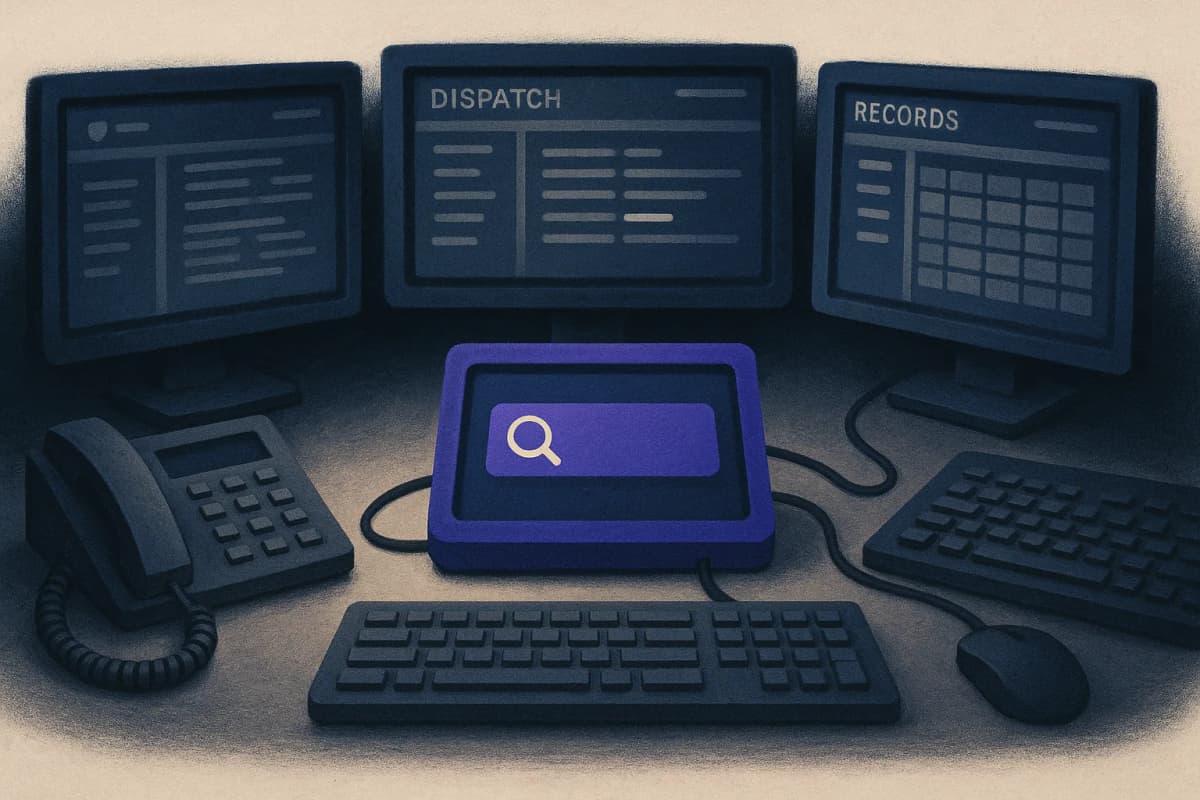
If your police department runs ForceMetrics, the AI layer that searches across your dispatch, records and jail systems now belongs to a company that sells dispatch and records systems. Mark43 announced on September 28, 2026 that it has acquired ForceMetrics, terms undisclosed, and the entire public commitment to agencies on other vendors' platforms is one sentence: ForceMetrics "will continue to work across the technologies and systems agencies use." That is a direction, not a contract. Before your next renewal, get written terms on third-party connectors, CJIS data custody, price and export — because the neutral layer is exactly the part an acquirer has the least reason to keep neutral.
This is not a story about a small analytics startup being absorbed. It is a story about who controls the index over a city's criminal justice records, and whether that index still points at systems the owner competes with.
What Did Mark43 Actually Buy?
Mark43 bought the search-and-context layer that sits on top of an agency's existing CAD, RMS and JMS — not another records system. ForceMetrics' product, Velocity, promises "unified search across CAD, RMS, JMS, and regional data," with a generative feature called Horizon AI that summarises reports and runs "inside our CJIS-compliant environment." Its product page says the platform supports "multiple generations of those systems" plus license plate reader feeds, e-citations, crash reports, court data and EMS records. A CAD (computer-aided dispatch) system logs 911 calls and unit assignments; an RMS (records management system) holds incident reports, arrests and case files. ForceMetrics' pitch was that officers should not have to know which one a fact lives in.
The company grew fast on that pitch. When it raised a $22 million Series A in October 2024, GovTech reported it served 30 departments across 11 states. By the time Mark43 announced a partnership on May 19, 2026, that had become 64 agencies in 17 states and more than 1 billion records under management, with a claimed "average adoption among more than 75% of its user base across all roles" — ForceMetrics' own numbers, published in Mark43's release.
Mark43, on the other side, sells the systems of record. The acquisition release describes it as "trusted by over 300 agencies" with an integrated RMS, CAD and analytics suite. That is up from "over 120 agencies" when it raised a $101 million Series E in July 2021. The May partnership announcement already described ForceMetrics' software as integrating "directly on top of Mark43." Four months later, Mark43 owns it, and the ForceMetrics homepage now reads "ForceMetrics is now part of Mark43."
Why Does Ownership of the Search Layer Matter More Than the Price?
Because a cross-system search layer becomes shared infrastructure between neighbouring agencies, and shared infrastructure is hard to leave. The clearest evidence is a small town in North Carolina. In December 2025, Kernersville's board approved a sole-source purchase of ForceMetrics, skipping competitive bidding because its existing data-sharing platform would no longer supply the data it needed and the neighbouring agencies it works with were moving to ForceMetrics. The town manager's summary: "We're kinda forced."
That is the dynamic that makes this acquisition matter. Once a region's agencies search each other's records through one layer, the layer is not a tool one department can swap out on its own schedule. Whoever owns it gets a say in every neighbouring agency's future CAD and RMS decision — because the easiest integration to keep working is always the one the owner also sells.
The contracts are small, which is part of the risk. In August 2026, the Hope Mills, N.C., town board tabled a ForceMetrics pricing amendment after learning its three-year agreement — whose first-year fee the police chief had negotiated down from $34,000 to $22,000 — had been executed without a pre-audit. The town attorney's verdict: "It is not binding because it is not pre audited." A $22,000 line item rarely gets the change-of-control review that a $2 million RMS contract does. That is how the connector layer ends up governed by the least-reviewed paper in the building.
What Did ForceMetrics Promise Agencies About Their Data?
At least one large city got specific, written data commitments — and those are the template every other agency should now ask the new owner to reaffirm. Seattle's 2025 Privacy Impact Assessment of ForceMetrics, dated January 29, 2025, is the most detailed public record of how the product handles police data. It is worth reading line by line:
- Scope: ForceMetrics searches "data stored in Computer-Aided Dispatch (CAD) and Mark43," which Seattle names as its RMS. It "does not search any external data, including online or social media."
- Hosting: the solution is hosted in AWS GovCloud, which the city relies on to meet CJIS requirements. No data is stored on premises.
- Retention: "ForceMetrics does not retain data."
- AI tagging: the product uses natural language processing to tag incidents, not people, and labels tied to vulnerable populations, such as immigration status, "will not be activated … unless expressly authorized under a new PIA."
- Training: "Contractual requirements are in place to ensure City data will not be used to train or fine-tune the commercial product."
Every one of those is a commitment made by a standalone ForceMetrics. After the close, the question is not whether Mark43 intends to honour them — there is no public sign it does not — but whether the contracting entity, the staff with access and the model-training policy are now Mark43's. Note, too, what Seattle's own document shows: the city runs Mark43 as its RMS and lists its CAD separately. Even a flagship Mark43 customer used ForceMetrics to search across more than one system.
The federal rules make the entity question concrete. Under the FBI's CJIS Security Policy — version 6.1, effective June 25, 2026 — every private contractor that processes criminal justice information must sign the CJIS Security Addendum, which limits use of the data to the purposes the agency provided it for, and CJI must be stored and processed in the United States. There is no FBI certification a vendor can point to; compliance is attested agreement by agreement. When the company holding your addendum is acquired, your CJIS officer should know whose signature now covers the people who can see your records.
Where Is the Pledge Thin?
The pledge names no connector, no duration and no price, and the steel-man for trusting it is real but not enforceable. The strongest case for Mark43 is commercial: ForceMetrics' value is that it works across systems, and a Mark43-only ForceMetrics is a much smaller product. Mark43 also gains a sales channel into every agency ForceMetrics already serves on another vendor's RMS, which only works if those connectors keep running. The acquisition release says the ForceMetrics team — its five founders, including Andre McGregor — is joining Mark43, which argues for continuity of the people who built the integrations.
The industry has run this play before. Axon partnered with real-time crime centre vendor Fusus in May 2022 and acquired it on February 1, 2024. Same sequence as Mark43 and ForceMetrics: partnership, then purchase. But Axon's release was more specific than Mark43's: it said both companies believed customers "benefit from open ecosystem compatibility," and that the combined offering "currently supports devices and sensors from dozens of different providers." Mark43's sentence does not say how many systems ForceMetrics supports today, which ones, or for how long.
And the product roadmap already had gaps where portability lives. When ForceMetrics launched FMStat in May 2025, its CompStat-style analytics module, "improved data export and visualization options" were listed as future updates. An export capability that was on the roadmap before the acquisition is not one to assume survived it.
None of this means the connectors will break. It means the only document that says they will not is a press release, and a press release is not in your contract.
What Should Agencies Do Before Renewal?
Treat this as a change of control on a CJIS contractor and put four commitments on paper before you sign anything else.
This Week:
- Pull your ForceMetrics agreement and find the assignment and change-of-control clauses. Note who signed it, when it renews, and whether it was pre-audited — Hope Mills is proof that small police-tech contracts slip past procurement.
- List every system ForceMetrics touches for you, by vendor and version — CAD, RMS, JMS, LPR, court and EMS feeds. That list is the connector schedule you will ask Mark43 to guarantee.
- Brief your CJIS officer. Ask for the signed CJIS Security Addendum on file and confirm which legal entity and which personnel it now covers.
This Month:
- Request a written connector commitment: every integration on your list maintained for the full contract term plus a minimum notice period before any is retired, with no new fee for a connector to a non-Mark43 system.
- Request reaffirmation of the data terms Seattle got: no retention of source data, no use of your records to train or fine-tune any Mark43 or ForceMetrics model, and no new AI tag categories without your written approval.
- Get a price hold. If your agency buys CAD or RMS from a Mark43 competitor, ask for a clause that ForceMetrics pricing cannot be tied to, or discounted only with, a Mark43 records purchase.
Before Renewal:
- Write export into the contract, not the roadmap: saved searches, tags, FMStat dashboards and audit logs, in a documented format, within a fixed number of days of termination.
- If you share the layer with neighbouring agencies, negotiate together. The Kernersville dynamic cuts both ways — a region that buys as a bloc has leverage no single town has.
The Bottom Line
The records system is where your data lives; the search layer is where your officers decide what it means — and that layer just joined one of the vendors it was built to sit above. Enterprise IT has watched this pattern for two decades: the integration hub is acquired by a platform vendor, the pledge of openness is sincere, and five years later the best-supported connector is the one the owner sells. Public safety agencies run on smaller contracts and thinner procurement staff, which makes the pattern faster, not slower.
Mark43 may keep ForceMetrics open for years. Get that in writing while the new owner still needs your renewal more than you need its roadmap.
One sentence in a press release is a promise to the market. A clause is a promise to you.
Continue Reading
- Visa Bought BioCatch. Get Neutrality in Writing.
- Nasuni Bought DryvIQ. Now Ask Which Connectors Survive.
- d-Matrix Bought Wallaroo. Get 'Any Hardware' in Writing.
- Mitratech Buys BotDojo, Whose Terms Offer No Data Export
- DoiT Bought Attribute. It Also Sends Your Cloud Bill.
- The Army Shipped Agentforce. Anthropic's Models Were Off.