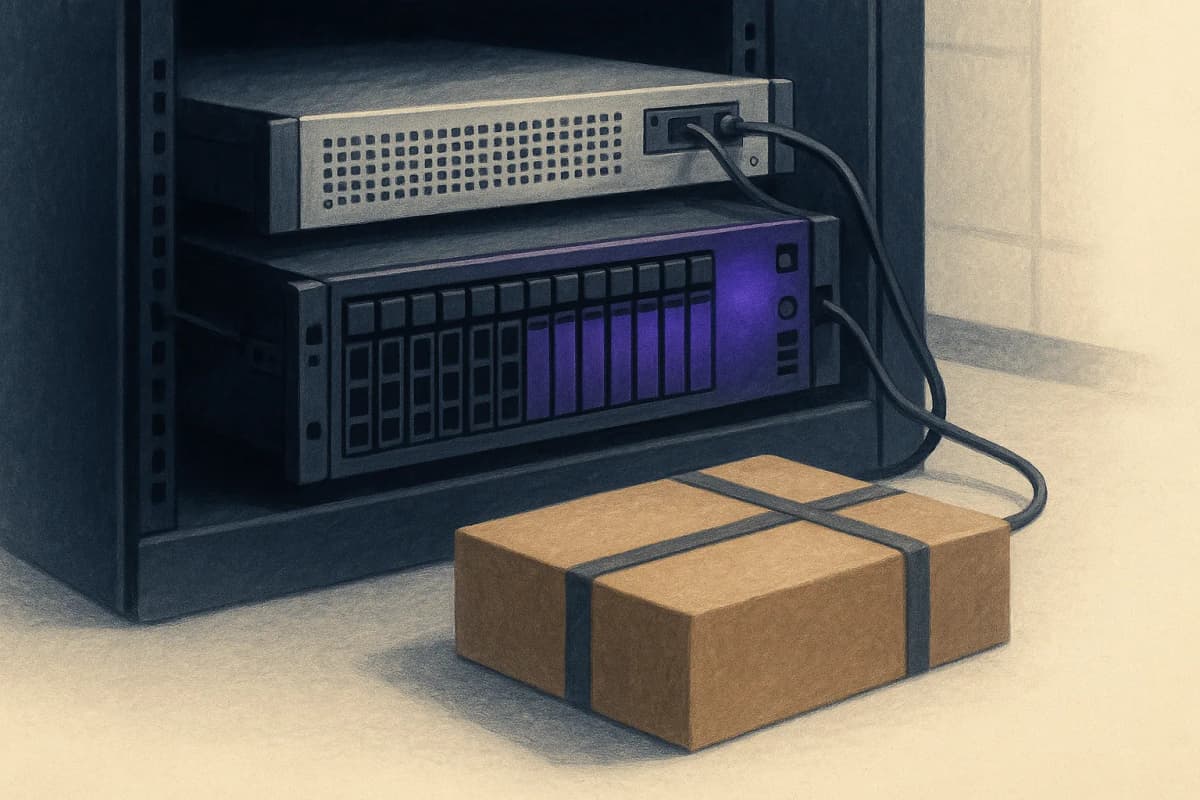
If you run PEAK:AIO on your own GPU servers, NetApp's announcement tells you where the technology is going and nothing about what happens to the box you already bought. NetApp announced its intent to acquire PEAK:AIO on September 25, 2026 to fold its metadata and parallel-file-system engine into ONTAP. The release promises "a clear evolution path for existing ONTAP customers." It does not say whether the standalone AI Data Server, the Open pNFS product, or support for PEAK:AIO running on non-NetApp hardware survives. Until it does, treat the ONTAP path as a roadmap, not a SKU, and get your continuity terms in writing before the deal closes.
That gap matters because of what PEAK:AIO sold. Its own site pitches software "built to scale on your hardware." NetApp sells ONTAP, most visibly now on its own AFX storage controllers. Those two business models can coexist. The announcement does not say they will.
What Did NetApp Actually Buy?
NetApp bought a metadata architecture and a parallel-NFS engine, not an installed base. The release says the deal will "add specialized metadata services and parallel namespace innovation to NetApp's ONTAP-based data architecture," aimed at "trillions of files, exabyte-scale environments, and massively parallel workloads." Terms were not disclosed, and the deal is subject to regulatory approvals with no closing date given.
Parallel NFS (pNFS) is an extension of the NFS protocol that separates the metadata server — which answers "where does this file live?" — from the data servers that hold the bytes, so clients read directly from many storage nodes at once. The metadata server is usually the bottleneck. That is the problem PEAK:AIO spent the last year on.
PEAK:AIO ships three things, per its homepage:
- AI Data Server — GPU-attached shared NVMe storage. StorageReview reports a 2U version delivering 1.5PB and 120GB/s on Dell hardware with Solidigm SSDs in 2025.
- Open pNFS — a scale-out metadata server that Blocks & Files described as vendor-agnostic, with roughly 160GB/s of reads per 2U Gen5 NVMe data server and a stated 2026 target of 320GB/s per node.
- Archive — flash-based protection storage.
Underneath Open pNFS sits pNFS Lattice, the open-source metadata server PEAK:AIO initiated with Los Alamos National Laboratory and Carnegie Mellon. It is licensed under MIT except for one GPL-2.0 file, and its own README says it is "not yet recommended for production use without independent validation, security review and operational testing." PEAK:AIO and Los Alamos released it under the Linux Foundation and were scheduled to present it at the SNIA Developer Conference on September 28 — three days after the acquisition was announced.
The company is small. It raised $6.8 million in seed funding in October 2025, $5 million of it from Pembroke VCT, and for Pembroke this is its first technology exit. NetApp is buying engineers and an architecture.
Who Is Exposed If the Standalone Product Stops?
The exposed buyers are the hospitals, universities, labs and government bodies that bought PEAK:AIO precisely because it was not an array. NetApp's release names deployments at Los Alamos, Carnegie Mellon, the Oxford Robotics Institute, NHS AIDE, the University of Liverpool, the University of Strathclyde's MediForge Hub and the Zoological Society of London. PEAK:AIO's own site lists the NHS, King's College London, the University of Liverpool, the University of Strathclyde, Medtronic, BT, Zebra, the Zoological Society of London and the Ministry of Defence. StorageReview notes the Zoological Society deployment put 1.2PB behind two NVIDIA DGX systems.
These customers bought software on commodity servers. PEAK:AIO's news page lists Dell, Supermicro and Gigabyte as server partners and PNY as a distributor, and the company claimed its latest AI Data Server cut "the cost of ultra-performance AI data storage by up to 70 percent" against its previous version — a vendor claim. The Open pNFS partner list reported by Blocks & Files adds Kioxia, Solidigm, Western Digital and Wiwynn. None of those is NetApp.
Now compare the destination. NetApp's disaggregated ONTAP runs on the AFX 1K storage controller, scales to 128 controllers and over an exabyte, already supports pNFS, and requires ONTAP 9.17.1 or later. That is a capable system — certified for NVIDIA DGX SuperPOD — and it is a NetApp-hardware system. StorageReview put the tension plainly: PEAK:AIO built a following among buyers "that couldn't justify a large array behind a single GPU server," while NetApp's framing is hyperscale cloud. Its reviewers said they would be "watching whether NetApp keeps Lattice developing in the open."
So would I. If you run PEAK:AIO on a Dell R-series box next to one DGX, the "evolution path" in the release is written for someone else.
Is This Deal Actually Good News for PEAK:AIO Customers?
Probably yes, on balance — which is the strongest case against worrying, and it deserves stating. A seed-funded startup with a $6.8 million round is itself a continuity risk. If you run it under a clinical imaging pipeline or a defence workload, the question your risk committee should have been asking was "what if PEAK:AIO runs out of money?" A buyer with a global support organisation removes that risk. George Kurian's quote in the release leans on "resilience, security, and operational simplicity" — exactly what a small vendor struggles to promise.
The open-source layer also caps the downside. Lattice's MIT licence means the code already published cannot be withdrawn. But the repository has 14 stars and 11 forks and describes itself as a research release. Nobody outside PEAK:AIO is going to maintain your production metadata tier from it. Open source protects the idea; it does not staff your support ticket.
And the history is mixed. NetApp bought Spot for roughly $450 million in 2020 and sold it, with CloudCheckr, to Flexera for about $100 million, citing a refocus on its core data infrastructure business. That is not a storage precedent. It is a reminder that acquired products at NetApp get re-scoped when strategy moves — and PEAK:AIO is NetApp's third acquisition in three months, after DataPelago in July and JetStream Software in August. An acquirer buying at that pace is buying for its own roadmap.
What the Announcement Leaves Out
Four things a PEAK:AIO customer needs are missing from every public statement so far. Checked against the NetApp release, the Pembroke-side announcement as reported by Intelligent CIO and PEAK:AIO's homepage, none of them addresses:
- Standalone sale. Will the AI Data Server and Open pNFS still be sold as software for third-party servers after close?
- Hardware support. Will NetApp support PEAK:AIO on Dell, Supermicro and Gigabyte servers it does not sell — and for how long?
- Channel. What happens to deals running through the PNY distribution deal and integrator partners such as Scan Computing?
- Price. A software licence on your hardware and an ONTAP system on NetApp's are priced on different models. No migration pricing has been published.
None of this means the answers are bad. It means they are not written down, and at close they stop being PEAK:AIO's to give. We have seen the same shape in AMD's World Labs deal, where the model survived the announcement and the API was never mentioned, and in Microchip's Hailo pledge, which covered the silicon and stopped short of the compiler customers depend on.
What to Do Before the Deal Closes
Use the window between announcement and close — it is the only period in which PEAK:AIO can still sign commitments on its own behalf.
This Week:
- Inventory every PEAK:AIO node — hardware vendor, firmware, software version, support end date, and which GPU jobs depend on it. If it sits behind a clinical, defence or regulated workload, flag it for your risk team as a change-of-control event; the playbook from HCL's Robotiq deal applies.
- Pull your contract and find the assignment and change-of-control clauses. Many software agreements let an acquirer inherit the contract without your consent. Know what you signed before you ask for anything.
- Email your PEAK:AIO account contact with the four questions above and ask for a written answer before close. A verbal "nothing changes" is worth what you paid for it.
This Month:
- Ask for a support-continuity letter covering your current software version on your current hardware for at least the remaining term plus 24 months, with security patches. If you are mid-expansion, negotiate a price lock on additional nodes now.
- Get a written position on Lattice and Open pNFS. Will the open-source project keep accepting contributions under the Linux Foundation? If the commercial Open pNFS product is folded into ONTAP, is there a supported path on non-NetApp hardware?
- Price the alternatives, even if you do not plan to move. Get a quote for NetApp AFX, and one for a software-defined option such as WEKA NeuralMesh. The number is your negotiating leverage, and you need it before renewal, not after.
Before Renewal:
- Do not sign a multi-year PEAK:AIO renewal without the continuity letter attached. If NetApp will not give one, shorten the term.
- Decouple your scheduler from your storage assumption. If your jobs assume a specific mount layout, document it; a storage migration is cheap only when the GPU side does not care. The GPU-scheduling comparison covers where those assumptions hide.
The Bottom Line
NetApp bought a good idea — separate the metadata, scale it independently, feed the GPUs — and it will very likely ship that idea inside ONTAP. That is good news for ONTAP customers and a reasonable bet for NetApp. It is neutral-to-uncertain news for anyone who picked PEAK:AIO because it ran on the server they already owned.
Storage has run this loop before. A small software-defined vendor wins on commodity hardware and price; an array vendor buys it for the architecture; the architecture ships inside the array. Nasuni's DryvIQ deal raised the same question about which cross-platform connectors survive an acquirer with its own platform to sell. Sometimes the standalone product lives for years. Sometimes it is a line on an end-of-sale notice. The announcement does not tell you which, and nobody will tell you after close unless you asked before it.
Ask now. The roadmap is NetApp's. The servers are yours.
Continue Reading
- AMD Buys World Labs for $8.2B Without a Word on Marble's API
- Microchip's No-EOL Pledge Stops Short of Hailo's Compiler
- Nasuni Bought DryvIQ. Now Ask Which Connectors Survive.
- Run:ai vs Kubernetes vs Slurm: Static Quotas Strand Your GPUs
- HCL Buys Robotiq.ai for €9M, Silent on the Banks Running Its Bots
- Cognex Buys RealSense, Leaving Face ID to a 25-Person Spin-Out