Your 2026 action item from GTC Berlin is software: the OpenShell agent runtime is open source and installs today, while the DSX POD ships through partners in early 2027 with no published price. Jensen Huang's October 21 keynote put both on the same stage. They belong in different budget lines. Pilot the agent sandbox this quarter on hardware you already run, and treat the POD as a 2027 capacity option you price against colocation and cloud, not something procurement can order yet.
The rest of the week (Vera Rubin in full production, the Agent Knowledge Foundation, RTX Spark laptops) mostly confirms roadmaps you have already heard. What follows is what each announcement lets a European infrastructure or security team do, and when.
What Nvidia Actually Announced in Berlin
Nvidia announced one hardware reference design, one security reference architecture, and a bundle of retrieval models, and none of them carry a price. The keynote post lists the headline items:
- DSX POD, a reference design for a complete Vera Rubin AI factory that partners build inside modular containers and validate before delivery. Nvidia says onsite deployment "can drop from six months to 14 days once site utilities are ready."
- The OpenShell Reference Architecture for Safe AI Agents, a full-stack design built on OpenShell, which Nvidia describes as an open-source, policy-controlled runtime with kernel-level sandboxing.
- The Agent Knowledge Foundation, models and libraries for connecting agents to enterprise documents and databases, including Nemotron parsing, embedding and reranking plus new Kumo models for predictions from structured data.
- Vera Rubin "in full production," and RTX Spark laptops with 1 petaflop of performance and 128GB of memory, which launched the week before the keynote.
Nvidia also said it has committed nearly $10 billion to Europe's technology ecosystem and works with more than 12,000 partners there, per the same post. Huang named L'Oréal, Revolut, Spotify, Merck, Vodafone, Zara, Porsche, Nestlé and HSBC as companies working with Nvidia on AI, though none was named as a POD buyer.
The DSX POD Is a 2027 Purchase You Can't Price Yet
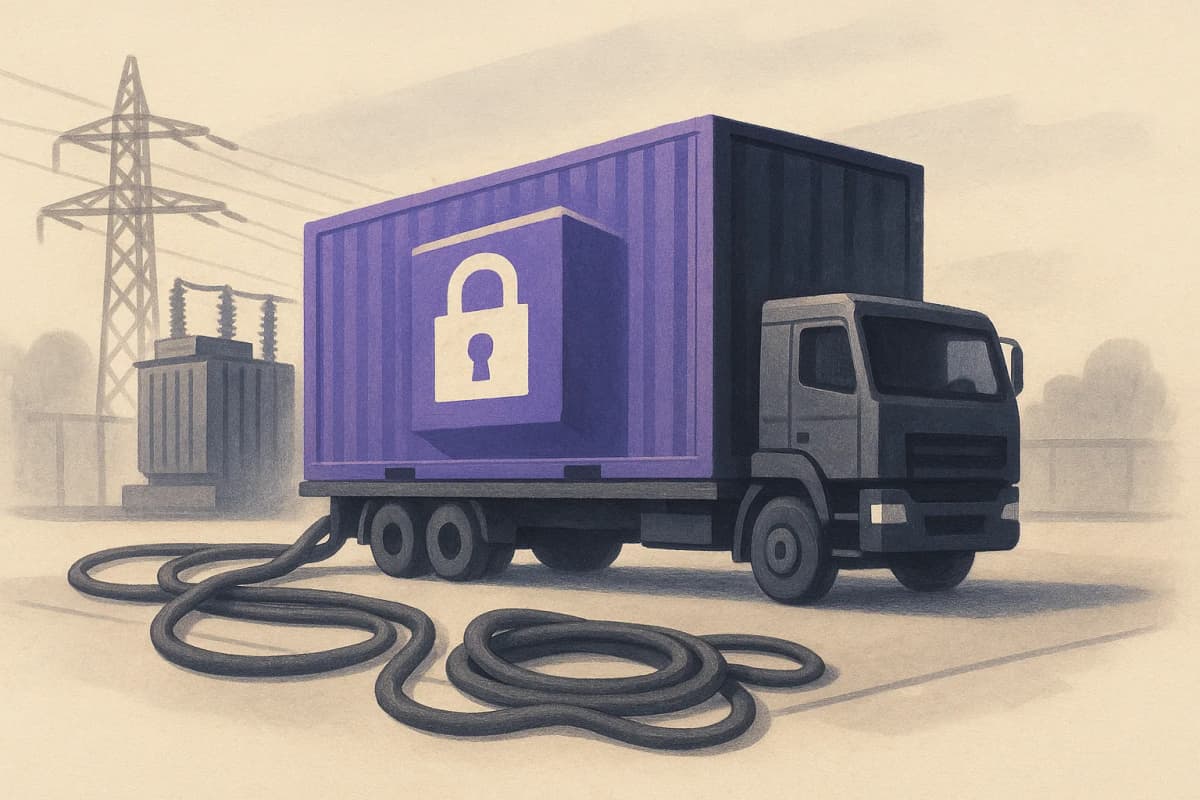
A DSX POD is seven Vera Rubin NVL72 racks plus networking, cooling and management hardware, assembled and tested in a factory and trucked to your site in one container. ServeTheHome reports that Nvidia will not build or sell PODs itself: partners do, with Gigabyte, HPE, Dell, Delta and QCT named, and deliveries are expected to begin worldwide in early 2027. Data Center Knowledge counts 17 partners in total, including the French integrator Bull and the facility vendors Eaton, Schneider Electric and Vertiv. Nvidia's Ian Buck called it "a fully assembled, fully tested, fully pre-plumbed, prebuilt, pre-validated container."
Nobody has published a price. You can still bound it. Analyst estimates for a single Vera Rubin NVL72 rack run from Morgan Stanley's roughly $7.8 million to Bernstein's $9.1 million, the higher figure driven by a projected tripling of HBM4 memory prices to $53 per gigabyte in 2027. Seven racks at those estimates is roughly $55 million to $64 million in compute before the container, cooling plant, integration margin or site work. Treat that as a floor for a conversation, since neither bank was pricing a POD.
Power is the second number your facilities team will ask for, and Nvidia did not give one per POD. Third-party sizing puts a Vera Rubin NVL72 rack at 190 to 230 kW, and there is no air-cooled version of Rubin. Seven racks therefore need about 1.3 to 1.6 MW of power and a matching direct-to-chip cooling loop at the pad. Most enterprise server rooms were not built for either.
The 14-day clock starts after the hard part
The 14-day figure is real only after power, cooling and networking are already at the site. Techstrong.ai quotes Mitch Ashley of The Futurum Group: "Its 14-day deployment figure is a vendor claim, and it starts only after power, cooling, and networking are in place." The same report puts the unit at about 62,000 pounds (roughly 28 tonnes), which can mean specialized hauling and permits. Even Nvidia's own framing varies: the keynote transcript describes the gain as four to five months cut to about one month, while the blog says six months to 14 days.
For a European buyer, the schedule is set by the grid connection and the permit. "For European buyers, grid access and permitting now decide when tokens flow," Ashley told Techstrong, and he flagged the lock-in that comes with the speed: "A factory-built Vera Rubin container also commits the site to NVIDIA's architecture, whichever partner builds it."
The strongest case for the POD comes from IDC's Ashish Nadkarni, who told Data Center Knowledge he sees three uses: sovereign deployments that need physical isolation, smaller-footprint AI sites, and edge AI. If you are a bank, a ministry or a defence supplier that cannot put a workload in a hyperscaler region, a partner-built container you own outright is a cleaner answer than a three-year colocation build. For an enterprise that can use a sovereign cloud region, the case is much weaker.
OpenShell Is the Part You Can Run This Week
OpenShell is an open-source runtime that puts each AI agent in its own sandbox and enforces a declared policy on what the agent can read, run and reach over the network. The GitHub repository is Apache 2.0 licensed, at version 0.1.x, and runs on Linux, macOS on Apple Silicon and (experimentally) Windows under WSL 2. Agents never see real credentials. Install is two commands: a script that sets up the CLI and a local gateway, then openshell sandbox create.
What shipped on keynote day is the reference architecture, a documented full stack around that runtime. ServeTheHome describes the division of labour: Vera Rubin GPUs do the model reasoning, Vera CPUs run agent execution and the OpenShell stack, and BlueField-4 DPUs act as "the hardware security enforcement mechanism." The keynote demo, per the transcript, breaks the software into a gateway (control plane), a supervisor that makes policy decisions and holds keys outside the sandbox, the sandbox itself, and a policy prover that checks policies against permission ceilings. "Every agent runs inside its own isolated sandbox with no direct route to the network," the narration said.
The runtime itself is not new. You may have read about it in May, and Nvidia folded it into its Open Agent Safety Platform on September 28 alongside Sentry, a watchdog that runs on BlueField-4 DPUs and, per Techzine, quarantines an agent "within milliseconds, according to Nvidia" when it exceeds its boundaries. That same report says Anthropic integrates Claude Managed Agents with OpenShell, Salesforce surfaces agent activity and permission approvals in Slack, and SAP is building OpenShell into its Joule Studio runtime.
You don't need the Nvidia hardware to start
The detail that matters for a pilot is on Nvidia's own agent safety page: "OpenShell can run on supported local, on-premises, cloud, and Kubernetes infrastructure without BlueField-4." The hardware layer (Sentry on BlueField-4) adds enforcement outside the host, which is what a regulator or a red team will eventually ask about. That hardware decision can wait for a 2027 refresh. How your agents get sandboxed can't, because your developers are already running coding agents with shell access.
The honest weakness is maturity. A 0.1.x runtime with a reference architecture published this week has no track record in production at your scale, and the millisecond quarantine claim is Nvidia's own, unverified by Techzine. If your platform team already standardized on a commercial sandbox, our E2B vs Modal vs Daytona comparison covers what those cost; OpenShell's advantage is that it is self-hosted and free to run, and its policy model is open to inspection. Microsoft is pushing a different answer on the desktop with Execution Containers, which shipped before Intune could manage them.
Agent Knowledge Foundation Repackages Retrieval and Kumo
The Agent Knowledge Foundation is Nvidia's bundle of models for turning company data into something an agent can query. Per the keynote transcript, Nemotron Parse reads unstructured documents, Nemotron Embed and Nemotron Rerank handle vector retrieval and ranking, and Kumo predicts outcomes from structured data. Huang's example was predicting which orders will run short, and for how long, after a supplier sends a delay notice.
Parsing, embedding and reranking are a market with plenty of options already. The Kumo piece is the more interesting addition because it moves Nvidia into tabular prediction, a job LLMs handle badly. We covered the licensing trade-offs of Kumo Tabular against TabPFN last month. Neither the keynote post nor the transcript gives a license, price or availability date for the Foundation as a package, so check each model card before you plan around it.
What to Do Before 2027 Capacity Talks
This Week:
- Have one platform engineer install OpenShell on a Linux box and wrap one internal coding or data agent in a sandbox with a written network policy. Record what the policy blocked that the agent tried to reach.
- Ask your security lead which agents in production today can reach the network and hold credentials directly. That list is your OpenShell pilot scope.
This Quarter:
- If you run SAP Joule Studio, Slack-based agents or Claude Managed Agents, ask each vendor in writing when its OpenShell integration is generally available and whether it needs BlueField-4 hardware.
- Get a written quote from your server partner (Dell, HPE, Lenovo or Bull) for a DSX POD delivered in 2027, with the site requirements spelled out: MW at the pad, cooling loop spec, weight on the slab.
Before You Sign a 2027 Capacity Deal:
- Put the POD quote next to a colocation build and a reserved cloud contract for the same seven-rack footprint. Compare total cost over three years, including the grid connection date and who carries the loss if site cooling fails, the gap our colocation insurance piece walks through.
- Write down which sovereignty requirement the POD meets that a sovereign cloud region would not. If you cannot name one, the container's speed advantage is worth less than the flexibility you give up.
The Bottom Line
GTC Berlin repeated a pattern from Nvidia's March San Jose show: the hardware story is large and arrives later, and the software you can use ships the same day. The POD shortens the build inside the fence. The grid queue outside it still sets the date for European AI capacity, and Huang himself put a 1 GW AI factory at about $50 billion all in.
Install OpenShell this week, and ask your partner for a POD quote with the site spec attached.
Continue Reading
- NVIDIA OpenShell: The AI Agent Layer Your Stack Forgot
- Why SAP + NVIDIA Just Solved Enterprise AI's Trust Problem
- E2B vs Modal vs Daytona: Idle Time, Not Cold Start, Sets the Bill
- When the Colo's Chillers Fail, the GPU Loss Is Yours
- Intel's Crescent Island Fits 300B Models in Old Racks, Slowly
- Samsung Led Mistral's Round. Score the Clauses, Not the Flag.