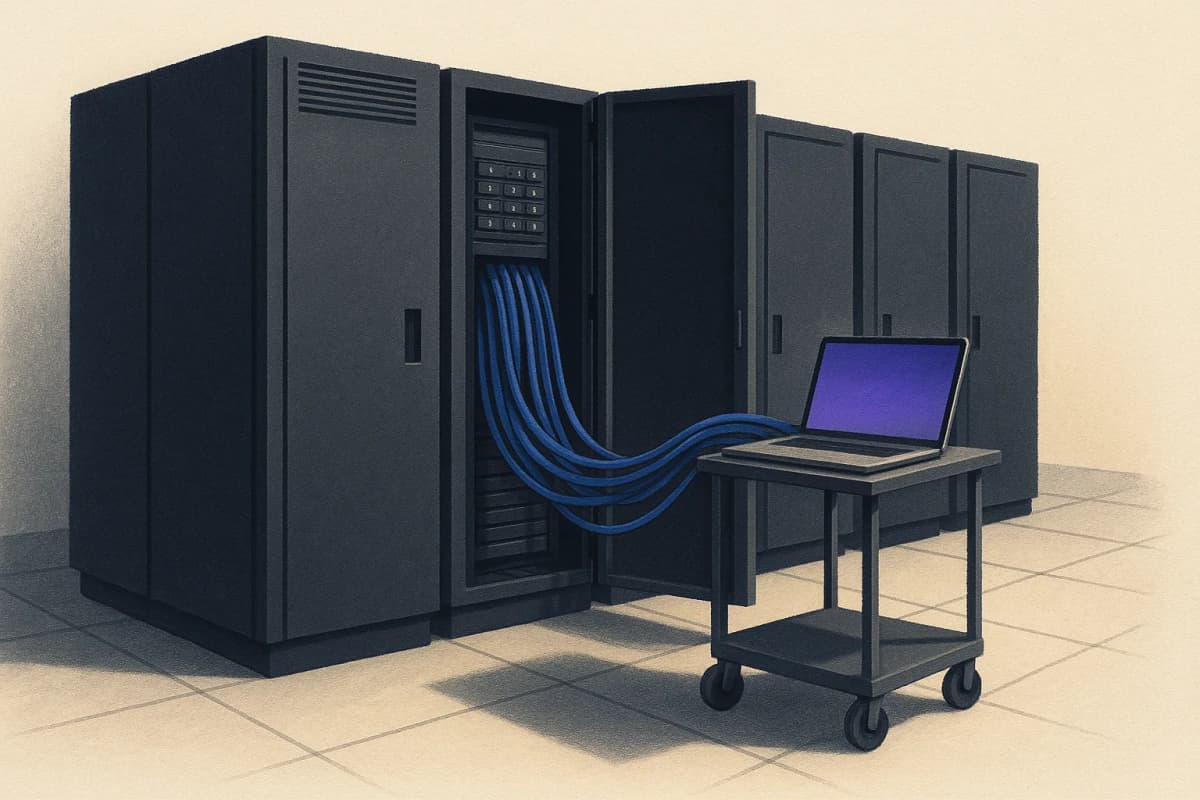
If you are piloting Geniez AI to let Claude, GPT or Gemini read your mainframe, Rocket Software now owns it and has not said it will stay model-agnostic, sold standalone or priced as quoted. Rocket announced the acquisition on October 13, 2026 and said Geniez's team will help build new capabilities in Rocket EVA, its agentic AI platform for core systems. The release gives no deal terms, no product roadmap, no customer commitments and no list of supported models.
That matters because model choice was the reason to buy Geniez in the first place. A bank that wanted an LLM to answer questions about Db2 or CICS without moving data off the box could pick its own model and keep its own security controls. Whether that survives depends on what Rocket does next, and Rocket has not said.
What Geniez Actually Did
Geniez sold a connector layer that gave large language models real-time access to mainframe data under the mainframe's own security controls. Blocks and Files described the product in September 2025 as a set of real-time extract connectors covering Db2, IMS, MQ, VSAM and data sets, working with Meta's Llama, Anthropic, OpenAI, Gemini and Amazon Bedrock, and governed by RACF controls with end-to-end encryption.
The company raised a $6 million seed round co-led by StageOne Ventures and Canapi Ventures in September 2025, describing a framework that runs natively on the mainframe and speaks MCP to models running on-premises or in a public cloud.
By the time of the sale it had grown past a data connector. The Geniez site, which now says Geniez "combines its talent with that of Rocket Software," lists modules for chat, monitoring with SMF reporting, natural-language agentic workflows, mainframe security posture management and IDE code assistants, plus integrations for Microsoft Teams, A2A and MCP. Its logo wall of supported AI providers names Claude, Claude Code, OpenAI Codex, ChatGPT, Gemini, Microsoft Copilot, Amazon Q, Bedrock, Llama and Mistral.
The traction figures on that page are Geniez's own, labelled as reported by customers: more than 200 daily users including at Fortune 50 companies, more than 50 agentic workflows in production, and "over $32M in annual savings for the average customer." No customer is named in the text. Treat the savings figure as a vendor claim until a reference customer repeats it to you on a call.
The one independent look we found is an IBM Community blog from January 2026 where one commenter reported a successful proof of concept and another said the product worked "without any overhead to General processor on mainframe." Those are practitioners' comments, and it is the kind of claim worth measuring yourself on your own LPAR, because general-processor MIPS is where mainframe software costs land.
What Rocket Said, and What It Left Out
Rocket's release frames the deal as a talent and roadmap move into EVA, and says almost nothing about the product Geniez customers are running. CEO Milan Shetti called it a step toward "accelerating our vision to help enterprises securely apply agentic AI to their systems." Geniez co-founder and CEO Gil Peleg said joining Rocket provides "scale, customer reach, and deep mainframe expertise." The listed benefits are adding talent, speeding the agentic roadmap and narrowing the mainframe skills gap.
What is missing is everything a buyer signs against:
- Whether Geniez stays available as a standalone product, or only inside EVA.
- Whether the model list survives. EVA is described as model-agnostic, but Rocket's October 6 EVA update named no specific models, while Geniez published ten provider logos.
- Pricing, for either product. The EVA coverage lists no price and no general availability date, and Geniez never published one.
- Support and continuity commitments for existing Geniez contracts.
EVA itself is a week-old expansion. On October 6 Rocket added PlanGuard, a layer between an agent's decision and its execution that uses identity and policy checks to limit what the agent can touch, logs activity for audit and allows human oversight. Rocket said organisations in financial services, government, insurance, retail and telecommunications are piloting EVA, without naming any. Geniez's data access plus PlanGuard's action controls is a coherent product. It is also one you would buy from a single vendor, on that vendor's terms.
Who Rocket Is When It Buys Something
Rocket is a private-equity-owned consolidator, and its recent deals tell you how it treats acquired products. It closed the $2.275 billion purchase of OpenText's Application Modernization and Connectivity business in 2024, which it said lifted revenue more than 60%. In May 2026 it completed the Vertica acquisition, adding more than 600 customers and 170 employees, and placed Vertica alongside its DataEdge and ContentEdge products.
Rocket is majority-owned by Bain Capital Private Equity. Reuters reported in February 2025 that Bain was weighing a sale of its stake at a valuation of $8 billion to $10 billion, per IT Jungle. We found no report of a completed sale or a buyer since then. A sale of Rocket would be a second change of control on top of this one, so whatever you negotiate needs to survive both.
The Last Time This Team Was Acquired, the Product Name Lasted About a Year
Peleg and co-founder Dan Shprung have been through this once already. Both worked at Model9, which BMC acquired in April 2023. About eleven months later, Model9's software had been rebranded into the BMC AMI Cloud suite. BMC's own Model9 transition page states plainly that "The Model9 name was retired," with Model9 Manager becoming AMI Cloud Data, Shield becoming AMI Cloud Vault and Gravity becoming AMI Cloud Analytics.
The technology carried on under BMC's brand. The same page says nothing about what happened to Model9 customers' contracts or support; it offers a "Contact Sales" button. That is the most likely template here: Geniez's connectors keep running, and within a year the way you buy them is EVA.
Folding a seed-stage startup into a platform with 13,500 customers and 850 partners can be good for a bank. A $6 million company is a vendor-risk finding at most regulated buyers. A Rocket product line with a support organisation behind it is easier to get through third-party risk review. The question is what you give up in exchange: model choice and a standalone price.
What Your Alternatives Look Like Now
The two large mainframe software vendors both sell an AI assistant for Z, and neither is a drop-in for a vendor-neutral data layer. IBM's watsonx Assistant for Z release of October 2025 added an agentic framework with multi-agent orchestration, a no-code and pro-code Agent Builder, and prebuilt agents for monitoring, scheduling and ServiceNow incident response. That announcement does not state which models it supports or whether you can bring your own.
BMC's AMI Assistant advertises bring-your-own-model support alongside a "curated LLM library vetted for mainframe tasks." Ask BMC for the documented list of supported model runtimes before you rely on that line; marketing copy and the supported-configurations page are not always the same thing.
The third option is to build. Geniez itself spoke MCP, which is the obvious interface for an in-house version. Building your own connector to Db2 and VSAM means owning RACF mapping, audit logging and zIIP placement yourself. Read our MCP server governance guide before you open that door.
One technical question applies to all three. Geniez claims "All data remains on-premises" while letting you use frontier models in the cloud. Whatever an agent reads from Db2 and puts in a prompt goes to the model provider that answers it. Ask any vendor in this category to show you exactly which fields leave the box, and under which provider's retention terms.
Why Regulators Will Ask About This
Banking supervisors are already asking how firms would shut down an AI agent and reconstruct what it did, and a vendor that changed owners mid-pilot belongs in that answer. The US banking agencies' supervisory questions on AI agents and the Monetary Authority of Singapore's requirement to inventory AI inside third-party software both land squarely on a mainframe agent with read access to customer records. Update your third-party register for the ownership change this month, before an examiner notices it first.
What to Do Before EVA Becomes the Only Way to Buy It
This Week:
- Pull your Geniez order form or pilot agreement and find the assignment and change-of-control clauses. Our AI vendor exit clauses review lists what standard terms usually give you, which is often nothing.
- Write down every model and endpoint your pilot actually calls, including Bedrock regions and Azure OpenAI deployments. That list is what you will ask Rocket to commit to.
- Ask your Geniez contact, in writing, three questions: will the product be sold standalone through your renewal date, will every model you use stay supported, and will the price you were quoted hold.
This Month:
- Measure general-processor and zIIP consumption for your Geniez workload over a normal week. If Rocket repackages it inside EVA, you want your own baseline, not theirs.
- Run the same ten operations questions through watsonx Assistant for Z or BMC AMI Assistant, so you have a priced alternative before Rocket quotes EVA.
- Have your security lead confirm that RACF profiles, not a service account with broad READ, are what limit the agent. Our piece on agents running under every role a user holds shows what happens when they are not.
Before Renewal:
- Get model choice written into the contract as a list of named providers with a notice period before any is dropped. Atlassian's Rovo shows how a partnership can leave admins with no provider choice at all.
- Ask for a price-hold and standalone-availability clause that survives a sale of Rocket itself.
The Bottom Line
Rocket bought a small team that had solved a narrow, valuable problem: reading live mainframe data from whichever LLM you already trust, under RACF. When BMC bought the last company this team worked at, the product name was gone within a year, and Rocket's announcement offers no reason to expect a different path for Geniez. If your pilot depends on model choice, get the model list and the standalone price into your contract before the EVA quote arrives.
Continue Reading
- AI Vendor Exit Clauses: Standard Terms Give 0 to 90 Days to Get Out
- MCP Server Governance: Enforce at the Client, Not the Registry
- Fed, OCC and FDIC Ask Banks How They Would Shut Down AI Agents
- Harness Buys Augment's Cosmos With No Word on Augment Contracts
- Snowflake Agents Run as All Your Roles. Revoke From PUBLIC.
- Automation Anywhere Buys Boost.ai With No Word on Its Contracts
