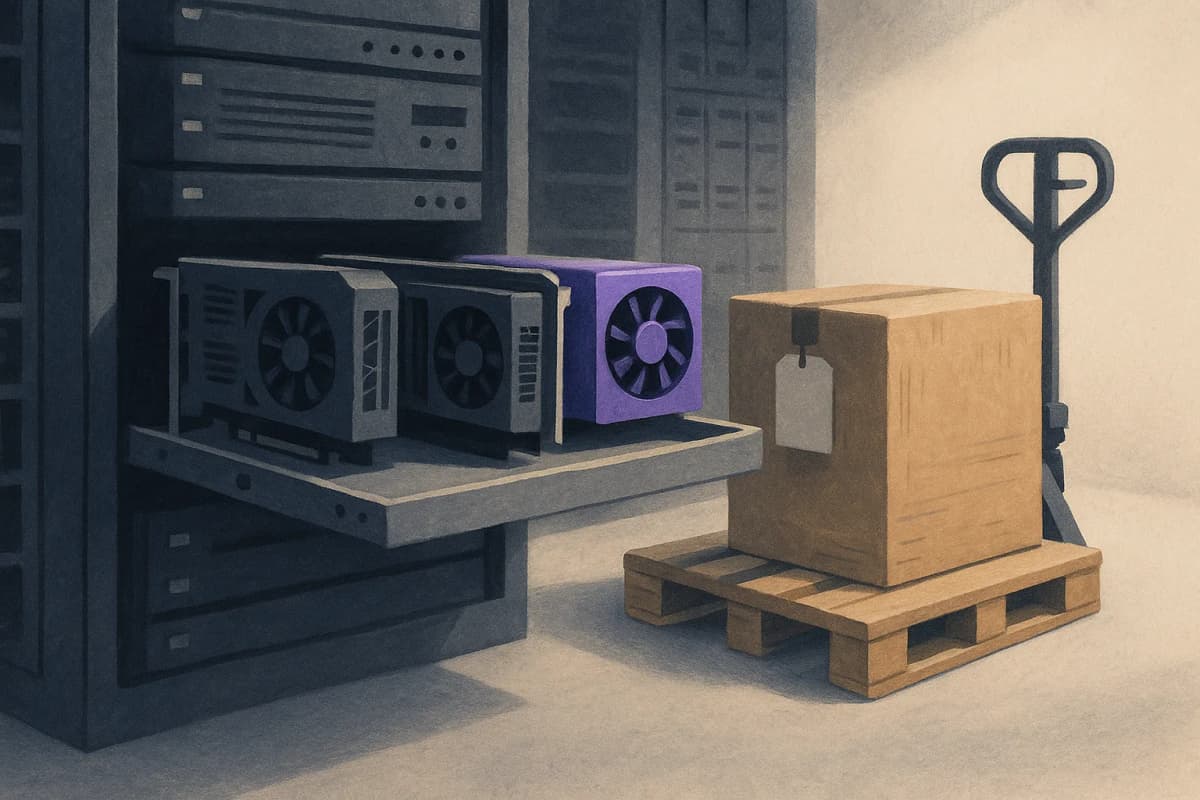
If you adopted Decart's optimization stack so you could move models between Nvidia, Trainium and TPU, the company that makes Trainium is now negotiating to own it. Amazon is in talks to buy Decart for around $7 billion, The Wall Street Journal reported on Sunday, October 11, and the people it cited said a deal could come together soon. Nothing is signed. That window is the only time you will have leverage, so treat this as a change-of-control event now and get multi-chip support terms in writing before terms are agreed.
This is the second buyer in two months. Anthropic ran diligence on Decart at roughly $6 billion and walked away, Bloomberg reported on September 8. We covered that bid, and what it said about inference pricing, in Anthropic Walked From Its $6B Decart Bid. Amazon raises a different question. Anthropic would have kept DOS for its own cost curve. Amazon sells one of the chips DOS is supposed to stay neutral across.
What Amazon Would Be Buying
Amazon would be buying a software layer that makes a model run well on whichever accelerator you have, plus two world-model products. Decart's own site says DOS, the Decart Optimization Stack, "unlocks the full performance of every major chip" and is "Built across NVIDIA, AWS Trainium and Google TPU". A chip portability layer, in plain terms, is software that takes a model tuned for one processor and retunes it for another, so you can shift a workload when a chip gets scarce or expensive. SiliconANGLE's write-up of the WSJ report says DOS compresses an optimization workflow that used to take months into a couple of weeks.
The rest of the company is products you may be paying for directly. Lucy does real-time video transformation (virtual try-on, live advertising, social platforms, gaming) and Oasis is an interactive world model aimed at robotics, autonomous vehicles and drones, per Decart's site. Both are sold through a pay-as-you-go API: Lucy 2.5 is $0.02 per second realtime and $0.04 per generated second at 720p, Lucy Restyle 2 is $0.01 per second, and the page says there are "No subscriptions and no minimum spend". Enterprise volume pricing is by email.
The numbers on the company are modest next to the price. Decart was founded in 2023, had about 100 employees and roughly $450 million in total funding as of August, according to Calcalist. Its May round was $300 million at a valuation of nearly $4 billion, led by Radical Ventures with Nvidia participating, per SiliconANGLE. At that round the company said it was generating "significant revenue" from licensing DOS to cloud providers and AI labs, and gave no figure. At $7 billion, Amazon would be paying about 75% over the May price for a company whose revenue nobody outside it has seen.
Why the Trainium Connection Changes the Neutrality Question
The neutrality you bought depends on the owner having no chip of its own to favor, and Amazon has a very large one. Amazon CEO Andy Jassy said on the first-quarter 2026 earnings call that the company holds more than $225 billion in revenue commitments for Trainium, and the same report puts the custom chip unit's annual revenue run rate above $20 billion. In June, AWS executive Peter DeSantis told Bloomberg that Amazon is in talks to sell Trainium for installation in other companies' data centers and that Trainium3 is "largely sold out".
The relationship with Decart already exists. AWS gave Decart early access to Trainium3 in 2025 after its engineers met the founders and came away impressed, per the WSJ account carried by Seoul Economic Daily, and AWS's own Trainium page lists Decart among its named customers, next to Anthropic, Databricks, OpenAI and Uber.
Steel-man Amazon's side, because it is a reasonable one. The hardest thing about adopting Trainium is the porting work. A layer that turns months of kernel tuning into weeks makes Trainium a lower-risk bet, which is good for anyone who wants a second source to Nvidia. Amazon could keep DOS multi-chip because a tool that only targets Trainium is worth far less to the cloud providers and labs that license it. Both of those can be true and still leave you exposed, because the owner sets the roadmap. The question is which chip gets the next optimization first, and which one gets it last.
Read SiliconANGLE's own framing carefully: it says DOS "could be very useful" for AWS. No report says Amazon plans to restrict it. That is speculation in both directions, and the only thing that settles it is contract language.
What Happened the Last Time a Chip Company Bought the Software Layer
The precedents say the product survives the deal and the roadmap follows the buyer. Nvidia bought Run:ai, a GPU orchestration platform that then supported only Nvidia GPUs, for a reported $700 million and completed the deal on December 30, 2024 after separate competition reviews by the European Commission and the US Department of Justice. At announcement Nvidia said it would keep selling Run:ai's products under the same business model for the "immediate future," and the founders said they would open source the software so it could reach "the entire AI ecosystem," per ITPro. "Immediate future" carries no date, and nothing in the public record gave customers a dated commitment for other vendors' hardware.
Amazon's own most relevant deal is the Adept transaction in June 2024. Amazon hired CEO David Luan, four co-founders and other staff, and Adept licensed its technology to Amazon. Adept kept operating under a new CEO, and its products went on running on in-house models. The point for you: an Amazon deal does not have to be a full acquisition to move the team, and a reported $7 billion "acquisition" could still close in a different shape. Your change-of-control clause may not fire if the people move and the entity stays.
We have tracked this pattern through the summer. When Nvidia bought Hugging Face's accelerator bridge and when d-Matrix bought Wallaroo, the advice was the same: get the hardware-agnostic claim into the contract, because a press release does not bind the buyer. When AWS hired DuckDB's board majority, governance moved without anything you could call a sale.
Who Is Exposed, and How Much
Your exposure depends on which part of Decart you touch. Three groups have different problems.
If you license DOS directly or through a provider, you bought optionality. If DOS stops getting Nvidia or TPU optimizations first, your cost to move off Trainium rises quietly, with no announcement. Remember who else is involved: Nvidia is a Decart investor and, per Calcalist, held advanced acquisition talks of its own before higher offers emerged. Decart's site also describes edge inference work with Comcast on NVIDIA GPUs. A Decart owned by Amazon and an Nvidia that once tried to buy it will both have opinions about that work.
If your product team builds on the Lucy or Oasis APIs, "no minimum spend" protects you from nothing once the owner changes. Pay-as-you-go pricing can be repriced, rate-limited, or folded into an AWS service with different terms, and you have no contract that says otherwise. If Lucy powers a customer-facing feature, the realistic risk is a migration: to an AWS console, AWS billing and AWS data terms, on Amazon's schedule.
If you run on Trainium without Decart, you might come out ahead. If Amazon puts DOS behind the Neuron toolchain, porting to Trainium could get easier. AWS's Trainium page already says PyTorch, vLLM, Hugging Face and Ray "work without modification" (AWS's claim, not an independent test), and the cost-per-token case for Trainium was already the strongest of the Nvidia alternatives. Easier porting onto Trainium does nothing for your cost of leaving it later, and that cost is what DOS was supposed to keep low.
What to Do Before the Deal Signs
This Week:
- Inventory every place Decart sits in your stack: a DOS license, a cloud provider or model vendor that licenses DOS, or a Lucy/Oasis API key in a product. Ask your inference providers directly whether DOS is in their serving path. Vendor-of-your-vendor exposure is the part nobody discloses.
- Pull your Decart agreement, if you have one, and find the assignment and change-of-control clauses. If it is click-through API terms, assume you have no protection.
- Snapshot today's performance. Run your production models through DOS on each chip you use and record throughput and cost per million tokens on Nvidia, Trainium and TPU. That baseline is your only evidence if parity slips after a deal.
This Month:
- Ask Decart in writing for a named-platform support commitment: Nvidia, Trainium and TPU by name, with a minimum horizon (24 months is a reasonable opening ask) and a parity clause so new optimizations ship to all named platforms within a fixed window.
- Ask what happens if the deal closes as a hire-and-license rather than an acquisition, as Adept's did. Your clause should trigger on loss of the key engineering team, not only on a sale of the entity.
- For Lucy or Oasis in production, get enterprise pricing on paper with a notice period for price changes, and scope a fallback model so a repricing becomes a test cycle, not an outage. Our AI vendor exit clauses guide has the standard terms to ask for.
Before Renewal:
- If you rely on DOS for portability, keep a second path warm: maintain one workload on native tooling for each chip you depend on, so that if the layer tilts toward one vendor, the porting skill is still in your team.
The Bottom Line
This is the oldest pattern in infrastructure software. The neutral layer gets valuable because it sits between competing hardware, and then one of the hardware vendors buys it. Run:ai went to Nvidia with an open-source promise and "same business model for the immediate future." Decart may go to Amazon with a promise of its own. Promises written while a deal closes are addressed to regulators and the press, and you cannot enforce one.
Get Nvidia, Trainium and TPU support named in your Decart paper this month, while Decart still has an incentive to sign it.
Continue Reading
- Anthropic Walked From Its $6B Decart Bid. Don't Fix Your Rate.
- Nvidia Buys the Bridge to Trainium. Go Grep Your Imports.
- d-Matrix Bought Wallaroo. Get 'Any Hardware' in Writing.
- NVIDIA Alternatives for Inference: Only Trainium Pays Off
- AWS Didn't Buy DuckDB. It Hired Its Board Majority.
- AI Vendor Exit Clauses: Standard Terms Give 0 to 90 Days to Get Out