You can now download Kimi K3.1 Pro and run it internally for free, but self-hosting only pays at very high token volumes, and legal and tax teams should test it before upgrading from Kimi K3. The 2.8 trillion parameter model was the top open-weight entry on the Vals Index when Vals scored it in October, at 62.52%. An eight-GPU B300 node costs about $52,500 a month at RunPod's per-GPU list price, which equals roughly 13 billion input and 2.6 billion output tokens on Moonshot's $2/$10 API. On the same Vals page, its legal research and tax scores fell against its predecessor.
Moonshot launched K3.1 Pro on its API on October 23 and promised full weights by November 4. It met that date. If your platform team has been waiting for the licence and the file size before sizing this, both are now public.
What Moonshot Released on Hugging Face
The release is a single ungated repository holding about 1.56 TB of weights. The Hugging Face API record shows it was created on November 2 with no access gate, and the file listing shows 96 safetensors shards plus custom Python processing code.
The model card lists 2.8T total parameters, 104B active, a 1,048,576 token context window, text and image input, and MXFP4 weights with MXFP8 activations. Moonshot describes it as a post-trained version of Kimi K3, so you are looking at new training on the K3 architecture.
A mixture-of-experts model routes each token through a small subset of its sub-networks, so compute tracks the active count while memory tracks the total. We walked through that sizing trap when Tencent's 49B-active model still needed room for all 770B.
What the Kimi K3.1 Pro License Lets You Do
Internal use is free and uncapped, but the licence defines internal use more narrowly than most teams will assume. The Kimi K3.1 Pro License opens like MIT and permits fine-tuning and derivative works. Section 4(a) then exempts "any use that does not make the Software, its outputs, or its underlying capabilities available to third parties."
The word "outputs" is what your counsel should test. An employee coding assistant is clearly inside the exemption. A customer support bot is clearly outside it. A consultancy sending clients a memo the model drafted is an open question on a literal reading, and that reading is ours, since Moonshot has published no guidance on it.
Falling outside the exemption does not automatically mean paying Moonshot. Section 2 requires a separate agreement before commercial use if you or an affiliate run a business "giving a third party access to language model inference or fine-tuning" and the aggregate revenue of you and your affiliates exceeds $20 million over any 12 consecutive months. That counts group revenue, so a small hosting unit inside a large company trips it. Features embedded in end-user products, and relaying requests to models hosted by others, are carved out.
Section 3 is lighter. Commercial products with more than 100 million monthly active users or more than $20 million in monthly revenue must display "Kimi K3.1-Pro" on the user interface.
Use through Moonshot's own products or its "certified inference partners" is exempt from both under Section 4(b). The software comes "AS IS," with no warranty.
The terms have the same structure as the Kimi K3 licence, so a K3 legal review should transfer. They differ from Mistral Large 4's licence, which has a service clause with no revenue threshold and no display requirement.
How Much Hardware Self-Hosting Takes
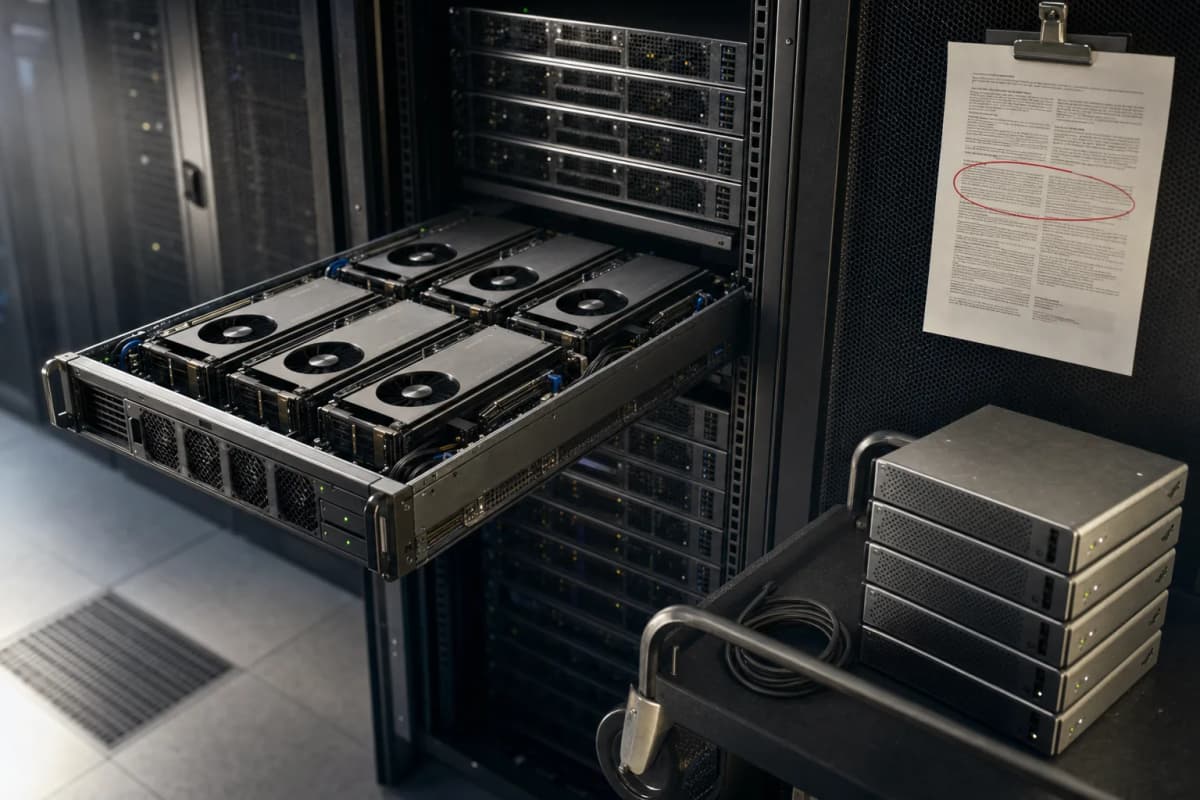
Plan on at least one eight-GPU B300 node for a pilot and several for production. The model card lists no GPU count, memory figure or throughput, so the planning numbers come from the parent model, which has the same parameter counts and weight format.
vLLM's K3 recipes set a minimum of 8x GB300 on NVIDIA or 8x MI355X/MI350X on AMD, and recommend multi-node for production traffic. Its opt-in B300 preset runs on one eight-GPU node at concurrency of 1 to 28, and its B200 preset needs two eight-GPU nodes. A DGX B300 has 2.1 TB of GPU memory and draws about 14 kW, which leaves roughly 540 GB after the weights for KV cache and overhead. SemiAnalysis's InferenceX page for K3 carries a recommendation of supernodes with 64 or more accelerators.
Check your serving version too. The same recipes list vLLM 0.29.0 or later, and October's vLLM advisories include code execution through a disguised image, fixed in 0.32.0. K3.1 Pro takes image input, so treat that path as in scope. The Transformers snippet on the repository page also sets trust_remote_code=True, which runs the repository's Python on your machines.
When Self-Hosting Beats the $2/$10 API
Self-hosting beats the API on cost only above roughly 13 billion input tokens a month for the smallest node, and that ignores staff. Moonshot's price list (rates checked October 24, 2026) charges $2.00 per million input tokens, $0.20 for cache hits and $10.00 for output, a third below K3. The table uses RunPod's Secure Cloud on-demand rates (updated October 28, 2026) of $8.99 per B300 GPU-hour and $7.99 per B200 GPU-hour over 730 hours, with a 5:1 input to output ratio.
| Setup | GPU cost per month | Break-even, no caching | Break-even, 90% cache hits |
|---|---|---|---|
| 8x B300 (pilot) | $52,502 | 13.1B in, 2.6B out | 22.1B in, 4.4B out |
| 16x B200 (two nodes) | $93,323 | 23.3B in, 4.7B out | 39.2B in, 7.8B out |
| 64x B300 (supernode scale) | $420,013 | 105B in, 21B out | 176.5B in, 35.3B out |
Those are our calculations from per-GPU rates. RunPod says B300 availability varies by datacenter and prices multi-node B300 clusters through sales, so the 64-GPU row is our extrapolation. The figures leave out storage, networking, on-call engineers and reserved-capacity discounts, and the cache column ignores any premium on 1-hour cache writes. At the first row's no-cache break-even, the node must sustain about 1,000 output tokens per second around the clock, so load-test that before you trust the row.
The stronger case for self-hosting is control. Weights you hold cannot be switched off by a vendor or an export order, and your prompts stay on your own hardware. Speed may also favor it: Artificial Analysis measures Moonshot's standard API at 32 tokens per second, 55th of 58, with 131 seconds to first answer token.
Before you buy GPUs for speed, price the Highspeed tier. Its token rates double, yet Artificial Analysis puts cost per index task at $4.42 against $3.68, about 20% more, for tasks that take 16 minutes rather than 37.
Those two Moonshot tiers are the only API options Artificial Analysis lists, and the Hugging Face card shows no inference provider deploying the model yet. Together AI's pricing page now lists K3.1 Pro as serverless at $2/$10, but its model page still carries a "Launching soon" banner (both checked November 4, 2026), so treat that third-party host as announced rather than live. If your policy rules out Moonshot's own endpoint, today's choice is self-hosting or waiting.
Where the Benchmarks Improved and Where They Fell
Independent testing confirms the agent coding jump and shows a decline in legal and tax work. Vals scored K3.1 Pro at 62.52% on its index, up from 52.96% for K3 and ahead of DeepSeek V4.1 Flash 1017 at 61.26%. Terminal-Bench 4.0 rose from 17.17% to 63.64%, within two points of Claude Opus 5.5 on the same page. That largely backs Moonshot's self-reported 65.7%.
The same page records the falls. Legal Research Bench dropped from 46.15% to 37.50%, and Tax Agent Bench from 33.37% to 24.87%, both beyond the margins Vals publishes. HLAB-Vals-1.1 slipped from 12.92% to 11.67%, which is inside those margins. The Vals Legal Index ranks it 25th of 33 and the Vals Finance Index 20th of 35. Moonshot's internal finance benchmarks show gains against K3, but those are its own tests and they measure different tasks.
You can be exposed without running the model yourself. Harvey launched its own model in August post-trained on Kimi K3, so a legal vendor moving its base from K3 to K3.1 could inherit a shift you never see in a release note. No public test shows that has happened to any vendor, so ask yours.
Treat the summary index with care. A launch-day report put the model 4th on the Artificial Analysis Intelligence Index at 55, while the current page, on index v5.0.1, shows 46 and 22nd of 62. Quote the version with the score. That page also records 113 million output tokens across the index against a 72.5 million median, so a per-token price comparison will flatter this model.
What Changed for Your Security Review
If your security team approved K3, K3.1 Pro needs a fresh review, because its exploit capability rose sharply on Moonshot's own test. Moonshot reports 81.0% on its internal xdev-bench-hard, against 33.3% for K3 and 90.5% for a checkpoint trained without its cyber data removals. It says K3.1 Pro remains behind proprietary frontier models that have been public for at least three months. Notebookcheck notes that none of these numbers has been independently verified, and that Audn AI has announced plans to strip the safeguards after release.
Origin is the other review item. No US law bars a private company from running Chinese-origin weights, and the October DHS order names DeepSeek, not Kimi. US bank supervisors, however, are asking whether banks use Chinese-developed technology, so a bank should have its answer written down before anyone downloads a shard.
What to Do Before You Download 1.56 TB
This Week:
- Send Sections 2, 3 and 4 of the licence to counsel with three questions: does any affiliate sell hosted model access, do we pass model outputs to clients, and does any product using it exceed $20 million in monthly revenue?
- Email license@moonshot.ai and ask for the current list of certified inference partners, since buying through one exempts you from both conditions.
- Run your legal, tax and finance evals on the $2/$10 API against K3 and your current model, recording pass rate and cost per finished task.
This Month:
- Pull your monthly token counts by workload and compare them with the table above. Below 13 billion input tokens at that 5:1 mix, the API is cheaper, and a decision to self-host rests on continuity or data control.
- If continuity is the reason, compare a smaller fallback first. Mistral Large 4 fits a DGX B200 at FP8 for $0.70/$2.10 on its API, though Mistral's self-reported 41% on Terminal-Bench 4.0 sits well under K3.1 Pro's score.
- Ask your legal AI vendor which base model it runs and whether it re-ran its evals after any base change.
Before Production:
- Mirror the checkpoint into your own registry with a hash, run vLLM 0.32.0 or later, and put agents on this model behind egress controls.
- Load-test one rented B300 node at your real concurrency before you sign for reserved capacity.
The Bottom Line
K3.1 Pro narrows the agent coding gap between open and closed models, and its licence leaves internal teams alone. Its limits are scale and fit: the model needs a 2.1 TB GPU node to start, and it lost ground on the legal and tax tasks where a regulated buyer would most want a private model.
Moonshot shipped K3 on July 16 and K3.1 Pro on October 23 with the same parameter counts, and scores moved in both directions. Hardware plans can carry across a release like that, but your evals have to run again each time. Run the legal and tax set on the API before anyone reserves a node.