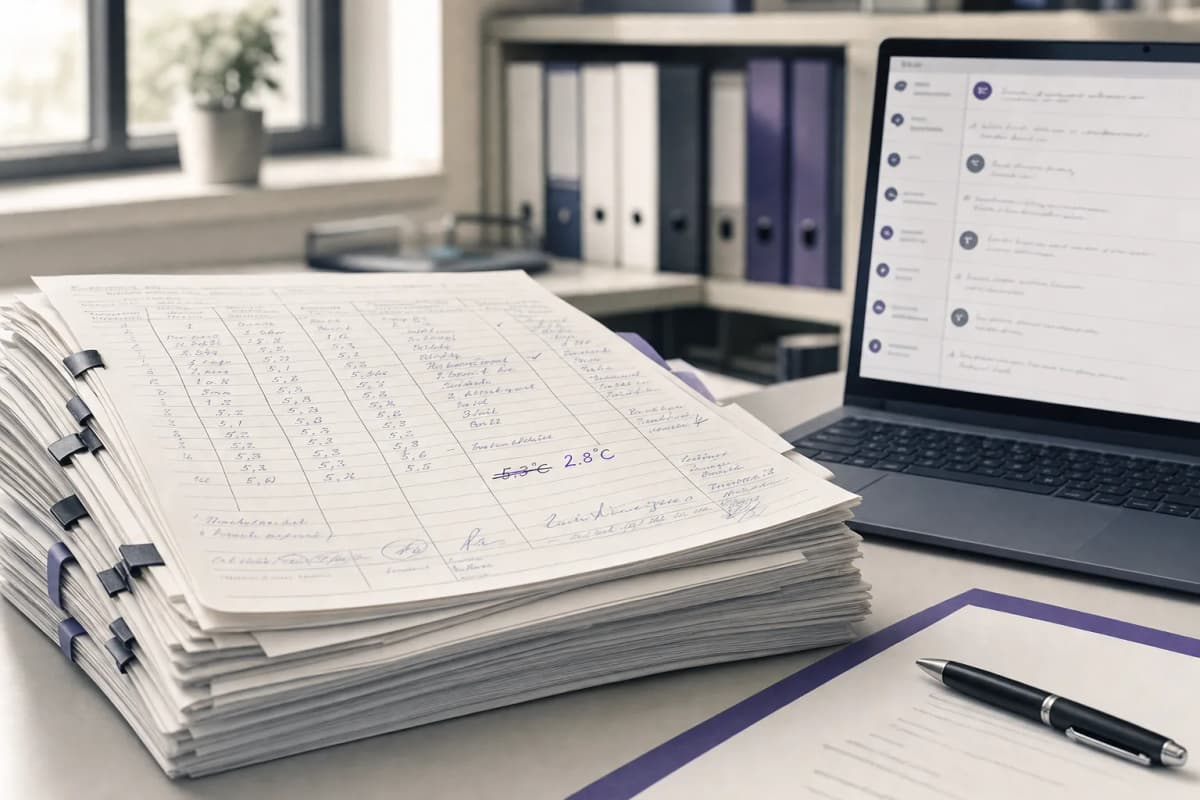
Enveda's Claude-based batch record reviewer caught all 11 issues human reviewers found across 1,061 pages, raised 7 more, and cut review time from 1,553 minutes to 166. If your quality unit spends days reviewing executed batch records before every release, Enveda has published what it believes is the first measured case for putting an LLM in front of that review. The part worth copying is the design that kept the tool outside GMP validation scope. The model only advises, it cannot write to the system of record, and every call is logged. The study itself is small: four records from one campaign, scored by one adjudicator.
Enveda released the technical report on its CMC Document Processor (CDP) on October 27, 2026, the same day Anthropic published a roundup of six drug-developer deployments. Anthropic's post says Enveda's manufacturing chemists had spent up to 75% of their time on paperwork. The report is more useful than the roundup because it gives the evaluation design, the timings, the per-page cost and a list of its own limitations. Most vendor case studies leave those out.
What Enveda's Batch Record Study Actually Measured
CDP matched every actionable issue the human reviewers raised and missed none, though the sample was four batch records. An executed batch record (EBR) is the filled-in, signed copy of a master batch record, the evidence that each manufacturing step ran as written. Under 21 CFR 211.192, production and control records "shall be reviewed and approved by the quality control unit" before a batch is released, and unexplained discrepancies must be investigated. That review is the work CDP pre-screens.
The design, per Enveda's report:
- Four EBRs from one Phase 2 GMP clinical campaign, 1,061 scanned pages, mostly handwritten.
- Two internal CMC and Quality pairs each reviewed two records. Two external consultants reviewed all four jointly.
- One Quality adjudicator, who had reviewed none of the records, scored every comment. A second person confirmed each actionable or not-actionable label.
- The main run used Claude Opus 4.7. A second run used Claude Opus 5.5.
The humans raised 11 distinct actionable issues. CDP raised all 11 in at least one run: 9 as direct matches and 2 that needed explanation (cross-record weight reconciliations and reactor-temperature excursions). It also raised 7 relevant issues no human flagged, all verified accurate and graded 2 Minor and 5 Informational. Two of them were first posted as Major and then lowered. Examples include a wet-cake rinse soak that ran about 8 minutes past its printed window, an in-process control marked Fail with no result entered, and a printed temperature set point struck through and rewritten 10 °C lower with no documented confirmation. The Opus 5.5 run produced 6 additions, 4 of them new compared with earlier runs.
Noise was about the same on both sides. Of the humans' 96 distinct comments, 79 (82%) needed no action. Of CDP's 42, 33 (79%) needed none. The report's abstract calls CDP "more precise on non-actionable comments," but those figures show a slightly lower no-action share for CDP, and the report does not reconcile the two. CDP did produce fewer than half as many comments, so a reviewer had far less to read.
Time is the headline. The internal pairs took 1,553 minutes (25.9 hours), or 1.46 minutes a page. The CDP arm, meaning CDP processing plus a reviewer checking its comments, took 166 minutes, which Enveda calls 9.4-fold less. Anthropic's summary describes the same result as an 89% cut, from over 25 hours to under 3. The external consultants reported 1,380 minutes, though Enveda saw no time log for that figure.
Why the Design Keeps CDP Outside GMP Validation Scope
CDP is built as a non-critical advisory tool, which is the only lane the draft EU GMP Annex 22 leaves open for an LLM. The draft Annex 22 covers static, deterministic models in critical applications. It says plainly that it "does not apply to Generative AI and Large Language Models (LLM), and such models should not be used in critical GMP applications." In non-critical uses, qualified personnel must be responsible for the outputs, a human-in-the-loop (HITL) arrangement. The Commission's consultation on the draft, alongside revised Chapter 4 and Annex 11, ran from 7 July to 7 October 2025.
Enveda's report states that CDP is "not validated as a GMP computerized system." The controls that make that position defensible are concrete:
- The model has no tools, credentials or write path. The records live in a validated cloud content-management platform (ECM). An orchestration layer writes only comments and metadata, and renaming and moving files are disabled. CDP never modifies a source record.
- People decide. CDP returns one of four advisory outcomes (Recommend Release, Needs Investigation, Recommend Reject, Insufficient Data), and fixed rules in code can only make an outcome more cautious. Named people decide every comment and take every consequential action.
- Coverage is checked in code. Pages go to the model in windows of at most 40 consecutive pages at full resolution, and a code-based ledger flags any page that was not read.
- Every AI call (model, instructions, response, tokens) goes to an append-only log in the ECM, and configuration changes sit in version history.
- Changes are tested in a sandbox or capture-only mode and need quality sign-off. The codebase carries about 3,000 automated tests.
The last control is the one teams skip. Enveda ran the study on Opus 4.7 and again on Opus 5.5, and the second run surfaced different additions. A model upgrade changes what your reviewer finds, so it belongs under change control even when the tool is advisory. Lab instruments raise the same issue, covered in Anthropic's MHS change-control piece.
The HITL lane has its own cost. Section 3.3 of the draft says that where a model feeds a human decision and testing effort has been reduced, "the training and consistent performance of the operator should be monitored like any other manual process." If your reviewers start rubber-stamping CDP-style output, your inspector will ask how you know they aren't. For the broader validation question, see our GxP AI validation buyer's guide.
What the Study Does Not Prove Yet
The results are descriptive, and Enveda says so itself: it calls the analysis "exploratory." The report's own limitations list is the first thing a validation lead should read.
- Four records from one campaign, scored by one adjudicator. A different product, site or handwriting style could change the miss rate.
- One misread per run, posted at Major. In the example given, CDP misread a struck-through handwritten IPC correction, which produced the only "Needs Investigation" outcome in that pass. A misread that escalates fails safe, and it still costs a reviewer's time.
- Each window's output is not yet checked against the output schema, so an unreadable answer would go unflagged. None occurred in the study.
- Earlier-step lot records were not given to CDP, so weight reconciliations across records could not be traced.
- A fallback model answers if the primary refuses. It stayed on during development, Enveda says it will be switched off for validation, and the report does not name it.
- Prompt revisions cut findings by 54%, 76% and 79% on a 12-record test set, and the report notes those cuts "do not by themselves show that real findings were kept."
- The Opus 5.5 run's review time was not recorded.
The authors are Enveda employees and CDP is "not a commercial product." The larger campaign numbers (about 2,800 pages across 12 EBRs, roughly 2 hours with CDP against about 30 hours projected manually) come from reviewer reports and were not timed under study conditions, so use them only as a rough indication.
The conclusion that does hold up is the authors' own: CDP "added to a human review and did not replace one." If you need a way to score a reviewer like this against your own adjudicated labels, our piece on LLM-as-a-judge calibration covers the agreement statistics.
What It Costs and Where the Data Goes
At list prices the model cost is trivial: US$36.97 for 1,061 pages, about $0.035 a page, before development, hosting and human time. Enveda projects a 500-page pair at under $20 and about 1.3 hours, against about 12 hours by hand. The main run used Claude Opus 4.7, which lists at $5 per million input tokens and $25 per million output. Opus 5.5 lists at $4 and $20, per Anthropic's pricing page (checked October 28, 2026). Engineering, the ECM integration and quality sign-off will cost far more than the tokens.
The data question needs more of your attention. Enveda states that it does "not have a zero-data-retention agreement," so documents are processed under the provider's standard terms. Each request carries only the document, its reference documents and instructions, and uploaded copies are deleted after each review. Under Anthropic's commercial retention policy, API inputs and outputs are deleted "within 30 days of receipt or generation," with longer retention for flagged Usage Policy violations and for services such as the Files API. Anthropic's API data-retention documentation says zero data retention (ZDR) is requested through sales and enabled per organization. The same page notes that the Fable 5.x and Mythos 5.x Covered Models require 30-day retention, so ZDR is not available on them unless Anthropic expressly authorizes it.
Executed batch records hold process parameters, yields and deviation history, which is exactly what a CMC team treats as trade secret. Decide what retention your quality and legal teams will accept before the pilot, and get it in the contract. Our Covered Models and ZDR piece and the six AI vendor security review questions cover what to ask.
How to Run This Pilot in Your Quality Unit
Start with records you have already released, so the model's output cannot touch a live disposition.
This Week:
- Pull four to eight executed batch records that have already been released, with their master batch records, specifications and cited deviations, plus the final review comments. Those comments are your answer key.
- Get your head of Quality and validation lead to agree in writing that the pilot is a non-critical, advisory use under the HITL lane of draft Annex 22, and what would move it out of that lane.
- Ask procurement which retention terms your model provider contract carries today, and whether ZDR is in place for the organization the pilot will run under.
This Month:
- Build the read-only path first: model with no tools or credentials, an orchestration layer that writes comments only, an append-only call log, and a page ledger that proves every page was read.
- Name one adjudicator who did not review the records, plus a second confirmer, and score every comment from both arms as actionable or not, the way Enveda did.
- Spread the sample across at least two products or campaigns. Enveda's biggest gap is that all four records came from one.
Before Any Live Batch:
- Switch off any fallback model and pin the model version. Route every model or prompt change through change control with quality sign-off.
- Write down how you will monitor reviewer performance on CDP-style output, per section 3.3 of the draft annex, and what a misread posted at Major costs your release timeline.
- Add the earlier-step lot records to the input set if you want weight reconciliations checked across records.
The Bottom Line
Enveda has shown that an LLM can pre-screen handwritten batch records at a few cents a page without entering GMP validation scope, and it has published the gaps alongside the result. The design keeps the disposition decision with a named person and logs everything the model sees and says. The other deployments in Anthropic's roundup, and OpenAI's Orchestra Bio acquisition, are aimed at discovery and development operations. Batch release is where a quality unit can measure the result against its own records within a quarter.
Pull your last four released batch records and their final review comments this week, and score the model against them.
Continue Reading
- GxP AI Buyers Must Validate Models for Their Own Context
- 4 Instruments, 8 Hours. The Weeks Were Your Change Control.
- OpenAI Buys Orchestra Bio to Bring Agents Into Drug Development
- Fable 5 Needs Retention On. ZDR Was Never Zero.
- 3 AI Giants, $3.25B Market, Zero FDA Approvals
- AI Vendor Security Review: 6 Questions That Change the Answer
