If you are weighing a humanoid robot pilot for 2027, the useful part of GXO's expansion with Agility Robotics is its contract, because GXO's CEO said in August that humanoids have not paid back yet. GXO will put Agility's Digit robots into two more e-commerce warehouses starting in early 2027, on the robots-as-a-service model it has used since 2024. Neither company has disclosed how many robots, what GXO pays, or when the deployment is expected to break even. Treat this as a well-structured option on a technology that is still unproven, and borrow the structure.
The announcement landed on October 26, 2026, while Agility expects to become a public company before the end of the year. That timing matters to anyone negotiating with Agility or its competitors, and it is covered below.
What GXO and Agility Announced
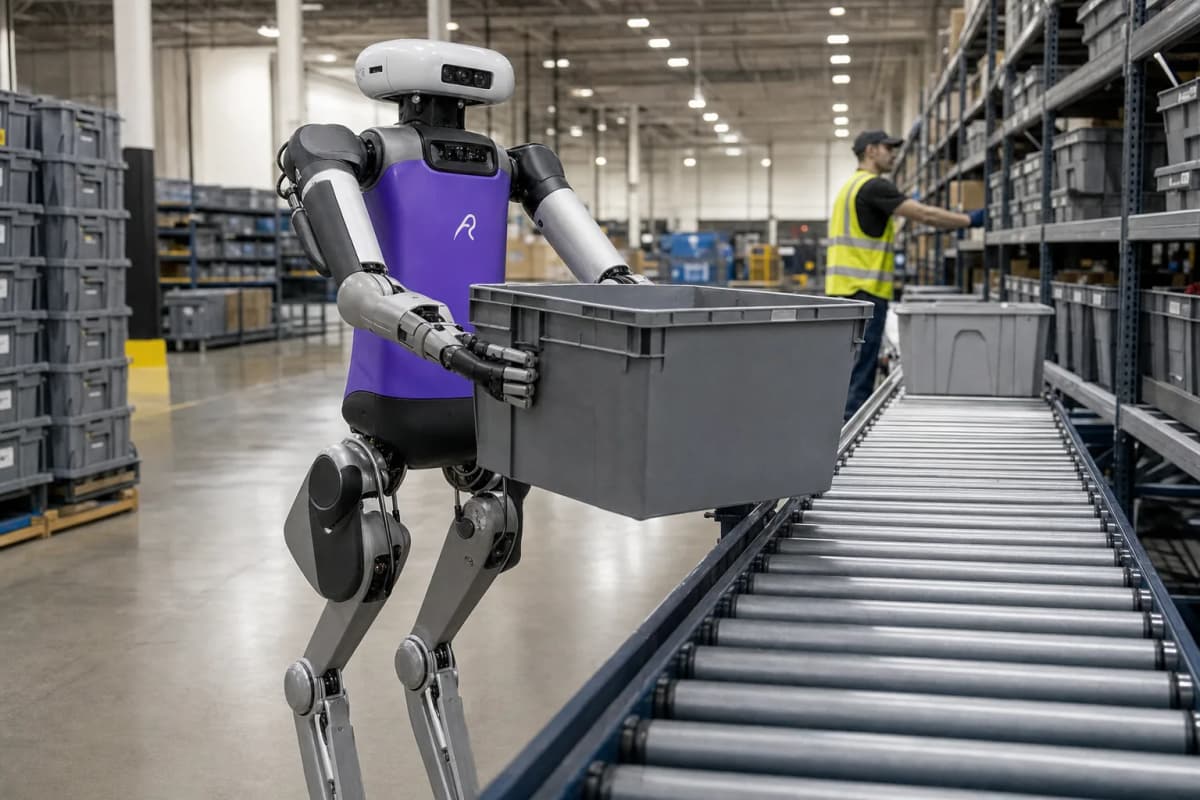
GXO is extending Digit from one Georgia site to warehouses in Statesville, North Carolina, and Lebanon, Tennessee. Per Agility's release, the robots will handle "highly repetitive" material movement for e-commerce fulfillment, starting in early 2027 on Digit 4 and moving to Digit 5 once that model is commercially available.
The history is short and specific. GXO began a proof of concept at its Flowery Branch, Georgia site in late 2023 and signed a multi-year robots-as-a-service (RaaS) agreement in June 2024, which Agility's release calls the industry's first formal commercial deployment of humanoid robots in live operations. At Flowery Branch, Digit works next to existing automation and moves totes onto conveyors. The release says it has moved more than 100,000 totes there, and that Digit has logged more than 65,000 hours of operation. That hours figure covers all of Agility's commercial operations and customer programs, not GXO alone.
Robots-as-a-service means the customer pays a recurring fee per robot, usually monthly, and the vendor keeps ownership, maintenance and software updates.
What the release leaves out is as important as what it says. The AI Insider's write-up notes there is no robot count for either new site, no contract value and no RaaS fee. The Robot Report confirms GXO did not say how much it is investing. (One caution if you read that piece: its body puts Statesville in Tennessee and Lebanon in Indiana. Agility's release says North Carolina and Tennessee.)
What 45 Pilots Have Not Proven
GXO has run dozens of humanoid pilots, and its CEO says the return is still two years out. On the August 5, 2026 Q2 earnings call, Patrick Kelleher said "We have done 45 pilots on humanoids so far" and "We have not achieved ROI on humanoids yet. I think we are a couple of years away from that," per FreightWaves.
Those pilots are not all Agility. GXO signed its second humanoid RaaS agreement with Reflex Robotics in September 2024 for tote transfers between automation systems and product picking, and The Robot Report lists Apptronik's Apollo among the other robots GXO has tested, with another pilot due to start in Europe.
The expansion therefore says nothing yet about whether the economics work. Twelve weeks after saying ROI was a couple of years away, GXO chose to put one vendor's robot into two more buildings anyway. In the release, Kelleher frames the move as reflecting confidence in the technology's measurable value. Neither he nor Agility has published that value.
The task is also narrow. Picking up a tote and placing it on a conveyor is the job Digit has done at Flowery Branch since 2023. It is real work, and it is also the kind of fixed, repetitive move that conveyors, autonomous mobile robots and fixed arms already handle in many buildings. A humanoid earns its premium when it can do that job in a building designed for people, without re-laying the floor, and then be moved to a different job. Nothing published yet shows the second part.
What the Robot Is Supposed to Cost
Agility's own investor material puts a number on the pitch, and you should read it as a vendor's projection. The investor day presentation filed with the SEC, dated October 6, 2026, gives an illustrative RaaS price of about $8,500 a month, roughly $100,000 a year per robot, against about $200,000 a year in fully burdened labor it says the robot replaces. Over five years it puts RaaS at about $500,000 against $1.1 million of equivalent labor, and puts outright ownership at about $400,000 lifetime with a payback near 1.1 years.
Every one of those figures is Agility's estimate. The $200,000 labor number implies a robot covering more than one shift, which depends on uptime and charging that Digit 4 deployments have not publicly demonstrated. The same deck shows two example deployments, one with three robots at 98% accuracy and more than 100,000 totes, and one with eight robots and about 60,000 totes. It does not name the customers. If the first is Flowery Branch (the tote count matches, but the deck does not say so), then GXO's flagship site has been running a three-robot fleet.
The detail most worth copying is in the same deck. Agility's $300 million-plus of committed Digit 5 orders, as of May 2026, covers 1,000 robots under a three-year RaaS contract, with warrants issued to the buyer that vest in proportion to robots deployed. That works out to about $100,000 per robot per year, consistent with the illustrative price. The buyer's upside grows only as robots actually show up and work. Agility's October 26 SEC filing adds that the order figure is "subject to contractual milestones" and is not current revenue.
Why a 3PL Signs Before the Payback Is Proven
The strongest case for GXO's decision is that RaaS lets it buy experience cheaply while someone else carries the hardware risk. A contract logistics firm sells operating capability to its clients. Being the operator with three live humanoid sites, two years of tote data and a trained maintenance crew is worth something in a bid, whether or not each robot pays for itself in 2027. GXO runs more than 1,000 facilities, so a few sites are a small, reversible bet.
RaaS also moves the obsolescence problem onto the vendor. GXO's new sites start on Digit 4 and switch to Digit 5, which the filing says reaches early access in the first half of 2027 and general availability by the end of 2027. An owner would be stuck with Digit 4 units. A renter can expect the swap to be the vendor's cost, if the contract says so.
That logic holds for a 3PL with 45 pilots behind it. It holds less well for a single-site manufacturer or retailer whose board will ask for the payback date. If that is you, the GXO story supports a structured pilot with a stop date, and Agility's deck should stay out of the business case.
The Risks You Inherit From a Vendor Going Public
Agility's ownership and incentives are changing in the same quarter you would sign. The company agreed in June to merge with Churchill Capital Corp XI at a $2.5 billion pre-money equity value, with more than $620 million in gross proceeds, of which $420 million comes from the SPAC trust assuming no shareholders redeem and about $200 million from a PIPE led by Foxconn. The filing says the deal is expected to close in Q4 2026, trading on Nasdaq as AGLT.
Warehouse robotics has been through this cycle before. Berkshire Grey listed through a SPAC in 2021 and in March 2023 agreed to be taken private by SoftBank for $1.40 a share, about $375 million, against a $2.2 billion de-SPAC valuation. Its customers kept a vendor, but under an owner with different priorities. The October filing's own risk language lists an emerging technology, a history of net losses and redemption risk on the deal.
Agility may well avoid that path. Your contract should still assume the company you sign with in November may be priced, managed and pressured differently by mid-2027. We made a similar point about Yellow.ai's SPAC and what it meant for its customers.
The hardware transition carries its own risk. A Digit 4 deployment in early 2027 that migrates to a model not generally available until late 2027 means your site may run on a robot the vendor is actively replacing, during the months its engineering attention is on the new one.
How to Structure a Humanoid RaaS Pilot
Copy three things from the GXO and Agility arrangements: a narrow task, a rental model, and buyer upside tied to robots actually deployed. Then write down the metrics you will judge it on before the first robot arrives, because neither company has published theirs.
This Week:
- Pick one task and measure the human baseline. Totes moved per hour, error rate and labor cost per tote for the exact move you would hand to a robot. Without it, a vendor's "100,000 totes" has nothing to compare against.
- Ask any humanoid vendor in your pipeline for its fee per robot per month, its uptime guarantee and the charging time per shift, in writing. Agility's own illustrative figure is about $8,500 a month; use it as the opening reference.
This Month:
- Draft the hardware-generation clause. If the pilot starts on one model and the vendor plans another, the contract should say who pays for the swap, how long the old model stays supported, and that your fee does not rise on migration.
- Add change-of-control and continuity language: a right to terminate or renegotiate if the vendor is acquired or delisted, escrow or a transition plan for the fleet software (Agility runs its fleets on its Arc cloud platform), and data export for every operating log.
- Ask for milestone-linked economics. Agility gave the buyer behind its 1,000-robot order warrants that vest as robots deploy. A smaller buyer can ask for fee credits or price steps tied to throughput or uptime thresholds.
Before You Sign:
- Set the exit metric in advance: the cost per tote at which you expand, the cost at which you stop, and the date you will decide. GXO's CEO has said publicly that he expects its payback a couple of years out; your board should see your own date before the robots arrive.
- Run the comparison against fixed automation for the same task. If a conveyor extension or a mobile robot handles the move at a lower cost per tote, the humanoid needs a second job to justify it.
For a sense of how differently vendors and buyers report humanoid returns, compare this with the BMW humanoid payback claim we examined in April, and with the research side covered in our look at Physical Intelligence's pi0.7 robotics model.
The Bottom Line
Humanoid robots in warehouses look a lot like enterprise AI agents did two years ago: plenty of pilots, a few named production sites, and no published return. The lesson from software carries over. The companies that got value out of AI pilot programs were the ones that defined the task, the baseline and the stop rule before they started, and that kept the vendor's risk on the vendor. Planning software went through a similar shift, as Blue Yonder's move to owned models for supply chain agents showed.
GXO has 45 pilots, three named sites and a CEO on record saying the money is a couple of years away. Ask your vendor for the fee, the uptime and the migration terms in writing before you agree to a start date.
Continue Reading
- BMW Robots Build 30,000 Cars: 18-Month Payback, Then $90K Profit/Year
- Physical Intelligence pi0.7: A GPT-3 Moment for Robots?
- ABB and NVIDIA Close the Sim-to-Real Gap: 80% Faster Robot Deployment
- Yellow.ai Is Going Public to Buy Your Outsourcer
- Blue Yonder Picks 30B Nemotron Over GPT-5 in Supply Chain