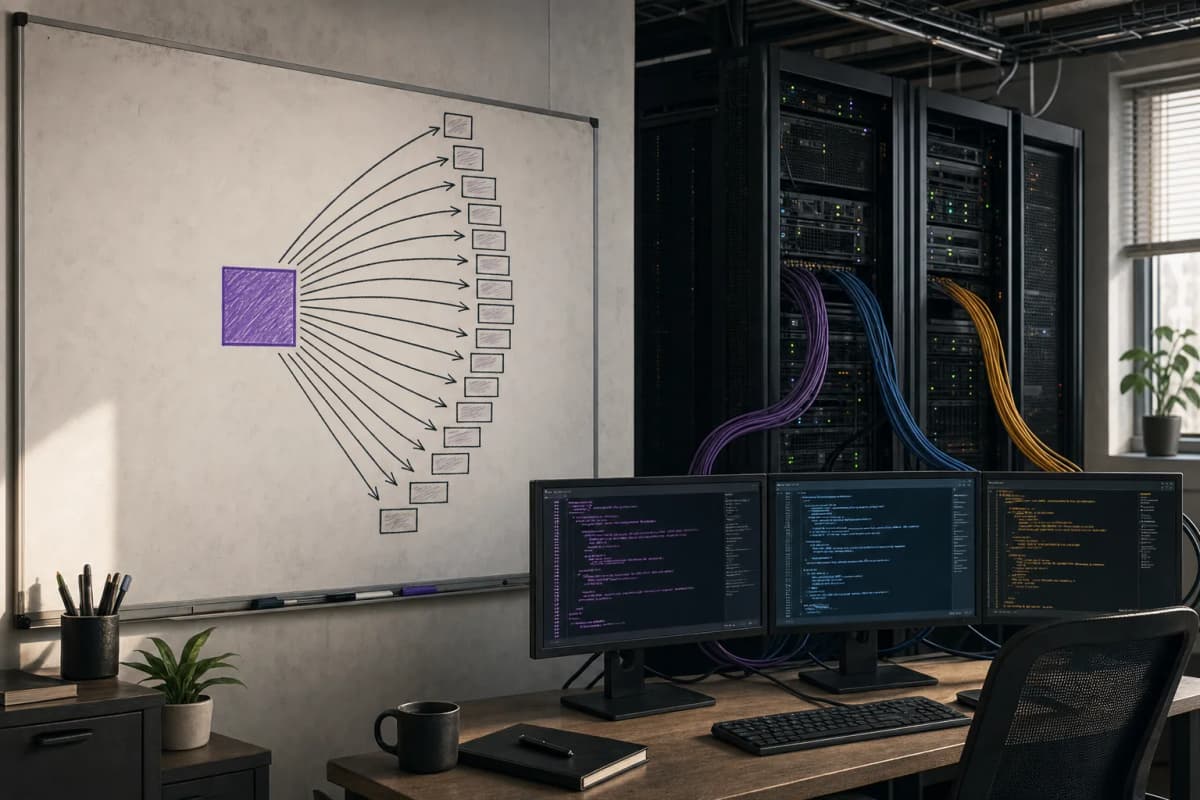
If your internal agent works in the demo and falls apart in production, Meta's data team says the fix is architecture: take routing away from the model entirely. In an October 19 engineering post, Meta described replacing one knowledge-loaded agent with a roughly 1,300-line deterministic orchestrator that sends 20+ workflows to 14 isolated subagents. Configuration prep for a new data column went from 3-4 days by hand to under an hour, and about two-thirds of the system's changes now land without significant human edits.
The useful part for you is the boundary Meta drew. The orchestrator makes no model calls to decide what happens next. The model reasons only inside a narrow subagent, with only the knowledge that step needs.
What Meta Was Trying to Automate
The job was onboarding new data columns across Meta's recommendation systems, and it is the kind of work most enterprises have plenty of: a change that has to land consistently in several places at once. According to Meta's write-up, one column touches three code repositories, three programming languages and up to six pipeline stages that must stay in sync. Python configurations drive C++ code generation, which feeds data processing services, which populate analytics systems.
Before any agent, the team had already cut the manual 3-4 days to about one day with a config-driven system. The agent work started from that baseline. That detail matters when you read the headline number: the agent took a process that was already partly automated and shortened it from a day to under an hour.
Why the Single Agent Failed
The first version was one agent carrying everything: configuration schemas, code generation rules, pipeline routing, validation requirements and population patterns for 10+ data sources. Meta says it worked in demos and "started hallucinating" in production.
Two failure modes showed up, per the post. Past a certain amount of context, adding knowledge made performance worse. And the agent cross-contaminated concepts, applying one subsystem's naming conventions to another or using a code generation pattern meant for a different data source.
The team also tried keeping a single agent and hand-writing a system prompt for each task. That reached 70-80% success. Without the per-task prompt, success fell to 10-20%. A 70-80% agent that needs an engineer to write a custom prompt every time has moved the work around without removing it, and Meta's authors concluded the problem was architectural.
Outside research points the same way. Chroma's context rot study tested 18 models and found that "performance grows increasingly unreliable as input length grows," even on simple tasks. A Mount Sinai study that Meta cites found a single agent's accuracy fell from 73.1% to 16.6% as clinical task batches grew from 5 to 80, while an orchestrated multi-agent setup held 65.3% at 80 tasks and used up to 65-fold fewer tokens.
How the Thin Orchestrator Works
A thin orchestrator is a router written as ordinary code: it decides which specialist runs, in what order, with what inputs, and it does none of the domain work itself. Meta's version follows the same seven steps on every request:
- Read the relevant subagent's instruction file.
- Check whether the target already exists.
- Gather required fields from the user.
- Auto-discover what can be inferred.
- Run a reliability gate for active warnings or required reviewers.
- Delegate to the subagent with full context.
- Handle results, surface errors and confirm success.
Only step 6 involves model reasoning, and it runs inside an isolated subagent. Everything else is deterministic code that behaves the same way every time.
The 14 subagents all have the same shape. A schema agent owns configuration registries, a population agent handles code generation for 10 data sources, and a validation agent runs builds and quality checks. Each one has the same sections: knowledge sources, a pre-gathering checklist, a step-by-step workflow, discovery patterns and troubleshooting.
Workflow templates decide the order, and Meta describes them as deterministic state machines. Column onboarding runs Schema, Validation, Population, Testing. Event onboarding and pipeline migration reuse the same agents in a different sequence, and Meta added pipeline migration as a new use case by writing a template, with no new agent code.
Knowledge sits outside both. More than 25 knowledge files, each typically a few thousand tokens and organised by workflow domain, are pulled in only when a subagent runs, so an edit takes effect in the next session without touching the orchestrator.
The isolation is the same mechanism the commercial tools now ship. Claude Code's documentation says "each subagent runs in its own context window with a custom system prompt, specific tool access, and independent permissions," and the OpenAI Agents SDK describes handoffs as letting one agent "delegate tasks to another agent." What Meta added is the rule that the thing doing the delegating is not a model.
Who Disagrees, and Why Meta's Design Survives It
The strongest case against Meta's approach is that multi-agent systems mostly win because they spend more compute. Dat Tran and Douwe Kiela's April 2026 paper found that single agents "consistently match or outperform" multi-agent systems on multi-hop reasoning when reasoning tokens are held constant, and that many reported multi-agent gains come from "unaccounted computation and context effects." Anthropic's own multi-agent research system used about 15 times the tokens of a chat, and token usage alone explained 80% of performance variance on BrowseComp.
Cognition's Walden Yan made the reliability argument in June 2025: parallel subagents each make decisions the others cannot see, and "conflicting decisions carry bad results."
Both critiques land hardest on a different design from the one Meta built. Meta's subagents do not collaborate or debate. They run in a fixed order set by a template, each owns one bounded step, and code passes results between them. There are no parallel agents making conflicting choices about the same artifact. Meta also reports the opposite token pattern: each subagent loads a few thousand tokens of relevant knowledge instead of the whole corpus. Meta did not publish its token spend, so you cannot check that claim against the Anthropic figure.
This is the split Anthropic's agent guidance drew in December 2024, between workflows ("LLMs and tools are orchestrated through predefined code paths") and agents ("LLMs dynamically direct their own processes"). Meta's system is a workflow at the top and an agent only at the leaves.
What the Post Leaves Out
Meta gives two outcome numbers and says nothing else quantitative. You do not learn which model the subagents use, what a run costs, how long it took to write the 14 instruction files and 25+ knowledge files, or what goes wrong in the third of changes that need significant human edits.
That last gap is the one to care about if you are copying the design. A step-5 reliability gate that checks for active warnings and required reviewers tells you Meta still expects humans in the loop. The team says its next step is automated feedback loops that spot failure patterns and propose knowledge-file updates, with human review gating every change. Until then, the knowledge files are hand-maintained, and someone has to own them.
What to Do Before You Scope Your Next Agent
Meta's result gives you a test for any agent proposal on your desk: can you write the routing as code? If the steps and their order are known, the model should not be choosing them.
This Week:
- Pull the system prompt of your largest internal agent and list every distinct domain it covers. If one prompt carries schemas, routing rules and validation for several subsystems, you have Meta's first design, and cross-contamination is the failure to look for in your logs.
- Ask the owning team the question Meta answered with numbers: what is the success rate with a hand-tuned prompt per task, and without one? A gap like 70-80% versus 10-20% means the prompt engineer is doing the routing.
This Month:
- Pick one multi-step workflow and write it as a template: the steps, their order and the inputs each needs. Mark each step deterministic or model-driven. Meta's version had seven steps and one model call.
- Split the knowledge into per-step files loaded at runtime, and name an owner for each file. Treat those files as code with review, because an edit changes agent behaviour in the next session.
- Add a pre-delegation gate that checks for open warnings and required reviewers before any model step runs.
Before Your Next Agent Platform Renewal:
- Check whether the platform lets you write the router in your own code and call agents as isolated steps. Frameworks such as LangGraph, CrewAI and the OpenAI Agents API support it; a platform where only the model can route forces Meta's first design on you.
- Require the vendor to report success rate per workflow step, not one end-to-end number. Meta's two-thirds figure is only useful because you can see which component produced it.
For the platform question, our agent orchestration selection framework scores exit costs, and the LangGraph vs CrewAI vs AutoGen comparison covers which frameworks are still maintained. If you put a model in the supervisor seat anyway, read the MasDrift results on supervisor agents rewriting tasks first.
The Bottom Line
Meta's design looks a lot like the integration architecture enterprises already run: small services with clear contracts behind a router that holds no business logic. Its agents follow that pattern: deterministic orchestration, narrow specialists, knowledge kept outside the code that routes. It also fits what IBM found when it wired six agents together and then struggled to upgrade them, and what harness design does to coding-agent rankings: the structure around the model moves results as much as the model.
The cheapest version of this is a whiteboard session. Draw your agent's workflow, circle the steps a model must decide, and write the rest as code before anyone asks for a bigger context window.
Continue Reading
- Agent Orchestration Platforms: Score Exit, Not Features
- LangGraph vs CrewAI vs AutoGen: One of Them Is Retired
- Your Supervisor Rewrote the Task. The 'Do Not' Fell Off.
- IBM Wired 6 Agents With A2A. Then Couldn't Upgrade Them.
- Your Bake-Off Ranked Harnesses, Not Models. Re-Run It.
- Pick Your Agent Engine by Its Limits, Not Its Meter