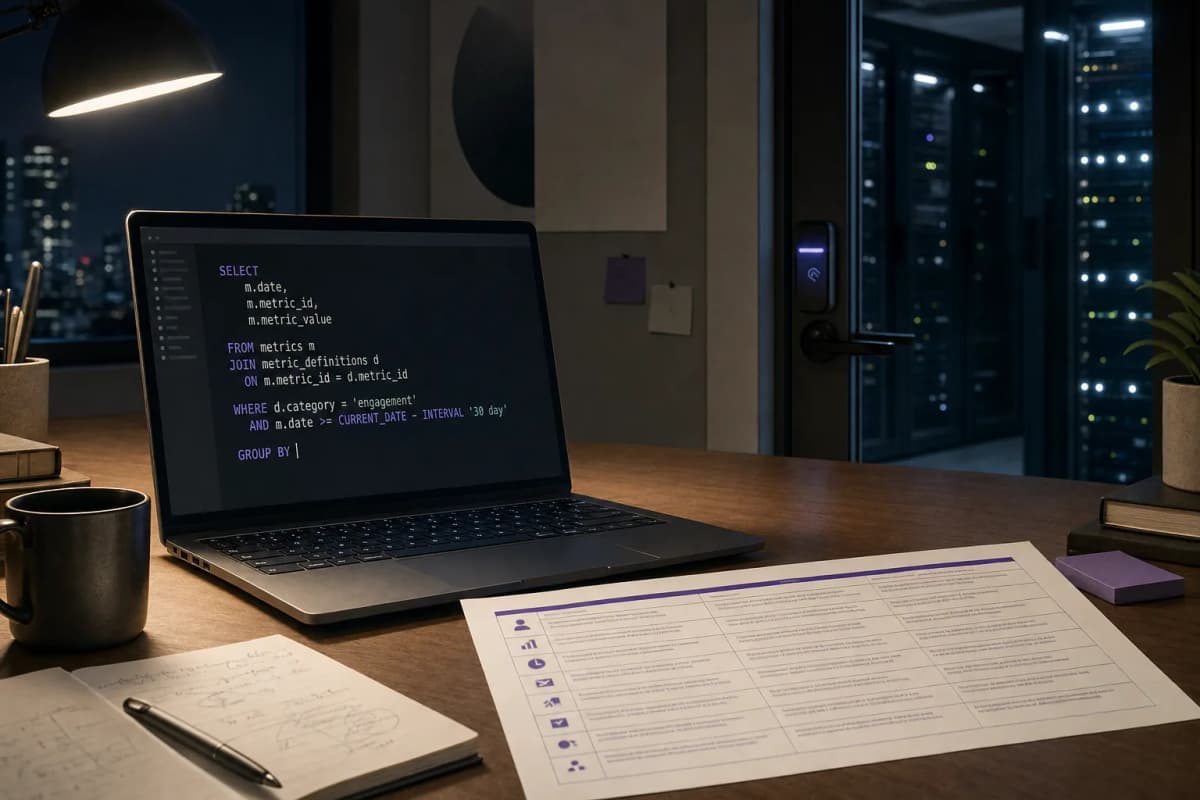
If your data team runs Sundial, plan to lose it: the product stops serving outside customers when Meta's acquisition closes. Nobody has published a closing date, a wind-down window or what happens to the warehouse access and metric definitions you gave it. Meta confirmed it is buying the AI analytics startup on October 23, 2026, and the Sundial team is going inside Meta to build analytics agents for Meta's own use, according to AI Chat Daily's account of the deal. Treat the time between now and close as your migration window, because it may be the only one you get.
The work this week is concrete. Pull out every metric definition, playbook and saved analysis you built in the tool, decide who revokes the service account it uses to read your warehouse, and get a written answer on what happens to your query history after close.
What Meta Bought, and Why Outside Customers Lose It
Meta bought Sundial for its people and its product, and it is pointing both inward. A Meta spokesperson confirmed the deal to Axios, which broke it on October 23, per ExplainX's summary; price and terms were not disclosed, per AI Chat Daily. Co-founders Julie Zhuo, Meta's former VP of product design, and Chandra Narayanan, Facebook's former director of analytics, are rejoining Meta with other Sundial staff.
The team lands in a new analytics organization run by Alex Schultz, whom Meta named its first chief data officer on July 1, 2026, TokenPost reports. Narayanan will lead Meta's data analytics tooling and agents work. Schultz's stated reason: "AI has created effectively unlimited demand for insights, and we want to define the future of AI analytics."
The customer consequence is short. Digital Today reports that Sundial "will stop serving external customers once the acquisition is completed," and gives no transition support or timing. Crypto Briefing adds that Sundial will not continue as a standalone product line and frames the deal as being about Meta's internal decision-making rather than a new external offering.
One detail suggests the two sides already knew each other well. Sundial's July 2025 funding release lists Alex Schultz among the company's individual investors, alongside firms including Sequoia Capital, so the executive whose organization now absorbs the product was an early backer.
Who Was Running Sundial in Production
Sundial sold to companies that wanted business users to query the warehouse without filing a ticket with the data team. The product combined dashboards, notebooks and data pipelines, and used AI for data cleaning, building semantic layers and writing SQL, per AI Chat Daily. It raised $23 million in total, including a $16 million Series A led by DJ Patil of GPV.
The only customer named on the record is OpenAI. In the funding release, David Sasaki, OpenAI's VP of Analytics and Insights, said Sundial "automated complex data engineering tasks that would have taken our small team months to build internally." The same release refers only to "Fortune 500 companies and fast-growing AI start-ups" without naming them. ExplainX's summary of the reporting also lists Gamma as a reported past client and says neither OpenAI nor Gamma has commented on whether they will stay through close.
That OpenAI example is the useful one for you. A tool that took raw logging to "comprehensive data visibility" sits on top of event tables, transformation logic and a definition of every metric the business argues about. Those definitions took your analysts the longest to agree on, and they are the hardest thing to rebuild in a new tool.
What You Stand to Lose at Close
When an analytics agent leaves, the chat window is the least of it. You also lose the semantic context (the metric definitions, joins and business rules the agent used to turn a question into correct SQL), and you are left with an access path into your warehouse that outlives the product unless someone closes it.
The semantic context is the expensive part. Sundial joined the Snowflake-led Open Semantic Interchange in April 2026, and co-founder Chandra Narayanan said the point was to "build critical data context for our customers in a way that is inter-operable," per the announcement. The Open Semantic Interchange is a Snowflake-led open source effort to write one vendor-neutral specification for semantic metadata; Snowflake launched it in September 2025 with partners including dbt Labs, Hex, Salesforce, Sigma and ThoughtSpot. Joining the group commits Sundial to a standard; nothing we found shows Sundial shipped an export in that format, so assume you will be copying definitions out by hand unless Sundial tells you otherwise in writing.
The access path is the part teams forget. A warehouse-native analytics agent usually reads through a service account or OAuth grant with broad SELECT rights, and it keeps query logs, cached results and uploaded playbooks on the vendor side. When the vendor's owner stops serving you, that grant does not expire on its own.
How Earlier Acqui-Hire Shutdowns Played Out
The recent pattern gives you weeks to a few months, set by the acquirer. When Klaviyo bought Agency, the product was wound down by August 31. Cloudflare gave Deno Deploy customers six months after its deal. Prime Intellect's purchase of Moondream came with a hard cloud shutdown date of November 13, and Fetcher customers faced a shutdown on October 16 after Juicebox bought its assets.
Sundial's case is closer to the last two than the first. The product is being absorbed into an internal Meta team rather than sold to Meta's customers, so the acquirer has little commercial reason to run a long transition for outside accounts. The strongest counterargument is that Meta has every reason to avoid a messy exit for a customer like OpenAI, and may negotiate a longer runway with large accounts. If you are not one of those accounts, do not plan around that.
Which Warehouse-Native Agents Can Replace It
Your shortlist starts with whatever already runs inside your warehouse, because the semantic layer and the permissions are already there. These three cover most stacks, and the Snowflake vs Genie vs ThoughtSpot comparison we ran in September goes deeper on accuracy and row-level security.
| Option | Where the metric logic lives | How it bills | Who should skip it |
|---|---|---|---|
| Snowflake Cortex Analyst | Semantic views; legacy YAML semantic models still supported | Per processed message, plus warehouse compute for generated SQL | Teams whose data is not mostly in Snowflake |
| Databricks Genie | Genie Agents configured with datasets, sample queries and instructions, governed through Unity Catalog | Genie One and Genie Agents free for users through January 31, 2027; service principals billed | Teams without Unity Catalog in place |
| ThoughtSpot Spotter | ThoughtSpot's semantic layer, Snowflake semantic views or dbt semantic models | Per seat, per customer or per warehouse query | Teams that want the agent and the warehouse bill from one vendor |
The details come from each vendor's own page. Snowflake's Cortex Analyst documentation says only successful responses are counted toward the message charge and that "additional warehouse costs apply when you execute the SQL generated by Cortex Analyst." Databricks' Genie documentation states the free period through January 31, 2027 and excludes service principals from it, which matters if you plan to call Genie from an automated workflow. ThoughtSpot's Spotter page says it queries live across more than 30 sources, including Snowflake, Databricks and BigQuery, and is priced "not per token."
If your team lived in Sundial's notebooks more than its chat, Hex is the closer fit, and it sits in the same Open Semantic Interchange coalition. If you are a Tableau shop, read what Salesforce bought with Loops before you sign anything, because that product is in a change of control too.
What to Do Before the Deal Closes
The order matters: get your definitions out while the product still works, then close the access, then pick the replacement.
This Week:
- Email your Sundial account contact and ask four questions in writing: the planned last day of service, whether there is any export of metric definitions or semantic models, how long query logs and cached results are retained after close, and whether Meta becomes the processor of that data.
- Export everything the UI lets you take: saved analyses, notebooks, dashboards, playbooks and every metric definition. Where there is no export, have an analyst copy the definitions into dbt or a YAML file in your repo.
- List every warehouse credential, OAuth grant and API key Sundial holds. Name the person who revokes each one and the date they will do it.
This Month:
- Run your 30 most-asked business questions through two candidates from the table above, using the definitions you exported. Score the SQL each one writes against the answer your analysts would accept.
- Get a signed data deletion certificate from Sundial covering query history, cached results and uploaded documents, before the last day of service.
- Check your contract's assignment and termination clauses. If prepaid fees cover a period past close, ask for the refund now, while the seller still has a reason to negotiate.
Before Renewal of Anything Similar:
- Add a change-of-control clause to every analytics agent contract: notice period, export in a documented format, and deletion certification within a fixed number of days.
The Bottom Line
Sundial is at least the third AI analytics startup to change owner since late September, after Databricks bought Row Zero and Salesforce agreed to buy Loops. An analytics agent leaves behind more than a dashboard tool did, because it also holds a live credential into your warehouse. Grab's five months with analytics agents found that metric context set the ceiling on what the agents could do, which is why the definitions are the first thing to get out of Sundial.
Send the four questions to your Sundial contact before Friday, and revoke the warehouse credential on the day you stop using it.
Continue Reading
- Snowflake Copilot vs Genie vs ThoughtSpot: Copilot Is the Wrong Tool
- Salesforce to Acquire Loops to Bring Agentic Analytics to Tableau
- Grab Ran Analytics Agents 5 Months. Context Was the Ceiling.
- Databricks Buys Row Zero, Whose Terms Allow 30-Day Cancellation
- Deno Deploy to Shut Down Six Months After Cloudflare Deal
- Boomi buys dbt observability vendor Elementary Data