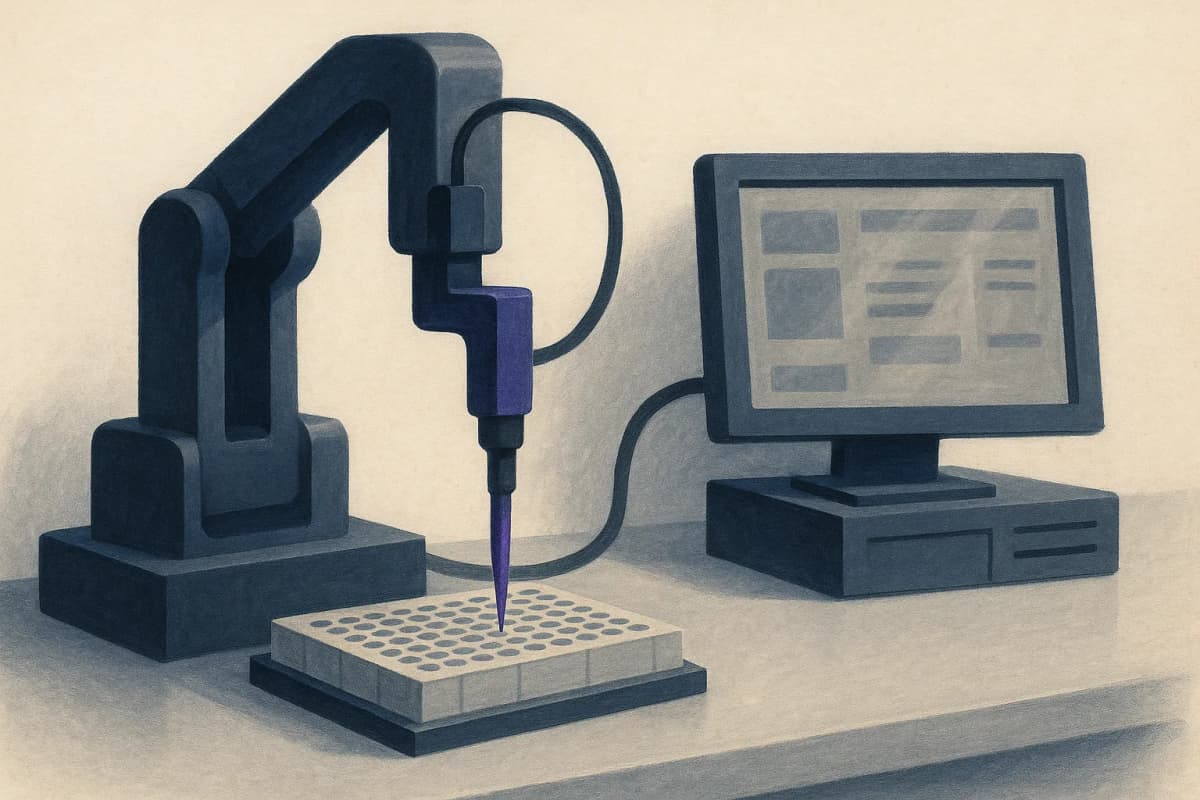
The eight hours is the story, but not in the way the launch post means it. Carnegie Mellon wired four instruments across three computers into an agent-driven workflow in eight hours using Anthropic's new Model Hardware Standard — against the several weeks a vendor-built setup typically takes, per Anthropic's own write-up. If you run a regulated lab or a validated plant, those weeks were not waste. They were the only reason a new instrument connection ever reached a change board.
Integration friction was doing unbudgeted governance work. It forced every new device connection through a specialist, a purchase order and a validation protocol, and it did that whether or not anyone had written a policy requiring it. Anthropic just deleted the friction. The policy was never written. So the question on your desk this quarter is not whether MHS works — the partner data says it works — but who owns the driver, who approves the safety limits it declares, and what happens the first Tuesday afternoon a scientist writes one without telling anybody.
What Anthropic Actually Shipped on August 27
MHS is a driver specification that lets an AI agent discover and operate a physical device through two primitives — read and write — plus a machine-generated reference file describing what the device measures, what can be adjusted, and what safety limits apply. Anthropic opened it as an application-based research preview on 27 August 2026. Alek Kemeny, on the technical staff, described it to Fortune as "kind of like the USB for AI to software connection."
The mechanism matters more than the analogy. A driver carries natural-language tags that a user — or an agent, in a chat window — fills in with the things the device's own code does not reveal, such as the weight of a payload on a robotic arm that changes what movement is safe. Agents reach the device three ways: through Model Context Protocol, a command line, or code files acting as APIs, according to IoT Tech News. Jonah Cool, who runs partnerships at Anthropic, framed the motivation to Fortune as escaping incumbent tooling that "suffers from proprietary solutions that are very brittle."
The partner results are genuinely strong, and they are the vendor's presentation of its partners' numbers. QuEra's laser relock went from a bespoke automation script at 58% success taking roughly 150 seconds to an agent-tuned controller at 99.3% success in 0.9 to 14 seconds, with residual error cut from 15.7 mV to 1.55 mV; across a 19-hour stability test the agent's tuning "did not lose the lock once" while expert parameters unlocked about 1.6 times an hour. HHMI Janelia reported that adding a new camera, previously "a multi-day project," took minutes. Tetsuwan Scientific measured 9,143 dispenses across 1,508 conditions and reported a model roughly 12% more accurate than the manufacturer's own technical specification, beating it on 31 of 45 runs.
Now read the launch partner list as a procurement document rather than a research one: Danaher, QIAGEN, Tecan and MBF Bioscience on the instrument side; Universal Robots, Doosan Robotics, Automata and AWS Strands Robots on the automation side; Hugging Face LeRobot and Raspberry Pi at the open end. Those are not startups. They are the boxes already sitting in your qualified lab and on your production floor.
The Weeks Were Doing Governance Work Nobody Budgeted For
In a GxP environment, instrument integration is slow because it is expensive, and it is expensive because it routes through people whose job is to ask questions. A vendor statement of work. An integration engineer. A qualification protocol. A change record that someone signs. None of those steps is labelled "governance" on the invoice, but together they were the control: an instrument could not quietly join a workflow, because joining a workflow cost money and calendar time that someone had to approve.
Collapse that to an afternoon and the approval step does not get faster. It gets skipped, because nothing in the process was ever anchored to the act of connecting a device — it was anchored to the purchase order. This is the same shape as the inherited-approval problem that shows up when a platform team ships an agent framework and one security review ends up covering fifty downstream agents. The review did not get worse. Its scope quietly grew by a factor of fifty.
Steel-man the other side, because it is strong: this friction was also genuinely bad science. Open lab-instrument standards are not new. SiLA has been at this since the 1.x standards of 2009, its current generation runs over HTTP/2, and the organisation states plainly that "SiLA standards are free and open." Tecan — an MHS launch partner — already publishes an open-source SiLA 2 SDK. A free, mature, vendor-neutral standard has existed for years and labs still pay for point integrations. That tells you the bottleneck was never the absence of a spec. It was that writing a driver required an engineer who understood both the instrument and the protocol, and MHS's real contribution is letting a model do that part.
Which is exactly why the governance gap is not theoretical. The capability that removes the engineer also removes the person who used to notice.
Draft Annex 22 Puts This Class of System Out of Scope
The EU's draft GMP Annex 22 on artificial intelligence, as written, does not permit the kind of system MHS is built to enable in critical GMP applications. The European Commission released the drafts of Annex 22, a heavily revised Annex 11 and Chapter 4 on 7 July 2025, with comments closing on 7 October 2025. Annex 22 is short — ten chapters covering intended use, acceptance criteria, test data independence, explainability, confidence and operation.
Its scope is the load-bearing part. The draft admits static, deterministic models that return identical outputs for identical inputs, and places dynamic or continuously learning models, non-deterministic models, and generative AI and large language models outside it — those categories "should not be used in critical GMP applications". Agentic AI is not itself a named category in the draft, which matters less than it sounds: an agent built on an LLM trips all three exclusions at once, so it falls outside scope by construction rather than by name. One consultancy reading of the same draft puts it more bluntly: "adaptive and generative models are explicitly prohibited in GMP-critical decisions", with formal adoption expected during 2026 and the usual six-to-twelve-month grace period after publication.
Two honest caveats, and the first is larger than it looks. Annex 22 is a draft, it is not legally binding, and the exclusion is under active reconsideration rather than settled. The consultation closed on 7 October 2025, and the EMA then convened a multistakeholder workshop on 30 June and 1 July 2026 to gather expert input on a risk-based approach — noting that consultation feedback suggested support for enabling GenAI and LLMs in medicines manufacturing, and asking directly how adaptive and probabilistic models could be accommodated, with what guardrails and human oversight. Plan against the text as it stands; do not build a strategy that assumes the prohibition survives intact. And "critical GMP application" is doing enormous work in that sentence — an agent optimising dispense parameters in a discovery lab is nowhere near it, while the same driver pointed at a QC release assay is squarely inside it. That boundary is where every argument in your quality organisation will happen for the next eighteen months, and MHS makes crossing it a copy-paste operation, because it is the same driver file.
Annex 22's change-control clause is the one to read aloud in that meeting: "Any change to the model, its host system, the process or physical inputs should be documented and impact-assessed," with justification required for any decision not to retest. An auto-generated reference file describing a device's adjustable parameters and safety limits is a physical-input description. It is a configuration item. Treat it as one now and the eventual audit is boring.
The companion Annex 11 draft grew from five pages to nineteen, and its centre of gravity shifted from validation toward security, identity and access management, audit trails and supplier oversight — including an expectation that documentation be accessible from the regulated user's site, not only from the vendor. In the US the anchor is older and unambiguous: 21 CFR Part 11 requires secure, computer-generated, time-stamped audit trails recording operator entries and actions, and ALCOA+ attributability means every action traces to whoever performed it. If an agent set the flow rate, "the agent" is not an acceptable audit-trail entry — which is the same non-human-identity problem that agent identity platforms are still arguing about, now with a pipette attached.
For work intended to reach a regulatory submission, the FDA's January 2025 draft guidance on AI in regulatory decision-making gives you the framing to use: define the model's context of use, assess model risk against that context, then build credibility evidence proportionate to it. It explicitly covers the manufacturing phase. A context of use is the specific role and scope of the model in answering one question — and "operates the instrument that generates the data" is a context of use nobody has written a credibility plan for yet.
A Declared Safety Limit Is Not an Interlock
The safety limits in an MHS reference file are configuration, not protection — and conflating the two is the most expensive mistake available here. Anthropic says this itself, in unusually plain language: Claude "learns about the physical world through text and images, meaning its spatial and physical reasoning have limitations that still require expert oversight," and "if something went wrong with the physical hardware, Claude didn't know how to troubleshoot." In the Genentech liquid-handling work, the agent read error codes correctly but misread the physics, retrying operations that generated bubbles until humans steered it toward gentler parameters. One independent analysis of the launch — written without preview access and without reproducing the partner results — puts the limit precisely: "Driver limits can prevent forbidden movement; they cannot supply missing scientific judgment."
On the factory side this stops being a philosophical distinction and becomes a conformity-assessment one. Universal Robots and Doosan Robotics arms are certified against functional safety requirements that live in a safety-rated controller, not in a text file. ISO 10218-1 and -2 were both revised in 2025, making functional safety requirements explicit rather than implied, absorbing the collaborative-application content formerly in ISO/TS 15066, and adding cybersecurity requirements insofar as they bear on robot safety. And Regulation (EU) 2023/1230 applies from 20 January 2027, replacing the Machinery Directive and written specifically to cover "artificial intelligence (AI), where specific modules of AI using learning techniques ensure safety functions" — with high-risk categories pushed into third-party conformity assessment rather than self-certification.
Put those two facts next to each other. You have roughly five months before a regulation lands that treats machinery whose safety functions depend on self-evolving ML behaviour as high-risk. If your safety case starts leaning on a limit declared in an agent-authored driver rather than on the robot's safety-rated stop, you have moved a safety function into a new artifact class at precisely the wrong moment. The correct architecture is unglamorous and old: the interlock stays in hardware, the driver limit is a second, softer fence, and nothing in the validation package treats the second as a substitute for the first.
Researchers working on the same problem reach the same conclusion from the other direction. The LAP agent-to-instrument protocol paper argues that neither SiLA 2 nor MCP was architected with agent authorization, safety constraints and audit trails as primary concerns — which is a fair description of MHS at preview stage too, and a decent checklist for what to demand before it ships. The lesson from operational technology security generally is that new instrument-control paths get discovered by the wrong people long before they get inventoried by the right ones.
You Cannot Write a Supplier Requirement Against This Yet
MHS is not currently a standard in the sense your quality system means by that word. As of the preview, Anthropic "has not linked a specification, SDK, schema, source repository, license, conformance suite, version number, or governance model" — and Anthropic's own post says only that "we have more work to do on the standard before we open-source it," with no date. Access is application-based.
That is a perfectly reasonable posture for a research preview and a completely unworkable one for a supplier assessment. Annex 11's draft expectation of user-accessible documentation, GAMP-style supplier evaluation, and any serious change-control process all assume an artifact with a version number you can pin and a governance process you can point at when it changes underneath you. None of that exists today. So the honest answer to "can we use this in a validated environment" is: not yet, and the useful work available this quarter is preparation rather than deployment.
The parallel worth holding onto is the software-connector wave. MCP shipped, spread through enterprises faster than anyone governed it, and only afterwards did the governance conversation catch up. The difference this time is that the connector moves a robot arm, and the gap between "somebody wired this up on a Tuesday" and "we found it in the inventory" is measured in physical consequences rather than data-access ones.
What to Do Before the Open-Source Release
This Week: Ask your lab informatics and automation leads a single question — is anyone in the research organisation already in the MHS preview, or piloting agent-driven instrument control by any other route? The answer in most companies is yes somewhere, and you want it from a colleague rather than from an inspector. Then write down, in one page, which of your instruments sit in a GMP-critical context of use and which do not. That line is the whole decision.
This Month: Declare the MHS driver and its reference file a controlled document class before the first one exists. Assign an owner, a review step, and a rule that the declared safety limits are reviewed by whoever owns the instrument's qualification — not by whoever wrote the driver. Separately, get your OT and plant engineering leads to confirm in writing that no robot cell's safety case depends on a software-declared limit, ahead of the January 2027 machinery deadline. Add agent-initiated instrument actions to your audit-trail requirements now, while it is a design conversation rather than a remediation one — the same registry-write and agent-action logging discipline that software teams are retrofitting this year.
Before You Adopt: Put four questions to Danaher, QIAGEN, Tecan and your robotics vendors, in your next scheduled business review rather than as a special escalation. Will MHS support ship on qualified instrument firmware or as a separate layer? What is the versioning and change-notification commitment once the spec opens? Who is the regulatory contact for the safety-limit declarations? And does MHS support alter anything in the instrument's existing conformity assessment? A vendor that cannot answer the fourth question has not thought about the machinery regulation yet, and that is useful to know in August rather than in December. This belongs in your AI system inventory, not in a lab notebook.
The Bottom Line
Every technology cycle that removed integration cost also removed a control nobody knew they had. Cloud removed the procurement gate on servers and gave us shadow IT. SaaS removed it on applications and gave us a decade of data-processing agreements written after the fact. MCP removed it on data connectors and the governance work is still catching up. MHS removes it on physical instruments, and the industrial and life-science incumbents signed on at launch — which means the diffusion will be fast and it will start inside organisations that are legally required to know what their equipment is doing. The regulators are moving too, just slower: Annex 22 in draft, the machinery regulation in five months, FDA's own AI docket still thin on evidence.
The eight hours are real, and they are a genuine gift to science — as the drug-discovery race has already shown, the constraint on this work has never been ideas. But you should spend some of the time you just saved writing down who signs the driver.
The friction was never the control. It was just standing where the control should have been.
Continue Reading
- Toyota Ships an Agent in 4 Days. One Review Covers 50.
- Why AI Stalls in Pharma—and How Iridius Plans to Fix It
- AI Wrote the S7 Exploit. There Is No CVE to Patch.
- FDA Cleared 1,357 AI Devices. Three Were Tested on Patients.
- Okta vs Entra Agent ID vs SailPoint: Two Issue, One Governs
- EU AI Act Governance Tools: Buy Inventory, Not Policy Packs
- Schneider's $3.1B Cognite Deal: Industrial AI's Data War
- The 2026 Agentic AI Stack: 8 Layers, 3 You Can Skip
