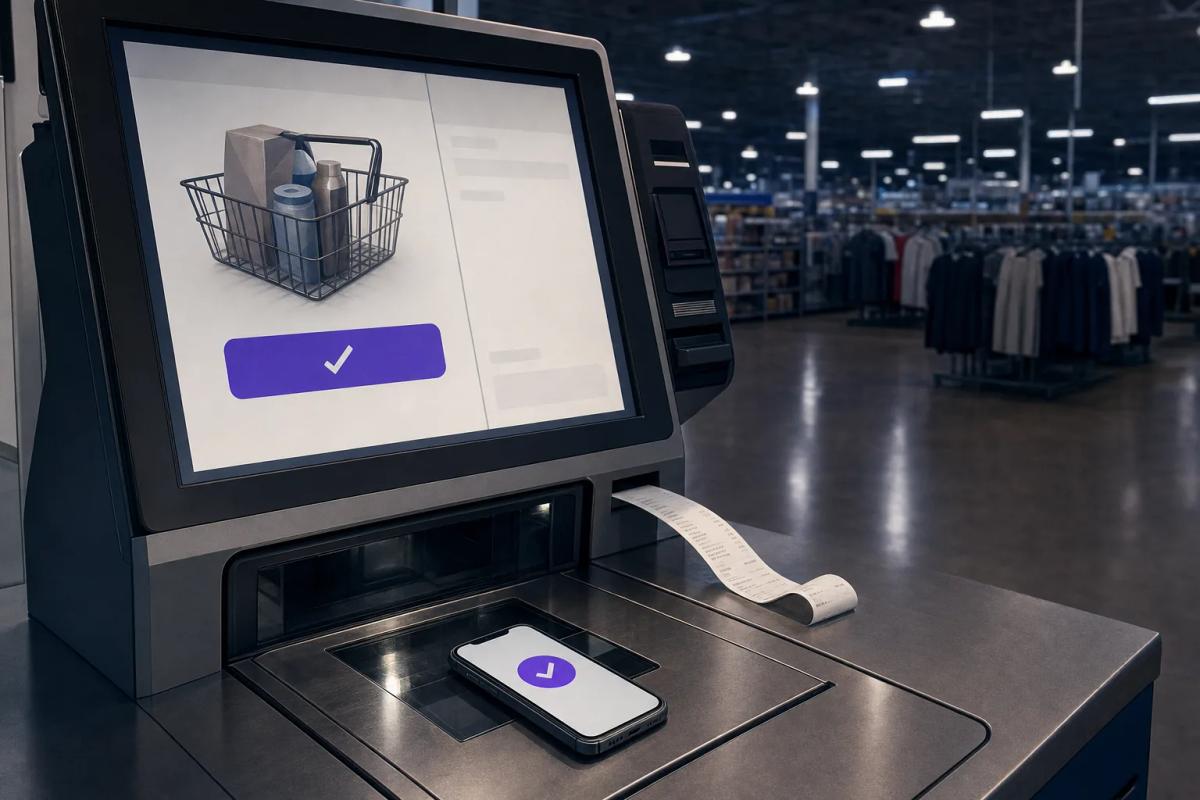
If you run a store, a bank or a marketplace, Walmart has just published the control set for letting someone else's AI agent buy from you. It gives each agent a separate profile inside the customer's own account, a spending limit the customer sets, approval on by default, purchases labelled by agent, and no card data ever handed to the agent. Meta's Muse is the first outside agent to use it. Walmart announced on November 24 that Muse can find items, build a basket and complete a purchase at Walmart, Black Friday deals included, "powered by the Walmart Agent Gateway."
The alternative is Amazon's, which blocked Muse in September. You now have two working answers to the same question, and the holiday season is when you find out which one your customers expect.
What Walmart Actually Turned On
Walmart turned on a checkout path for one named third-party agent, with the customer's Walmart account sitting between the agent and the money. According to Walmart's release, the first time a Muse user adds an item to the cart, Muse sends them to Walmart to sign in and then brings them back. During that step the customer sets up an "Agent Profile" in their Walmart account, "including a spending limit you're comfortable with." Payment uses a card already saved in the Walmart account, at "the same Walmart prices you'd find on Walmart.com." If something is wrong, "Walmart's return policy still applies."
The rules underneath were published a month earlier. On October 21 Walmart introduced Agent Profiles, the Agent Gateway and a set of terms for AI agents, covering Walmart and Sam's Club. The gateway uses MCP (Model Context Protocol, the open standard for connecting agents to tools and data), and Walmart said it would start as a beta for companies and developers. TechCrunch reported the launch alongside CEO John Furner's appearance at the Masters of Scale Summit, and noted that a profile does not require Walmart+.
An Agent Profile, in Walmart's design, is a dedicated sub-identity for one agent inside a customer's retail account. It holds that agent's permissions and spending limit and keeps its purchases separate from everything else. Walmart, as TechCrunch reported, compared it to an authorized user on a credit card, which is the right mental model for your fraud team.
The Five Controls Worth Copying
Walmart's design comes down to five controls, and each one answers an objection your security or payments team will raise. From the October terms:
- A spending limit the customer sets. Customers can let an agent buy "within a spending limit they set," with $50, $100 or $200 given as examples, and can switch that permission off at any time.
- Approval on by default, with a step-up. "Customers must approve agent purchases by default," and Walmart "may require additional approvals even for purchases within an agent's spending limits." The second clause matters most. It keeps the retailer's own risk engine in the loop after the customer has delegated.
- No payment credentials for the agent. "Agents don't receive customers' payment-card information and can't add or change a customer's payment methods." The card stays in the retailer's vault.
- Attribution in the order history. Agent purchases show up separately from the customer's own, so a disputed order can be traced to the agent that placed it. The November release tells customers to "check your purchase history to see which purchases were made by your agent."
- Data scoped to the task. The gateway lets agents find relevant products "without sharing the customer's broader shopping history," and the terms say agents "can access only the information needed for the task and allowed by the customer."
Two terms sit on the agent operator rather than the customer. Agents "must not take actions beyond what the shopper intends," and "agents that do not follow these terms will be blocked from Walmart's site." Walmart also says "we price products, not people," so the agent sees the same prices a person does.
Meta's side adds its own layer. In the UK launch post on November 23, Meta says "purchases need your approval every time" and that "a separate security agent checks Muse's actions and the information it sends out against the permissions you've granted." A Muse purchase at Walmart is therefore approved twice by default, once in Muse and once against Walmart's rules. That adds friction for the shopper, and for a first launch it is the safer setting.
Why Amazon Said No
Amazon's stated objections are about how Muse got in: no notice, no self-identification, and stored passwords. Amazon blocked Muse about two weeks after its September 8 launch. As GeekWire reported Amazon's position, Meta had not said Muse would access the store, the agent doesn't identify itself when it browses, and it appears to capture and store customer credentials. Muse users saw a message saying continued access by an unauthorized AI agent "violates Amazon's Conditions of Use." Amazon says its own Buy for Me agent identifies itself and lets brands opt out.
Take the strongest form of Amazon's position seriously. A browser agent carrying a customer's password through account pages and order history is an undisclosed third party in the session. Your fraud model cannot tell it from account takeover. Blocking it is defensible, and the legal ground for doing so is still being worked out after the Ninth Circuit's August ruling in Amazon v. Perplexity.
Walmart's gateway answers most of those objections in its design. Through an MCP connection the agent announces itself, the customer signs in on Walmart's page, and the agent never holds the password or the card. An agent with a sanctioned connection has no reason to drive a browser through the customer's account.
There is a commercial reading too, and you should hold it alongside the security one. Amazon sells shopping agents of its own. Walmart is betting that being reachable from every agent its customers use is worth more than owning the only one. Its Sparky assistant keeps expanding in parallel, so Walmart is running both strategies at once.
Where the Design Still Leaves You Exposed
The gateway fixes identity and credentials. It does not fix a wrong purchase. Visa's benchmark of 22 models published November 5 found an overall pass rate of 57.2% across 15 shopping scenarios, and across all models and scenarios all three attempts passed only 34.2% of the time. About 54% of failed runs still ended in a purchase. We walked through that study when it came out.
Now read Walmart's liability clause with that number in mind. The October terms say Walmart's returns process applies "including if an agent doesn't act as intended." In practice that puts the cost of an agent's mistake on the retailer's returns desk. Approval by default is what keeps the volume down, because a human looks at the basket before it ships. A spending limit without approval, or a $200 limit on a category with high return rates, moves that cost straight onto your P&L.
Three other gaps are worth naming:
- Privacy sits with two companies. Walmart says "the company that provides the agent handles what you share with its app under its privacy policy." Meta says Muse conversations are not shared with its advertising systems and that users decide whether their interactions train Meta's models. Your customer will not read either policy. Your support team will field the complaint anyway.
- Payment rails vary by market. In the UK Muse pays through Onelink built by Stripe, which Meta says generates "a unique, digital version of your card that's only accessible to agents using Onelink," and through Shop Pay at supported stores. At Walmart it uses the card in the Walmart account. If you onboard several agents you will support several payment patterns, and each one needs its own chargeback playbook.
- Regulators are writing the same questions down. The UK FCA's agentic AI page, published November 24, tells firms to consider "how you establish that you are dealing with an agent, what consents are in place, what an AI agent is allowed to do," and whether to accept payments instructed by one. Walmart's profile answers all three. Our FCA breakdown maps them for banks.
Walmart has published no volumes, error rates or return rates for agent orders. Treat this as a design you can copy, with no evidence yet that it works at holiday scale. The last time a retailer claimed results from an AI shopping assistant, nobody ran a holdout.
What to Do Before Agents Reach Your Checkout
You have two models to choose from: Walmart's sanctioned connection with rules, or Amazon's block. Doing nothing leaves you with neither, because a browser agent can still reach your checkout without identifying itself. Muse, ChatGPT and Gemini are all named in Walmart's October announcement as conversational commerce integrations, so assume their users are already trying your site too.
This Week:
- Ask your bot-management and fraud leads for one number: how many sessions in the last 30 days came from known agent infrastructure, and how many of those reached checkout. If nobody can produce it, that is the first project.
- Write a one-page agent access policy that says block, tolerate or onboard, signed by the heads of digital commerce, payments and security. Amazon and Walmart both made this call in public. You should at least make it in writing.
This Month:
- If you will onboard, scope a profile object in your customer account with the five Walmart fields: per-agent identity, customer-set spending cap, approval-by-default flag, agent attribution on every order, and a data scope that excludes purchase history. Price it with your identity team before you choose a protocol. Our protocol guide covers UCP, ACP and AP2.
- Get the return and chargeback rules in writing before the first agent order: who pays when an agent buys the wrong thing, and which reason code your acquirer uses. OpenAI's wallet leaves fraud decisions to merchants, so assume the cost is yours.
Before Q1 Close:
- Run a holdout. Give a slice of agent-originated customers the gateway path and leave the rest on the current experience, then compare return rate, dispute rate and basket size. Uber's numbers show how small third-party agent volume can be (four rides in a 320 million-trip week), so size the test before you build for scale.
The Bigger Picture
Banking went through the same argument over screen scraping before open banking replaced shared passwords with scoped, revocable API access. Schwab and JPMorgan are on the blocking side today, as Amazon is in retail. Walmart has shipped the scoped version first, with a named agent, real money and a returns policy behind it.
What you should copy is the account structure: the agent gets its own revocable identity inside the customer's account, the customer sets the limit, and the retailer keeps the card. Pull the agent-session number from your bot logs this week.
Continue Reading
- Amazon Blocks Meta's Muse Agent Where the Perplexity Ruling Stops
- Meta's Personal Agent Protocol Signs Walmart Before It Has a Spec
- Keep Your Checkout, Build UCP First and Feed Products to ACP
- Your AI Shopping Agent May Buy After It Fails, Visa Finds
- FCA Asks UK Firms to Set AI Agent Permissions and Payment Rules
- OpenAI's ChatGPT Wallet Leaves Fraud Decisions to Merchants