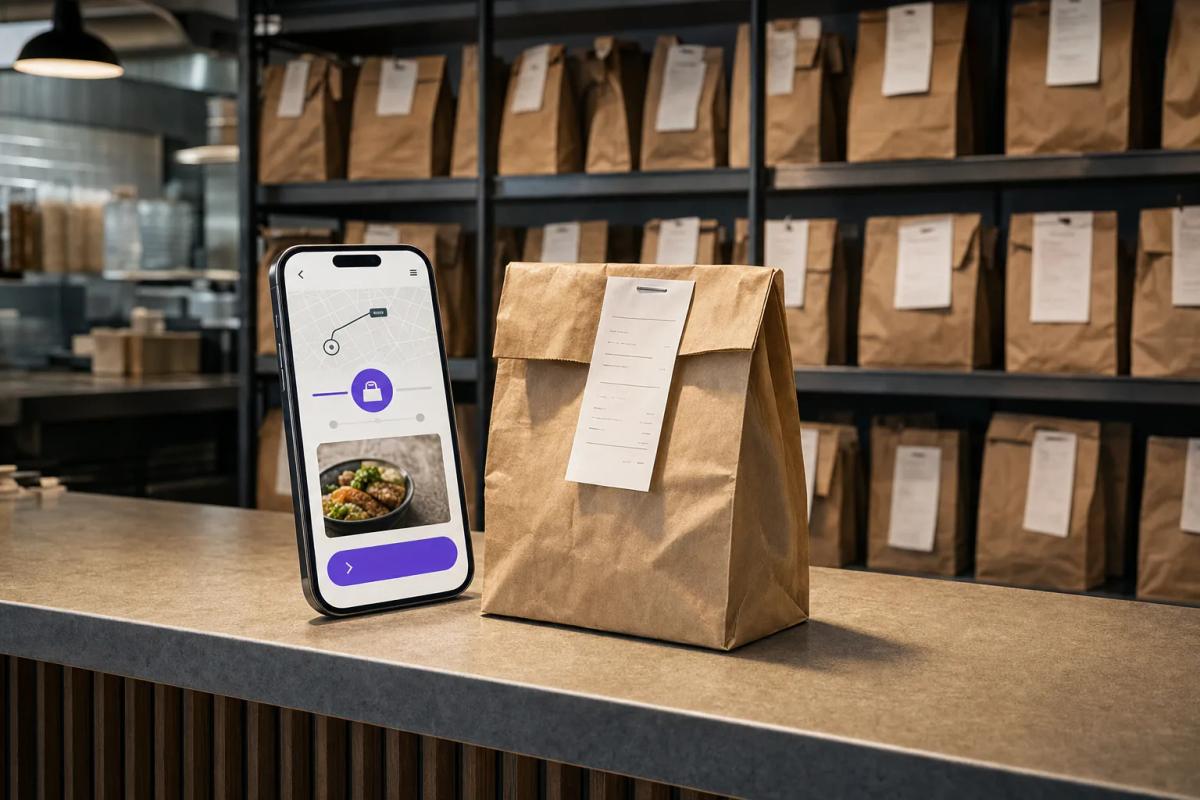
If you are deciding how much of your 2027 digital budget goes to third-party AI agent integrations, the first operator-reported numbers say to fund your own in-app assistant first. On Uber's third-quarter call, the CFO said AI agents produced about 500 Uber Eats orders and four rides in a week when Uber and Uber Eats handled roughly 320 million trips. DoorDash put its own count at "several hundred" agent orders in total. Uber's one measured AI win came from its own app, where baskets built with its Cart Assistant run about twice the average.
These are the first hard volumes from companies that already plugged into the assistants retailers are being told to build for this holiday season. They are tiny, and they should change the order in which you spend.
What Uber and DoorDash Actually Reported
Third-party agents are a rounding error in both companies' order flow today. On the November 4 call, CFO Balaji Krishnamurthy said Uber had "one of our largest weeks last week because it was Halloween," with about 320 million trips across Uber and Uber Eats. Agent volume for Uber Eats was "around 500 orders total," and for rides, "a grand total of four trips that we fulfilled from agents." The company called it "very, very early and very limited traction."
One caveat on the period. Uber had not posted its own transcript when this was written, so these quotes come from a third-party transcript and from TechCrunch's report, which places the four rides in the Halloween week. The CFO gave both figures in the same answer as the weekly total, but "in total" could be read as a longer window. Either way the ratio is the story: hundreds of agent orders against a business that completed 4.06 billion trips in the quarter, up 16% year on year, on $59.8 billion of gross bookings.
DoorDash said much the same thing a week earlier. On its October 29 call, CEO Tony Xu said, per TIKR's account of the call, "we're seeing maybe several hundred orders in total from some of these third-party agents." That is a cumulative estimate, not a quarterly count, which makes it smaller still next to the 993 million orders DoorDash handled in Q3, up 28%.
Neither company lacks access. Uber Eats and DoorDash both integrated with ChatGPT for food ordering in 2025, and DoorDash's shareholder letter says it shipped a Model Context Protocol server that interfaces with external AI agents, including ones companies use for corporate ordering. The integrations are live, and customers are mostly ignoring them.
Why Agents Barely Move a Habitual Purchase
An agent saves time only when the task is slow, and ordering a ride is not slow. TechCrunch notes that booking an Uber takes about 50 seconds on average and reordering a favorite meal about 90 seconds. Khosrowshahi said on the call that about 75% of rides take a single tap and that Uber One members account for more than half of bookings. A customer who is already a member, with a saved address and a one-tap reorder, has no reason to open a different app and describe the trip in a sentence.
That points at where agents might matter for your business: purchases with a lot of comparison, assembly or research. A grocery list, a trip itinerary, a gift with constraints. It also explains why the two numbers on Uber's call pull in different directions. The third-party channel is nearly empty, while Uber's own assistant, which sits inside a flow customers already use, is producing larger baskets.
Here is the strongest case against reading too much into four rides. Consumers are using agents to shop, just not on these apps. Meta told investors that more than 10 million people in the US and Canada had set up Muse since its September 8 launch, that more than a quarter of users shop with it, and Mark Zuckerberg said "we had to work with Stripe to raise credit limits since the volumes were above what any of us expected," according to The Next Web. Meta plans to charge businesses a fee on purchases Muse helps complete. So the demand is real somewhere. The data from Uber and DoorDash says it has not reached high-frequency, low-consideration orders, and you should not assume your category is different without your own numbers.
The First-Party Assistant Is Where the Measured Lift Is
Uber's one positive AI number came from a tool it owns. Khosrowshahi said "early signal shows that baskets that you build with a cart assistant are roughly twice the average." Cart Assistant launched in beta in February: a shopper types a list or uploads a photo of one, including a handwritten note or a recipe screenshot, and the assistant fills the basket, favouring items from past orders.
Treat "twice the average" as a vendor's early signal, not a measured lift. A shopper who uploads a full grocery list was always going to build a bigger basket than someone ordering one burrito, so the comparison to the average basket mixes selection with effect. We made the same point when Walmart and Amazon both claimed 40% gains from their shopping assistants without disclosing a holdout. The direction is still useful. The first-party assistant owns the customer, the data, the merchandising and the margin, and it is the only AI number either company reported that was not near zero.
DoorDash took the same route. Its letter lists Ask DoorDash, which builds grocery baskets and suggests restaurants like your usual orders, and Text DoorDash, a texting channel it calls the fastest way to order outside its app. Strategically, DoorDash says it will focus on "winning the battle for atoms," the physical delivery network, while leaving the race to be the leading digital assistant to others.
Uber's Terms for Agent Platforms Are a Template
Uber is treating agent platforms as distribution partners whose terms it negotiates one by one. Khosrowshahi said he has counted eight different assistants and expects more than ten over time, that "we're really now negotiating the terms of trade," and that "we want to make sure we're not dependent on any one player." He also told analysts, per TechCrunch, that "every single AI system company is talking to us," and that he expects agents to be a net positive for demand.
Read that as a negotiating posture. With eight suitors and four rides of volume, Uber has no reason to accept exclusivity, data restrictions or a revenue share before the channel proves itself. Xu, for his part, said he sees "advertising opportunities even within some of these AI agents," which means the agent platforms may end up charging merchants to appear, the way search did.
Airbnb has gone further. CEO Brian Chesky said in September, per Skift, "Next year we will launch our agent," describing an interface "much richer than a chatbot." Skift reports that Airbnb has not put booking inside ChatGPT, unlike Booking.com and Expedia, and treats outside assistants including ChatGPT and Meta's Muse as traffic sources that send people back to Airbnb.
If you sell through marketplaces, you have seen this before. Retailers that handed their catalogs to the big marketplaces early got reach and then paid for it in fees and lost customer data. The agent platforms will run the same play if you let them, and Meta has already said it plans to charge businesses on transactions. If you want a refresher on how these access rules are forming, see our pieces on Meta's Personal Agent Protocol and why Amazon blocked Muse's shopping agent.
What to Do Before Your 2027 Budget Locks
This Week:
- Pull your own agent-originated order count. If you already expose an MCP server, a ChatGPT app or an agent checkout, tag those orders and report them next to total orders for the same week. If you cannot count them, that is your first fix.
- Ask your e-commerce lead for the median time to complete a repeat purchase in your app. If it is under a minute, as at Uber, an outside agent has little to offer that customer.
This Month:
- Write down an adoption trigger before you spend more on agent integrations: for example, agent orders above a fixed share of weekly orders for four straight weeks. Below that line, keep integrations to maintenance.
- Scope a first-party assistant for your highest-effort purchase (the list, the multi-item basket, the itinerary). Design it with a holdout group from day one so you get an incremental lift, not a basket-size comparison.
- Draft your terms of trade for agent platforms: non-exclusive, your customer data stays yours, a cap or sunset on any revenue share, and the right to see which orders the platform sent. Our explainer on MCP, A2A and OpenAPI covers the integration side.
Before Renewal or Signature With Any Agent Platform:
- Refuse exclusivity. Uber is talking to eight assistants for a reason.
- Price any paid placement inside an agent against the volume the platform can show you, not the volume it projects.
The Bottom Line
Agentic commerce is following the path of early mobile and social commerce: platforms announce reach first, and merchants see orders later, if at all. Uber's and DoorDash's numbers put the current agent volume for habitual purchases close to zero, while the one measured AI gain in either report came from an assistant inside the merchant's own app. Fund that first, keep third-party agents on negotiated, non-exclusive terms, and revisit the split when your own agent-order count crosses the trigger you set.
Continue Reading
- Walmart and Amazon Both Said 40%. Neither Ran a Holdout.
- Meta's Personal Agent Protocol Signs Walmart Before It Has a Spec
- Amazon Blocks Meta's Muse Agent Where the Perplexity Ruling Stops
- Schwab and JPMorgan Block AI Agents Using Customer Logins
- Coveo Buys Anglera to Enrich Ecommerce Product Catalogs
- Google UCP Beats OpenAI Protocol: Microsoft, Amazon, Meta Adopt