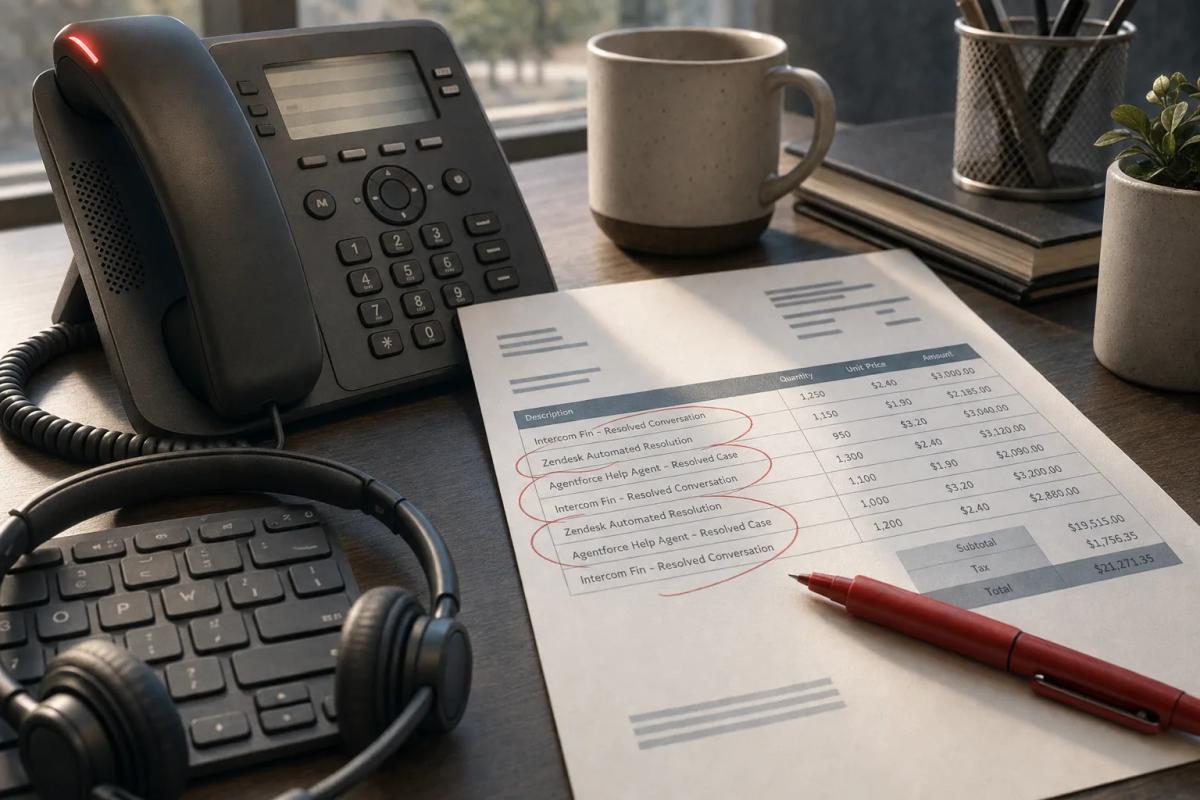
The per-resolution rate matters less than the vendor's definition of a resolution, because a customer who gives up and phones you can cost you the AI fee and a human contact. Intercom's Fin is the cheapest at $0.99 per outcome and has the loosest definition: a customer who leaves without asking for more help is billed. Zendesk charges $1.50 committed but bills only resolutions its own LLM check verifies, which is the most buyer-friendly definition on the market. Salesforce's Agentforce Help Agent costs $2 per resolution, needs a 1,000-resolution pre-purchase, and has defined a resolution mainly in launch statements. If you are on Zendesk, use Zendesk's AI agents. If you are anywhere else, price Fin, and negotiate its silence rule before you sign. Help Agent is the loser here.
A per-resolution price, also called outcome-based pricing, is a contract where the vendor bills each conversation its AI agent closes without a human, rather than each seat, message or action. Prices below were checked on each vendor's live page on November 8, 2026, list price in USD.
| Intercom Fin | Zendesk AI agents | Agentforce Help Agent | |
|---|---|---|---|
| Rate | $0.99 per outcome (Fin pricing) | $1.50 committed, $2.00 pay-as-you-go per automated resolution (Zendesk pricing) | $2 per resolution (Agentforce pricing) |
| Minimum | 50 outcomes a month on a non-Intercom helpdesk | None stated; 5 or 10 resolutions included per seat | 1,000-resolution pack, per CIO |
| Customer leaves without replying | Billed as an "assumed resolution" | Billed only if the LLM check verifies it | Not billed, per Salesforce |
| Customer asks for a human | Not billed | Not billed | Not billed |
| Seat fees on top | Intercom from $19 to $132 per seat a month, or your own helpdesk | $19 to $115 per agent a month, annual | Service Cloud from $195 per user a month, annual |
| Who should buy it | Teams not on Zendesk who can audit assumed resolutions | Anyone already on Zendesk Suite | Service Cloud shops whose cases fit a packaged agent |
| Who should not | Teams with high email or phone fallback after chat | Anyone not already paying for Zendesk seats | Anyone who can run Fin on Service Cloud for half the rate |
What Each Vendor Charges Per Resolution in November 2026
Fin is cheapest per billed unit, Zendesk is in the middle, and Help Agent is the most expensive, before you count seats.
Intercom renamed itself Fin and was acquired by Salesforce, but it still sells Fin on its own price list. The Fin pricing page charges $0.99 per outcome, with a 50-outcome monthly minimum when Fin runs on another helpdesk, and $9.99 for a sales "qualification" outcome. Fin's help article on outcomes describes the standalone fee as billed within a $49 monthly base plan. On Intercom's own helpdesk, the Intercom pricing page lists Essential at $19 a seat for new customers (normally $29), Advanced at $85 and Expert at $132 per seat a month. The page has an annual and monthly toggle and does not tie each figure to a billing cycle, so confirm yours on the quote.
The word "outcome" matters. Fin's billing moved from resolutions to outcomes, and an outcome now includes a "procedure handoff," where Fin completes a configured workflow and then hands the conversation to a person. That handoff costs $0.99 as well. Fin charges once per conversation however many questions it answers.
The Zendesk pricing page charges $1.50 per automated resolution on a committed volume, or $2.00 pay-as-you-go, on Support Team ($19 per agent a month, annual), Suite Team ($55) and Suite Professional ($115). Support Team and Suite Team include 5 automated resolutions per agent a month, Suite Professional 10. Suite Enterprise is "Talk to Sales."
The Agentforce pricing page lists Help Agent resolutions at $2, alongside Flex Credits at $500 per 100,000 (an action costs 20 credits, or $0.10) and Conversations at $2 each. Salesforce announced Help Agent as generally available in July 2026, with pay-per-resolution pricing from the same month. Service Cloud itself lists Core at $195, Advanced at $395 and Max at $550 per user a month, billed annually, on the Service Cloud pricing page. Neither page names the edition Help Agent requires. We have covered Flex Credits and the per-conversation meter in detail; this page compares the per-resolution meters.
Other vendors have moved the same direction. Craig Durr of The Collab Collective told TechTarget in August 2026 that HubSpot cut its per-resolution price from $1.00 to $0.50.
How Each Contract Defines a Billable Resolution
Zendesk bills the fewest conversations for the same traffic, because it requires an LLM check to pass; Fin bills the most, because silence counts.
Intercom's Fin resolutions article splits resolutions into two kinds. A confirmed resolution is a customer replying "Ok thanks" or "That helped." An assumed resolution is a customer who "exits the conversation without requesting further assistance." Both are billed. The article attaches no time window to that exit. An explicit request for a human is not billed, and if the customer "returns to the same conversation seeking further assistance," the resolution is "deducted and not charged," even in a later billing period.
Two details in the same article cut against the buyer. If Fin's collect-information step is on and the customer goes quiet without providing the information, the conversation is still marked resolved and charged. And the refund applies to the same conversation only. A customer who gives up on chat and emails or calls you instead was billed as resolved and then costs you a human contact.
On Zendesk, since May 18, 2026, Zendesk's automated resolution tiers sort each AI conversation into three buckets. A verified resolution is one where the customer did not ask for more help and "a large language model (LLM) that evaluates the text of the conversation" confirmed it was resolved; only that tier is billed. A contained resolution (handled to the end but not verified) and an assisted escalation (a human finished it) cost nothing. A conversation ends 72 hours after the first email, 2 hours after the first message by default on messaging (extendable to 72), and at hangup on voice. The article says nothing about a conversation that reopens after it was billed. Ask.
The weakness is who grades it. Zendesk's own model decides whether Zendesk's own agent succeeded. That is still a better default than billing silence, but you need your own check.
For Agentforce Help Agent, Salesforce's announcement says the agent bills when it "resolves an issue autonomously, start to finish," and that "If a customer gives negative feedback or asks for human escalation, there is no charge." A Salesforce executive told CIO that actions within a 10-minute window of a call count as one resolution, that chats use "a specific window" the article does not define, and that abandoned sessions are not billed. On paper that definition is kinder than Fin's on abandonment. The problem is where it lives: the pricing page shows "$2" in a table row with no unit and no definition, so the terms that matter sit in press quotes until your order form says otherwise.
Cost Per Ticket at 10K, 50K and 200K Conversations
At list price, Fin costs about half what Help Agent does at every volume, but the gap between vendors is small next to the cost of the conversations the AI does not close.
The workload: 10,000, 50,000 or 200,000 inbound chat conversations a month; the AI agent's billed resolution rate is 60%; humans handle the other 40%; and we staff one human seat per 800 human-handled conversations a month (5, 25 and 100 seats). The seat ratio is our modelling assumption; swap in your own. Fin runs on Intercom Advanced at $85 a seat, Zendesk on Suite Professional at $115 with 10 resolutions included per seat and the rest at $1.50 committed, and Agentforce on Service Cloud Core at $195 a seat. For comparison, the Flex Credits row assumes 8 actions per conversation at $0.10 each, billed on every conversation, per the Flex Credits rate card.
| Monthly vendor bill (AI fee + seats) | 10K conversations | 50K conversations | 200K conversations |
|---|---|---|---|
| Intercom Fin on Intercom Advanced | $5,940 + $425 = $6,365 | $29,700 + $2,125 = $31,825 | $118,800 + $8,500 = $127,300 |
| Zendesk Suite Professional, committed | $8,925 + $575 = $9,500 | $44,625 + $2,875 = $47,500 | $178,500 + $11,500 = $190,000 |
| Agentforce Help Agent + Service Cloud Core | $12,000 + $975 = $12,975 | $60,000 + $4,875 = $64,875 | $240,000 + $19,500 = $259,500 |
| Agentforce Flex Credits, 8 actions + Core | $8,000 + $975 = $8,975 | $40,000 + $4,875 = $44,875 | $160,000 + $19,500 = $179,500 |
| All-human baseline at $13.50 a contact | $135,000 | $675,000 | $2,700,000 |
The human baseline uses Gartner's benchmark of a median $13.50 per assisted contact and $1.84 per self-service contact. It is a median across companies; your own cost per contact is the number to use. Gartner's older 2019 poll put live channels at $8.01, so treat the baseline as a range.
Now blend it. Per conversation, the AI fee at a 60% billed rate is $0.59 for Fin, $0.89 for Zendesk, $1.20 for Help Agent and $0.80 for Flex Credits. The 40% that reach a human cost $5.40 per conversation at $13.50. So the all-in cost is roughly $5.99, $6.29, $6.60 and $6.20 per conversation, against $13.50 for all-human. Seat fees add about $0.04 to $0.10 a conversation and do not change the order.
Two things follow from that arithmetic:
- The vendor spread is $0.61 per conversation between the cheapest and dearest meter. Each 10 points of genuine resolution is worth $1.35 per conversation at $13.50. Resolution quality moves your bill more than the rate does.
- False resolutions are expensive. Suppose 15 of Fin's 60 billed points are customers who gave up and then emailed or called. You still pay $0.59, but humans now handle 55% of conversations, or $7.43. The real cost is about $8.02 per conversation, a third above the modelled $5.99, and none of it appears on Fin's invoice.
That is why Zendesk's stricter definition can be worth its higher rate. If its LLM check filters out the giving-up cases, you pay $1.50 on fewer, real resolutions.
Seat Fees That Still Apply on Top
Every vendor still charges for the humans, and on Salesforce the seat is the largest line at low volume.
On Intercom, every teammate needs a helpdesk seat (from $19 to $132 a month), and the Fin pricing page lists a Copilot add-on at $35 per user a month and a Pro add-on from $100 a month. On Zendesk, seats run $19 to $115 a month, with a small allowance of automated resolutions included per seat. On Salesforce, Service Cloud seats start at $195; Max at $550 includes 2.75M Flex Credits per org per year, and the rate card prices a Help Agent resolution at 400 credits, so that allowance covers about 6,875 resolutions a year.
Fin can also run on your existing helpdesk. Fin's Salesforce integration works inside Service Cloud with cases, email and Salesforce Messaging, so a Service Cloud team can price Fin at $0.99 against Help Agent at $2 without migrating. Salesforce now owns both products, so both quotes come from the same parent company.
How to Audit Billed Resolutions Against CSAT and Reopens
Treat every billed resolution as a claim to check: join the vendor's list of billed conversations against your own repeat-contact, CSAT and reopen data every month.
- Get the list. Fin's help article says billed conversations are viewed in Fin AI Agent's Analyze > Performance funnel and does not mention an export; for API users, conversations abandoned after a clarifying question fire no resolution or escalation webhook. Ask each vendor for a monthly file of billed conversation IDs with customer IDs and timestamps, and put that in the contract.
- Measure repeat contact across channels. For each billed resolution, check whether the same customer contacted you on any channel within 7 days about the same issue. That catches the customer who gave up on chat and called. The share of billed resolutions with a repeat contact is your false-resolution rate.
- Compare CSAT on billed conversations against human-closed ones. A large gap on billed assumed resolutions points at silence being counted as success.
- Track reopens. Fin deducts a resolution when the customer returns to the same conversation; confirm the deductions appear on the invoice. Zendesk's tier article is silent on reopens, so test one.
- Hand-read a sample. Pull 100 billed resolutions a month, stratified by topic, and have a team lead mark each solved or not. For Zendesk, also sample the contained tier to see what its LLM check rejects.
This matters because vendor reporting has been disputed before. In a May 2025 Intercom community thread, a customer said 9 of 16 conversations marked "resolved by Fin" were not solved by Fin, and Intercom staff conceded "a misstep in how we described how billing works" at its May 21 event before restating the rule. One customer's 40 tickets say little about resolution rates in general, though the thread shows the definition was disputed in public.
Clauses to Negotiate: Caps, Reopen Windows and Disputed Resolutions
Put the definition, the silence rule, a cross-channel reopen window and a dispute process in the order form; a price sheet that says "resolution" is not a contract term.
Craig Durr of The Collab Collective told TechTarget to get the definition in writing, including how silence is treated. UpperEdge's Help Agent analysis makes the same point for Salesforce, calling the $2 rate and 1,000-resolution pack "a starting point for negotiation." What to ask for:
- A written definition with examples, including how silence, a clarifying question left unanswered and a procedure handoff are treated. For Fin, ask to bill confirmed resolutions only, or assumed ones at a discount.
- A cross-channel reopen window. Fin's refund covers the same conversation. Ask for a credit when the same customer contacts any channel about the same issue within 7 days.
- A dispute process. Agree a monthly sample audit, and if the measured false-resolution rate exceeds an agreed threshold, credit that share of the month's resolution fees.
- A hard cap. Fin's help center says admins can set usage reminders and hard limits that cover all outcome types; get the cap behaviour (stop, or hand off to humans) written down. For Zendesk and Salesforce, ask for a monthly ceiling at the committed rate.
- Rollover and expiry on prepaid packs, especially Help Agent's 1,000-resolution minimum, and a price lock for the term.
- An exclusion list: spam, duplicates, internal tests and bot traffic never bill.
- Data access: the billed-conversation export from the audit section, at no extra cost.
Which One Should You Pick?
Choose on the definition you can audit, then on rate. The inputs that change the answer are your helpdesk, your fallback channels and your volume.
- If you run Zendesk, use Zendesk's AI agents at the committed $1.50. Verified-only billing removes most of the false-resolution risk, and you already pay the seats.
- If you run Intercom, or a helpdesk with no native per-resolution offer, use Fin. It is the cheapest per outcome, and at 200K conversations the difference against Help Agent is over $120,000 a month at list. Do not sign without the silence and cross-channel clauses.
- If you run Service Cloud, get quotes for Fin on Salesforce and for Help Agent. Pick Help Agent only if its packaged scope fits your cases and Salesforce cuts the rate toward Fin's or puts its no-abandonment rule in writing.
- If your customers fall back to phone or email when chat fails, Fin's assumed-resolution rule costs you most here. Prefer Zendesk's verified tier, or Help Agent's stated abandonment rule, and measure repeat contacts from day one.
The loser is Help Agent at list price: twice Fin's rate, a 1,000-resolution prepaid minimum, and a definition that lives in press statements, sold by a company that also owns a $0.99 alternative.
This Week:
- Pull last month's conversation volume by channel and your cost per assisted contact, so you have your own baseline instead of Gartner's median.
- Ask your vendor for a list of billed conversation IDs from the last full month.
This Month:
- Run the repeat-contact join on that list and hand-read 100 billed resolutions. Write down the false-resolution rate.
- Get the written resolution definition from each vendor you are considering, including the silence rule.
Before Signing:
- Put the definition, the 7-day cross-channel reopen credit, the audit-based dispute credit and a hard monthly cap in the order form.
- Size any prepaid pack to the low end of your pilot's billed volume, and get rollover in writing.
The Bottom Line
Per-resolution pricing moves the vendor's incentive closer to yours, but only as far as the definition reaches. Contact centres learned the same thing with containment metrics, where an IVR that kept callers from reaching an agent looked like a success until repeat calls were counted; we covered that gap in our contact-centre platform comparison. The rates here differ by $1.01 per resolution. A customer billed as resolved who then calls you costs $13.50 at the median. Measure your false-resolution rate before you compare rate cards.
Continue Reading
- Your Agentforce Bill Depends on How Many Actions an Agent Takes
- Best AI Contact Center Platforms: Containment Isn't Resolution
- Agentic AI Pricing: Don't Buy Consumption Without a Cap
- PayPal's AI Agents Resolved 24M Contacts as Support Costs Fell 3%
- Apple Pauses 5,000 AppleCare Layoffs Tied to Its AI Support Agent
- What Is Fin AI Agent? Salesforce's $3.6B CIO Breakdown
- Salesforce to Acquire Cresta for Reported $2.7B to Add Voice Agents