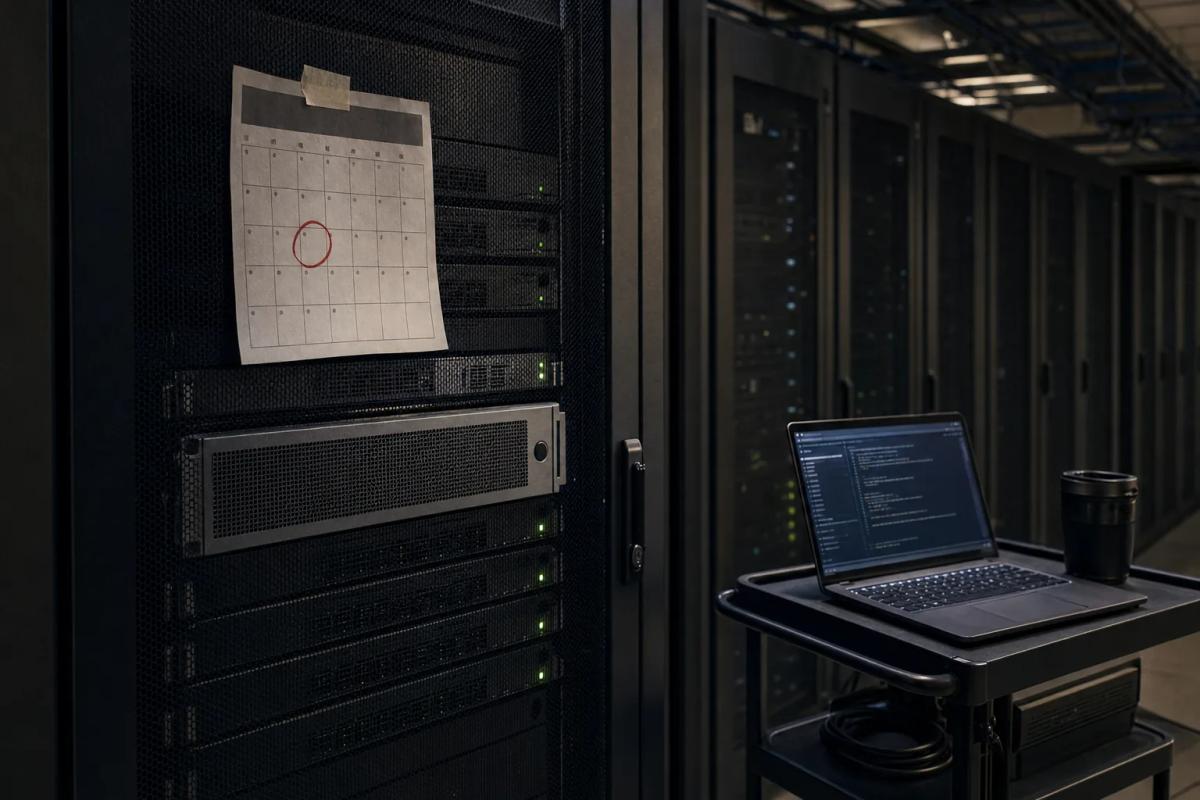
If you call Inception's Mercury models through api.inceptionlabs.ai, you have until December 28, 2026 to move, whatever happens with Nvidia. Inception's own documentation says the Mercury API "remains fully available through December 28, 2026" and that after that date customers lose access to the service "or to any data submitted to the platform." The Nvidia deal, reported by The Information on November 19 at more than $500 million, is still unconfirmed by either company. The shutdown date is already on Inception's docs site.
Engineering teams that put Mercury 3, Mercury Voice or Mercury Decide behind a latency-sensitive feature should run this as a migration with a fixed date, and treat any deal terms as news that might move that date later.
What Was Reported, and What Nobody Has Confirmed
The deal is a single paywalled report with no comment from either side. Newsquawk carried the headline on its live feed at 22:46 UTC on November 19, 2026, naming Inception as the target and putting the price at over $500 million, and noted that "confirmation from either party is the next tell." The Information's article, bylined Stephanie Palazzolo, Phoebe Liu and Amir Efrati, sits behind a subscription wall. Its headline says Nvidia "nears" the acquisition, which means nothing has been signed in public.
Nvidia is not a stranger to the company. Inception's $50 million seed round in November 2025 was led by Menlo Ventures, with participation from Nvidia's venture arm NVentures, Microsoft's M12, Snowflake Ventures and Databricks Investment. SiliconANGLE's report on the round describes co-founder and chief executive Stefano Ermon's pitch: diffusion models in place of the autoregression that makes most LLMs generate words one at a time.
A diffusion LLM is a language model that starts from a rough draft of the whole output and refines it over several steps, instead of predicting each token in sequence. Inception's claim for the approach is speed. Its Mercury 3 launch post cites 1,068 tokens per second on Nvidia GPUs, a vendor figure. That is the obvious reason a GPU company would want the team.
The API Ends December 28, Deal or No Deal
The shutdown notice comes from Inception and stands on its own. The docs home page carries a banner that reads "The Mercury API is winding down," and the wind-down page tells customers to move applications that call api.inceptionlabs.ai to another provider before December 28 "so requests do not start failing." It also tells them to download request logs and billing history and invoices from the dashboard first, because nothing stored on the platform will be reachable afterwards.
The page gives no reason beyond "careful consideration," carries no posting date, and does not mention Amazon Bedrock, Azure, enterprise contracts or refunds.
The notice was public before the deal report. A write-up on explainx.ai dated November 12 relays a customer email from Inception with the same December 28 date, and says a draft Vercel AI SDK provider pull request was closed that day with the comment "Mercury API is winding down." That post relays customer reports rather than an official statement, so treat its OpenRouter details as unconfirmed. The timing is still awkward for anyone who bought recently: Vercel announced Mercury 3 on its AI Gateway on October 19, 2026 "with 50% off launch pricing." Teams that adopted the model that week got about ten weeks of service.
Nobody has said the shutdown and the deal are connected. The simplest reading of the sequence is that Inception decided to stop selling a public API while it negotiated a sale. That is an inference from dates, and Nvidia could still choose to serve the models itself after a close.
What Mercury Customers Are Losing on Price
You are giving up some of the cheapest per-token pricing in the market, and the replacement will probably cost more. Inception's models table lists Mercury 3 at $0.10 per million input tokens and $0.35 per million output, both shown as discounts from $0.20 and $0.70, with a 1M-token context window. Mercury Voice is listed at $0.20 input and $0.75 output, also half its regular $0.40 and $1.50. Mercury Decide bills only input tokens, at $0.02 per million, half its regular $0.04.
For a decision or routing workload, the nearest like-for-like we have covered is Google's Gemini Decision 1, which launched at $0.10 per million input tokens with no output charge. That is five times Mercury Decide's discounted rate, and 2.5 times its regular $0.04. If you budgeted a routing layer on Inception's launch prices, re-run the budget before you pick a replacement, and price it at list, not at a promotion.
Speed is the harder thing to replace. Mercury Voice was sold on its latency, and our September analysis of Mercury Voice found the 320ms claim came without published benchmark scores. If your voice agent's turn-taking was tuned around Mercury's time to first token, measure the replacement on your own traffic. Fast-inference providers such as Groq and Cerebras are the natural first tests, and a router such as OpenRouter or a self-hosted LiteLLM proxy makes it cheap to A/B two of them.
Your Contract Gives You Very Little Leverage
Inception's standard terms let it walk away, and they cap what you can recover. The terms of use, effective September 1, 2025, say Inception "may transfer, assign, or delegate these Terms" without your consent, while you need its written consent to assign yours. They allow it to terminate "for any reason in our discretion" and to suspend or discontinue any part of the service. Liability is capped at the greater of $100 or what you paid in the prior twelve months. The terms contain no service-level commitment. The only uptime promise is a line on the Inception home page about "99.5%+ uptime and priority support with custom SLAs."
So a self-serve customer has a refund question and not much else. If your company signed a negotiated order form with a custom SLA, that paper governs, and it is the first thing to pull this week. Our comparison of LLM API SLAs shows what the large providers commit to, which is a reasonable baseline for what to demand from the replacement.
The same terms let Inception train on what you send unless the "Improve the model for everyone" setting is off. If a buyer acquires the company, ask in writing what happens to any retained submissions. The wind-down page says customers lose access to that data; it does not say the data is deleted.
Bedrock and Azure Customers Have an Open Question
If you reach Mercury through a cloud marketplace, the wind-down notice does not tell you what happens to you. AWS announced Mercury models in Amazon Bedrock Marketplace and SageMaker JumpStart in 2025, and Inception's home page says it is "available through major cloud providers like AWS Bedrock and Azure Foundry." SiliconANGLE's 2025 report said Azure Foundry support was "coming soon" at the time.
A marketplace listing is a separate commercial channel from the direct API, so it may run on a different timeline, or end on the same day. Inception's notice covers only api.inceptionlabs.ai. Ask your Amazon Bedrock or Microsoft Foundry account team, in writing, whether the Mercury listing and any subscription you hold survive December 28, and what notice they will give if it does not.
What Nvidia Has Done With Inference Startups Before
Nvidia's record on AI startup deals points in both directions, which is why you should plan for the worse case. When Nvidia bought OctoAI in 2024, customers received an email that quoted a September 26 decision to "initiate the wind down" of its commercial services and ended access on October 31, 2024, about five weeks later. That account is a reproduction of the customer email, and its wording varied by account.
The Groq deal went the other way. Groq's December 24, 2025 announcement of a non-exclusive licensing agreement, under which Jonathan Ross and other Groq staff joined Nvidia, said "GroqCloud will continue to operate without interruption." The difference was structure: Groq licensed its technology and stayed independent, while OctoAI was bought outright. When Nvidia hired 109 Poolside engineers under a licence in August, no customer clause fired at all, and its reported Reflection AI talks raised the same buy-or-license question.
Inception has already answered the question that mattered in the Groq case. Its public API is closing on its own schedule, so the OctoAI outcome is the one to plan around. Other buyers have followed the same pattern this autumn: Apple's Ascend.io deal and Meta's Sundial purchase both left external customers to migrate.
What to Do Before December 28
This Week:
- Search your code and your gateway configs for
api.inceptionlabs.ai,inception/mercuryand any Bedrock or Foundry Mercury model IDs. Put the list, with owners and traffic volume, in one ticket. - Download request logs, invoices and billing history from the Inception dashboard, as the wind-down page instructs. You will need the invoices for any refund claim.
- Check whether the "Improve the model for everyone" setting was on for your account, and email hello@inceptionlabs.ai to ask in writing what happens to retained submissions and any prepaid balance.
This Month:
- Pick a replacement for each workload. Test voice and autocomplete on latency against your own traffic, and test routing and decision calls on accuracy and cost per call at list price.
- Put a router in front of the replacement so the next shutdown is a config change. If you already run OpenRouter or LiteLLM, add a fallback model now.
- Get your AWS or Microsoft account team to confirm in writing what happens to Mercury marketplace listings after December 28.
Before December 28:
- Cut production traffic over by mid-December, so a failed migration still leaves days to roll back before the API stops answering.
- If the Nvidia deal is confirmed before then, read the announcement for one thing only: whether Nvidia commits to serving Mercury models anywhere. Unless it says so, keep the migration date.
The Bigger Picture
Inception sold enterprise buyers one thing: a model that was faster and cheaper per token than the large providers. In the OctoAI, Ascend.io and Sundial deals, the buyer kept the team and the technology and the public service closed. Diffusion LLMs may turn up inside Nvidia's software stack later, but nothing announced so far says so. Your December traffic needs a provider that exists on December 29, and Inception's own docs say it will not be Inception.
Continue Reading
- Mercury Voice Claims 320ms and a Benchmark Win With No Numbers
- Nvidia Hired 109 Poolside Engineers. No Clause Fired.
- Nvidia Could Buy, Invest in or Acquihire Reflection AI
- Apple's Ascend.io Deal Leaves Pipeline Customers to Migrate
- OpenAI, Azure, Bedrock, Vertex and Anthropic SLAs Compared
- Prime Intellect Buys Moondream, Local Fine-Tunes Need API Key