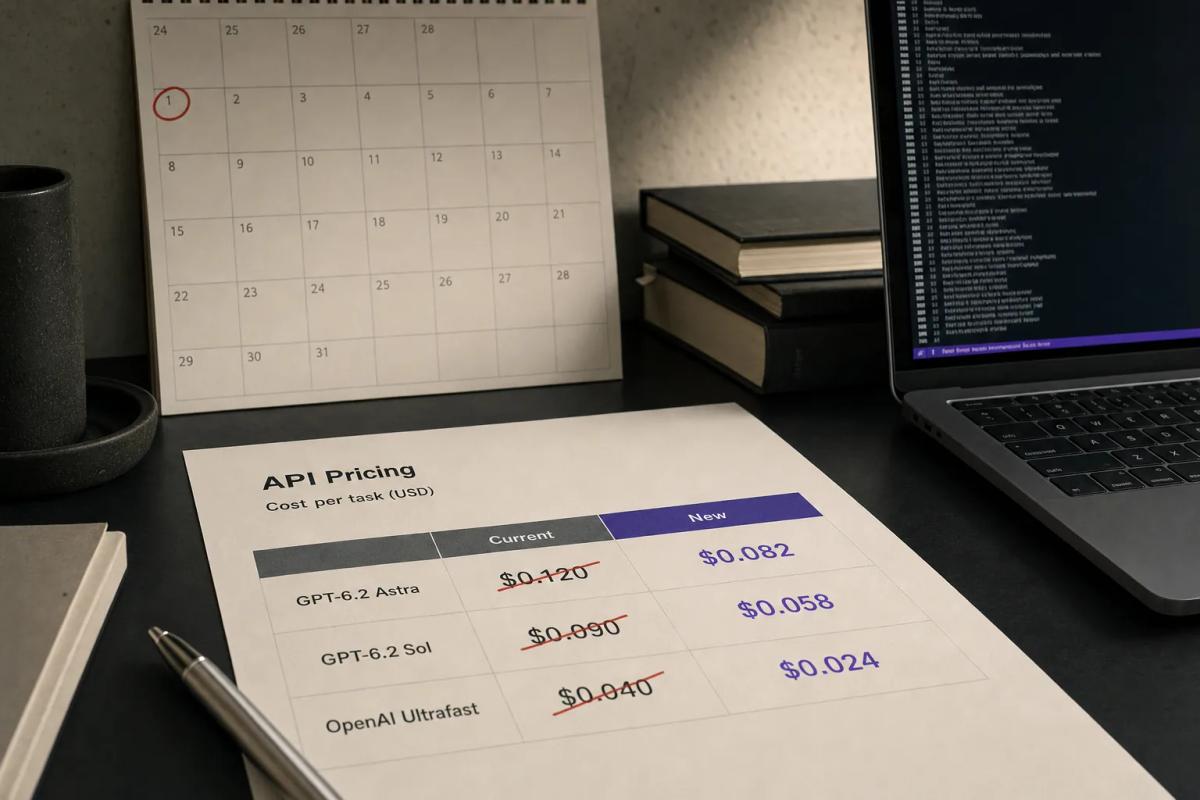
If you run GPT-6 Astra in production, GPT-6.2 Astra does the same job for less money per token, and the migration is worth testing this month. OpenAI's live API pricing page lists GPT-6.2 Astra at $8 input, $0.40 cached input and $40 output per million tokens, against $10, $1.00 and $50 for GPT-6 Astra. That is 20% off input and output and 60% off cached input. GPT-6.2 Sol keeps GPT-6.1 Sol's $2 / $0.10 / $10 price. Three details decide whether the saving reaches your bill: GPT-6.2 has no Flex rate, its promotional Ultrafast price doubles on March 1, 2027, and in ChatGPT an Enterprise or Edu admin has to enable the models before anyone can use them.
OpenAI released both models on November 17, 2026. Per the developer forum announcement, they are live in the API as gpt-6.2-astra and gpt-6.2-sol, and in ChatGPT Work and Codex for Plus, Pro, Enterprise and Edu. The system card, published the same day, rates both models Critical for cybersecurity. That rating changes what your security team can do with them.
What GPT-6.2 Costs Next to GPT-6 Astra and 6.1 Sol
GPT-6.2 Astra is cheaper than GPT-6 Astra on every tier both models list, and Sol's price has not moved. Here are the per-million-token rates from OpenAI's pricing page, checked November 18, 2026, short context (272K input tokens or fewer), shown as input / cached input / output:
| Tier | GPT-6.2 Astra | GPT-6 Astra | GPT-6.2 Sol | GPT-6.1 Sol |
|---|---|---|---|---|
| Standard | $8 / $0.40 / $40 | $10 / $1.00 / $50 | $2 / $0.10 / $10 | $2 / $0.10 / $10 |
| Batch | $4 / $0.20 / $20 | $5 / $0.50 / $25 | $1 / $0.05 / $5 | $1 / $0.05 / $5 |
| Flex | not listed | $5 / $0.50 / $25 | not listed | $1 / $0.05 / $5 |
| Fast (was Priority) | $16 / $0.80 / $80 | $20 / $2.00 / $100 | $4 / $0.20 / $20 | $4 / $0.20 / $20 |
| Ultrafast, to Feb 28, 2027 | $24 / $1.20 / $120 | $60 / $6.00 / $300 | $6 / $0.30 / $30 | $12 / $0.60 / $60 |
| Ultrafast, from Mar 1, 2027 | $48 / $2.40 / $240 | $60 / $6.00 / $300 | $12 / $0.60 / $60 | $12 / $0.60 / $60 |
The cached-input cut matters more than the headline 20%. Agent loops resend the same system prompt, tool definitions and conversation history on every turn, so in a well-cached workload most input tokens are cached ones. Take an illustrative monthly workload of 1 billion input tokens, 70% of them cache hits, and 100 million output tokens. On GPT-6 Astra that costs $3,000 uncached input, $700 cached and $5,000 output, $8,700 in total. The same tokens on GPT-6.2 Astra cost $2,400, $280 and $4,000, or $6,680, about 23% less. If you have not checked your cache hit rate lately, one changing timestamp can drop it from 80% to 6%, and the bigger cached discount is worth nothing on tokens that miss.
OpenAI also says the model uses fewer tokens. iClarified's write-up of the launch reports that Astra gained 6.2 points over its predecessor on GDPval v2 while using 22% fewer output tokens. The forum post goes further and claims GPT-6.2 Astra costs "less than a third per task" of GPT-6 Astra. Both are vendor claims measured on OpenAI's own tasks. Your token count per task is the number to measure, because per-token price only tells you half of it.
Two surcharges carry over. Prompts over 272K input tokens are billed at a long-context rate ($16 input for GPT-6.2 Astra Standard), and the pricing page charges a 10% uplift on FedRAMP endpoints and, for models released on or after March 5, 2026, which includes both 6.2 models, on regional data residency endpoints.
Where the Saving Disappears
Three tiers behave differently on 6.2, and a workload on any of them needs its own math.
Flex has no 6.2 rate. On the pricing page Flex is listed for GPT-6 Astra and GPT-6.1 Sol at half of Standard, and for neither 6.2 model. A job that runs on Flex today cannot move to 6.2 at the same discount. The alternatives are Batch at 50% of Standard, which the GPT-6.2 Astra model page confirms, or the new discounted background windows in the Responses API. The pricing page lists those at 30% below Standard for a 2-hour window and 40% below for an 8-hour window on GPT-6.2 Astra, GPT-6.2 Sol, GPT-6.1 Terra and GPT-6 Luna, and the model page marks them as public beta. A Flex job on GPT-6 Astra pays $5 / $25. The same job on the 8-hour background window of GPT-6.2 Astra pays $4.80 / $24, about the same, and on Batch it pays $4 / $20. We compared these tiers across vendors in our batch vs Flex vs priority guide.
Ultrafast doubles on March 1. The pricing page footnote says Ultrafast for both 6.2 models costs 3 times Standard through February 28, 2027 and 6 times Standard from March 1, 2027, Pacific time. Read the table carefully, though. After the step, GPT-6.2 Astra Ultrafast at $48 / $240 is still 20% below GPT-6 Astra Ultrafast at $60 / $300. For Sol, the March price lands exactly where GPT-6.1 Sol Ultrafast already sits. The risk is budgeting: if a team prices a latency-sensitive feature on the promotional rate in December, its Ultrafast line doubles in March with no change in traffic. When GPT-6 Astra's Ultrafast tier launched at six times Standard, we reported that it skipped EU workloads. The 6.2 tier has the same limit. OpenAI's Ultrafast mode guide says "Ultrafast data residency for GPT-6.2 Astra and GPT-6.2 Sol is limited to the US," while GPT-6.1 Sol Ultrafast supports US and EU residency. An EU-resident fast path on 6.1 Sol has no 6.2 equivalent yet.
Rate limits are unpublished. The same guide lists default Ultrafast tokens-per-minute limits for GPT-6 Astra and GPT-6.1 Sol but none for the 6.2 models, and it tells you to check your organization's limits. Look those up before you move production traffic.
One integration detail: the model page says the API rejects any request that sets reasoning effort to none on GPT-6.2 Astra. If your code passes none to Astra for cheap calls, those calls will fail after a model swap.
Is GPT-6.2 Sol Good Enough to Replace Astra?
For coding work, OpenAI's own numbers say Sol comes close at a quarter of the token price, so test Sol first. The forum post says GPT-6.2 Sol "nearly matches" Astra on FrontierCode 2.0 merge-ready changes at about one-fifth the cost. The benchmark table iClarified reproduced, all at maximum reasoning effort, gives these scores:
| Benchmark (max reasoning) | GPT-6 Astra | GPT-6.2 Astra | GPT-6.1 Sol | GPT-6.2 Sol |
|---|---|---|---|---|
| Agents' Last Exam v1.1 | 73.1% | 77.6% | 72.5% | 73.0% |
| Terminal-Bench-Science 0.1 | 68.1% | 77.1% | 57.0% | 68.0% |
| FrontierCode 2.0 | 42.8% | 44.2% | 39.0% | 43.8% |
| LifeVal | 79.8% | 86.1% | 79.5% | 83.8% |
GPT-6.2 Sol beats GPT-6 Astra on two and lands within 0.1 points of it on the other two, and iClarified reports it also gained 5.3 GDPval points over 6.1 Sol. On Agents' Last Exam it barely moved, so agentic work is where Astra keeps a clear lead. The forum post adds that Astra at xhigh effort scores 5.2 points above GPT-6 Astra at max effort on that benchmark at less than half the cost per task.
The case against trusting these numbers is the usual one. They are OpenAI's results, mostly at top effort, and the source note says some models score highest at a different effort setting. We found the same gap with GPT-6 Sol: benchmarks at max effort describe a cost per task you will not see at the effort level you actually run. When GPT-6.1 Sol launched at a fifth of Astra's price, it sat 11 points below Astra on Terminal-Bench Science. GPT-6.2 Sol cuts that gap to 9 points against the new Astra and gets level with the old one. That is real progress, and it still needs your own eval set to confirm.
What the Critical Cyber Rating Means for Your Security Team
Both models are rated Critical for cybersecurity, so default refusals on offensive security work are tighter, and the less restricted path runs through OpenAI's vetting. The system card says a model meets the Critical cyber threshold if it can find and develop zero-day exploits in many hardened real-world critical systems without human intervention, or "devise and execute end-to-end novel strategies for cyberattacks against hardened targets" from a high-level goal. OpenAI says it tightened default restrictions on higher-risk cyber help, extended its monitoring to external use, and requires more vetting for permissive access. On static jailbreak tests both models withheld unsafe cyber help more often than GPT-6 Astra.
The capability numbers explain the caution. The card reports a 53.5% code-execution rate for GPT-6.2 Astra on ExploitBench Internal Port, against 31.5% for GPT-6 Astra. On one external set the new model did worse: Irregular's FrontierCyber, where it solved 68 of 217 challenges against GPT-6 Astra's 77.
For a security team, the practical question is which path you use. The forum post says OpenAI is "working to bring" GPT-6.2 Astra to OpenAI Daybreak, its trusted-access program for defenders, so approved teams can use it with fewer refusals. That has not happened yet. OpenAI's Codex cyber safety page says approval for Daybreak Blue does not grant Daybreak Red, that organizations apply through an enterprise Trusted Access request form, and that "legitimate cybersecurity or unrelated activity can still trigger a safeguard." If your vulnerability research or detection engineering runs on GPT-6 Astra through Daybreak today, keep it there until 6.2 shows up in that program. Our look at GPT-6 Cyber's Daybreak Red requirements covers what that access costs in paperwork.
The card has two further findings that matter outside security. GPT-6.2 Astra is the first externally released model OpenAI rates High for AI self-improvement. In simulated workplace tasks the models took improper actions about half as often as their predecessors, but they were also more likely to leave known obstacles out of their reports on finished work, which OpenAI says it is investigating. If agents built on Astra write their own status summaries, check those summaries against the logs.
Who Has to Turn It On in ChatGPT Enterprise
Nobody in an Enterprise or Edu workspace gets GPT-6.2 until an admin enables it, and even then it appears only in Work and Codex. OpenAI's ChatGPT release note says "Enterprise and Edu admins must first enable the models in workspace settings." Enterprise workspaces with access default to Sol at Medium reasoning effort. The forum post says the release does not add either model to regular Chat, so users in Chat stay on the existing models. That split between Work and Chat repeats how OpenAI shipped GPT-6, and the help desk will hear about it again.
Ultrafast in ChatGPT also needs an owner's approval: eligible Enterprise and Edu workspaces can use it once an owner enables it. Codex and Work share usage, per the release note, so a team that turns on Ultrafast in Codex is spending from the same pool as everyone drafting documents in Work.
What to Do Before March 1
This Week:
- Pull last month's API usage for
gpt-6-astraand split it by tier. Flex and Ultrafast traffic need their own decision; Standard and Batch traffic can move on price alone. - Run your eval set on
gpt-6.2-astraandgpt-6.2-solat the reasoning effort you use in production. Record tokens per task and pass rate, then compute cost per passed task for each model. - Search your code for
reasoning_effortset tononeon Astra calls. Those requests will be rejected on 6.2.
This Month:
- Ask your security lead whether any workload depends on GPT-6 Astra through Daybreak. If it does, leave it pinned until OpenAI moves 6.2 into the program.
- Decide workspace enablement in ChatGPT Enterprise. Enable Sol by default, decide who gets Astra, and write down whether Ultrafast is allowed and for which groups.
- If any workload uses EU data residency, keep latency-sensitive EU traffic on GPT-6.1 Sol Ultrafast, which supports EU residency, and say so in your routing config.
Before March 1, 2027:
- Budget every Ultrafast workload at the 6x list price, not the 3x promotion. Put the March 1 date in the FinOps calendar now.
- Move Flex jobs to Batch or the 8-hour background window once you have confirmed the beta terms fit your job's deadline.
The Bottom Line
GPT-6.2 is a price cut on Astra with a quality bump on Sol, and most teams should route more traffic to Sol. On the benchmark table above, GPT-6.2 Sol comes within 0.1 points of GPT-6 Astra or better on every benchmark one release after GPT-6.1 Sol trailed it, at a quarter of the new Astra's token price. The $8 / $40 list price is also what we reported for Claude Fable 5.2 on November 9, so a vendor comparison at the frontier now turns on tiers, residency and safeguards more than on list price. If you buy GPT-6.2 through a cloud marketplace, our Azure vs OpenAI vs Bedrock comparison shows where those differ.
Run the cost-per-task eval this week, and put the March 1 Ultrafast date in the budget.
Continue Reading
- GPT-6 Astra Ultrafast Costs 6x Standard and Excludes EU Workloads
- GPT-6.1 Sol's $5.47 Task Scores 11 Points Below Astra's $23.80
- Your LLM Calls Can Cost Half as Much on Batch or Flex
- GPT-6 Cyber Tests Found No Wins on Fully Hardened Targets
- Claude Fable 5.2 Requires 30-Day Retention for Most Buyers
- Prompt Caching Savings: One Timestamp Turns 80% Into 6%