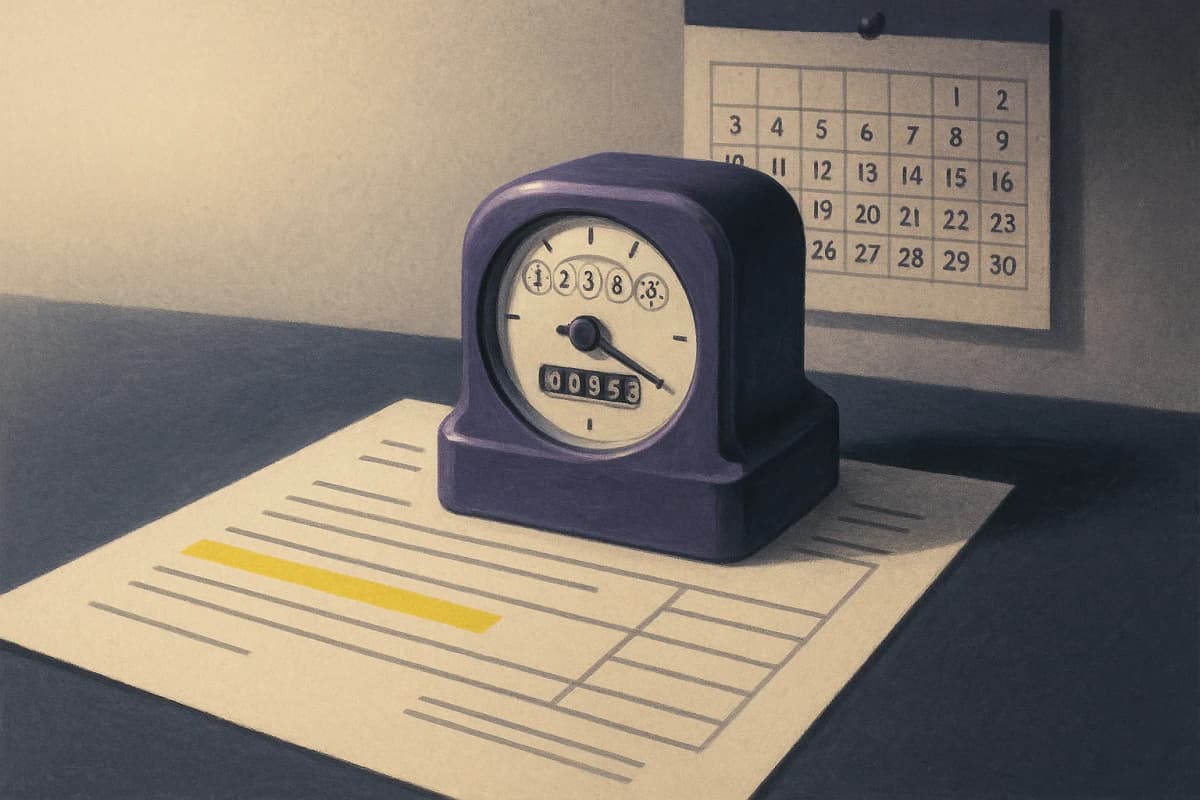
On October 1, ChatGPT gets cheaper to license and harder to budget for. The new GSA–OpenAI OneGov agreement drops the platform fee to zero and takes 50% off token usage, with "no platform-access fee, no minimum orders, and no spend commitment." But it swaps a $1 flat fee for a meter, and a federal agency cannot run an open meter: the Antideficiency Act bars obligating money beyond what is available. The agencies that come out ahead will size a token budget, write a ceiling into the order, and get renewal quotes from all three OneGov AI vendors before September 30.
Doing nothing is also a choice. The Claude and Gemini deals expire the same day, and the fiscal year opens on a stopgap budget.
What OpenAI's New OneGov Deal Actually Charges
The new deal charges nothing for access and half price for use. GSA announced the 27-month agreement on September 10: it starts October 1, agencies "pay only for what they use," and the 50% discount covers token-based usage across "ChatGPT models, including those in FedRAMP‑authorized environments." The agreement runs through December 31, 2028, and the platform licence it waives normally costs $15 per user per month.
It replaces the pilot GSA announced in August 2025: ChatGPT Enterprise for $1 per agency for a year. That pilot has given more than 1 million government employees access to ChatGPT, and the new terms open the door much wider. Eligibility covers "federal (executive, legislative, and judicial), state, local, and tribal governments," ordering directly, through resellers or via supported cloud marketplaces, per GSA. OpenAI expects eligibility to reach about 23 million people, Nextgov reports.
Security tooling comes along too. OpenAI's Daybreak offering comes in two tiers: Daybreak Blue at 50% off commercial pricing and Daybreak Red at standard commercial rates, according to Nextgov. GSA is clear about where this is heading: "providing consumption-based access is the next logical step," acting Federal Acquisition Service commissioner Laura Stanton said in the release.
The case for the meter deserves its full weight. A seat licence bills you for every employee who logged in once in March, which is exactly the gap M&T's three Copilot counts exposed. Under a meter, a bureau whose staff rarely open ChatGPT pays for what little they use. That beats a per-user renewal, which is what agencies had been told to expect. As recently as August, FedScoop reported that OpenAI's post-pilot "pricing is based on the number of users in tiers." Four weeks later, the unit is the token. Any FY27 estimate built in August was built on the wrong unit.
Why a Federal Agency Cannot Run an Open Meter
A metered service has to be funded before it is used, which means someone has to forecast the bill. The Antideficiency Act is the federal law that bars officials from obligating or spending money beyond what Congress has made available. GAO summarises 31 U.S.C. § 1341 as prohibiting "making or authorizing an expenditure from, or creating or authorizing an obligation under, any appropriation or fund in excess of the amount available." Violations bring administrative discipline, possible criminal penalties, and a required report to the President and Congress.
"No spend commitment" is a promise from the vendor. It does not lift the obligation rule off the buyer.
Federal IT has been through this before with cloud. "The rule requires that when a government agency budgets for cloud, it has to put money aside," cloud services expert Richard Beutel told FedTech in 2023. The same piece described the failure plainly: if the reserved pool runs out mid-cycle, the bill goes unpaid and the service "goes dark."
GSA already has the mechanism. Its acquisition letter MV-21-06 says the contracting officer "shall establish a task order ceiling price for all estimated requirements," that the government "will not be obligated to pay the Contractor any amount in excess of the ceiling price," and that the contractor must either provide usage-tracking tools or notify the contracting officer at "50 percent and 75 percent of the ceiling price for each CLIN." GSA's Cloud SIN ordering guidance calls the requirements task order "the preferred vehicle for consumption-based cloud buying."
A requirements task order is a contract vehicle that funds a ceiling for estimated usage and pays for actual consumption against it, month by month. Whether your ChatGPT order sits on that schedule line is a question for your contracting officer. The discipline applies either way: without a ceiling, the meter has no breaker.
The Stopgap Budget Shrinks the First Forecast to 72 Days
FY27 opens on a continuing resolution, so the first token budget has to fit inside about a fifth of a year's money. The House passed the stopgap 370-48, and President Trump signed it on September 2. It keeps most programs at FY2026 funding levels through December 11.
That matters twice. First, a CR usually provides a "funding rate": budget authority equal to a reference level "multiplied by the fraction of the fiscal year for which the funds are made available," per the Congressional Research Service. October 1 through December 11 is 72 days, so the first order should be sized to that window, not to the year.
Second, CRS notes that CR budget authority "is typically prohibited for new activities not funded in the previous fiscal year." Does moving from a $1 pilot to a metered usage line count as a new activity? That is a question for your appropriations counsel, not your contracting officer. Ask it this week, not in November, when the first real invoice lands.
The Discount Applies to a Rate the Deal Never Names
The 50% discount is real, but the announcement never prints the rate it comes off. GSA's release describes the discount and which models qualify, but lists no per-token rates. Securities.io's summary of the terms lists none either, though it reports OpenAI saying the tools offered include GPT-6 Astra. OpenAI does publish a token rate card for commercial Enterprise customers on usage-based billing, but neither announcement says that card is the baseline for the government discount.
That gap is the forecasting problem in miniature. You cannot fund a ceiling against a rate nobody has confirmed applies to your order. OpenAI says it will provide usage estimates, spend controls and FinOps guidance to participating organizations. That helps, but an estimate is not a rate card, and a vendor's spend control is not an obligation ceiling. OMB's own acquisition memo, M-25-22, lists "pricing transparency" among the protections against vendor lock-in that agencies should write into AI solicitations. Get the rate card attached to the order.
Treat pilot data carefully, too. The 2025 pilot came with "unlimited use of advanced models" for 60 days and cost $1 however heavily anyone used it. It is the only usage history you have, and nobody who generated it ever saw a price. Use it for the shape of demand (which bureaus, which weeks, which models), then price it with the rate on your order. Commercial buyers learned the same lesson from GPT-5.6 Sol's promotional pricing: budget at the rate you will pay after the discount window, not during it.
Doing Nothing on Claude and Gemini Is Also a Decision
The OneGov deals for Claude and Gemini end the same day as OpenAI's, and neither has published successor pricing. All three promotional deals expire September 30, the last day of FY26. A GSA official has previously signalled the agency is looking to re-up OneGov agreements, Nextgov reports, but it is unclear whether those two will be extended.
What exists in writing is thin. Anthropic's $1 offer, announced in August 2025, covered Claude for Enterprise and Claude for Government across the federal civilian executive, legislative and judicial branches. Google's $0.47 Gemini for Government offer says only that "at the end of the promotional period, customers must renew at a per user price," per Carahsoft's offer page. No price is given. Datadog argues that renewal decisions need "clear cost and usage evidence." Most agencies have 17 days to produce it.
So on October 1, an agency that does nothing may be left with exactly one OneGov AI product with a published successor agreement. That is consolidation by default, not by evaluation. For any Claude renewal file, record one more fact: GSA pulled Anthropic from its offerings on February 27 under a presidential directive to stop using its technology, then restored it on April 3 after a federal court's March 26 preliminary injunction. The Army's Agentforce rollout ran into its own version of that availability question.
An Earlier Free Government Software Offer Ended in Paid Renewals
Microsoft ran this play in 2021, and the renewals came in paid. ProPublica reported that after a White House cybersecurity summit, Microsoft pledged $150 million in technical services, including free upgrades to its G5 security suite for up to a year. Former Microsoft salespeople told ProPublica that the Defense Department customers who accepted the offer ultimately moved to paid G5 licences when their agreements renewed in 2022 and 2023. "The free services are allowing the government to bypass a competitive procurement process and locking them in for future procurements," Jessica Tillipman of George Washington University Law School told ProPublica.
The OpenAI deal is structurally cleaner. It carries no minimum spend, and M-25-22 names "minimum spend requirements" among the practices that "encourage consolidation of spending with one vendor or one group of vendors." This time the lock-in is behavioural: custom workflows, saved projects, and staff who have learned one tool. "When the promotional period ends, the cost of switching isn't limited to the price of licensing an alternative platform. It's the disruption of unwinding months of institutional dependency," Tillipman told FedScoop. Her shorter version: "The leverage agencies have today will not survive renewal."
Leverage is highest now, while three vendors still have to compete for the renewal.
What to Do Before the Meter Starts
Each item below can be started by a named person this week, and most of the work has to be done before September 30.
This Week:
- Pull the pilot's usage history by bureau. Get weekly active users, volume and model mix from whatever your workspace admin can export. Put it in front of your budget officer with the 72-day CR window marked.
- Get the price in writing. Ask OpenAI or your reseller for the per-token rates, the eligible model list and the billing cadence. A 50% discount is meaningless until you know the rate it comes off.
- Put two questions to appropriations counsel. Which account funds metered ChatGPT from October 1? And is it a new activity under the CR?
Before September 30:
- Write the order with a ceiling sized to 72 days of forecast usage. Require the 50% and 75% ceiling notifications that MV-21-06 already describes.
- Ask OpenAI in writing whether its promised spend controls enforce a hard limit, and at what level: agency, bureau or user. If they only alert, the 75% notice is your only brake.
- Request post-September pricing from Anthropic and Google through their schedule holders. Decide deliberately whether Claude or Gemini will lapse. If one will, export users' projects and shared content before access ends.
Before December 11:
- Re-forecast from October's actual invoice before the stopgap expires. Write sunset criteria into the renewal file. M-25-22 already says "changes in costs, agency needs, vendor-proposed requirements, or model performance" may signal an agency should reconsider continued use.
- State, local and tribal buyers: before signing a no-commitment order, have your finance office confirm how your own budget law treats a purchase with no fixed quantity. Then compare the offer with the contracts you already hold.
The Bottom Line
The $1 era worked as an acquisition strategy. GSA counts roughly 3.5 million federal employees with AI tools through OneGov and about $1.4 billion in savings from its AI agreements. The meter is the bill for that success, and it is the fairer bill: a bureau pays for use, not for seats nobody opened.
But public money cannot sit behind an open meter, and neither should an enterprise budget. Leaving a free pilot works the same way everywhere. Cap the consumption before you buy it, and price the habit you built, not the licence you were quoted.
A $0 licence is a price. A ceiling is a decision. Make it before October 1.
Continue Reading
- GPT-5.6 Sol Is $20 Until Nov 21. Budget Both Rates.
- Agentic AI Pricing: Don't Buy Consumption Without a Cap
- GPT Spend Management: OpenAI Enterprise Controls Explained
- True Cost of a Copilot Seat: The Licence Is the Floor
- One AI Clause, $91.8B Market: Half of Vendors Locked Out
- Federal AI Vendor Risk: The $32B Test Every CIO Must Run
