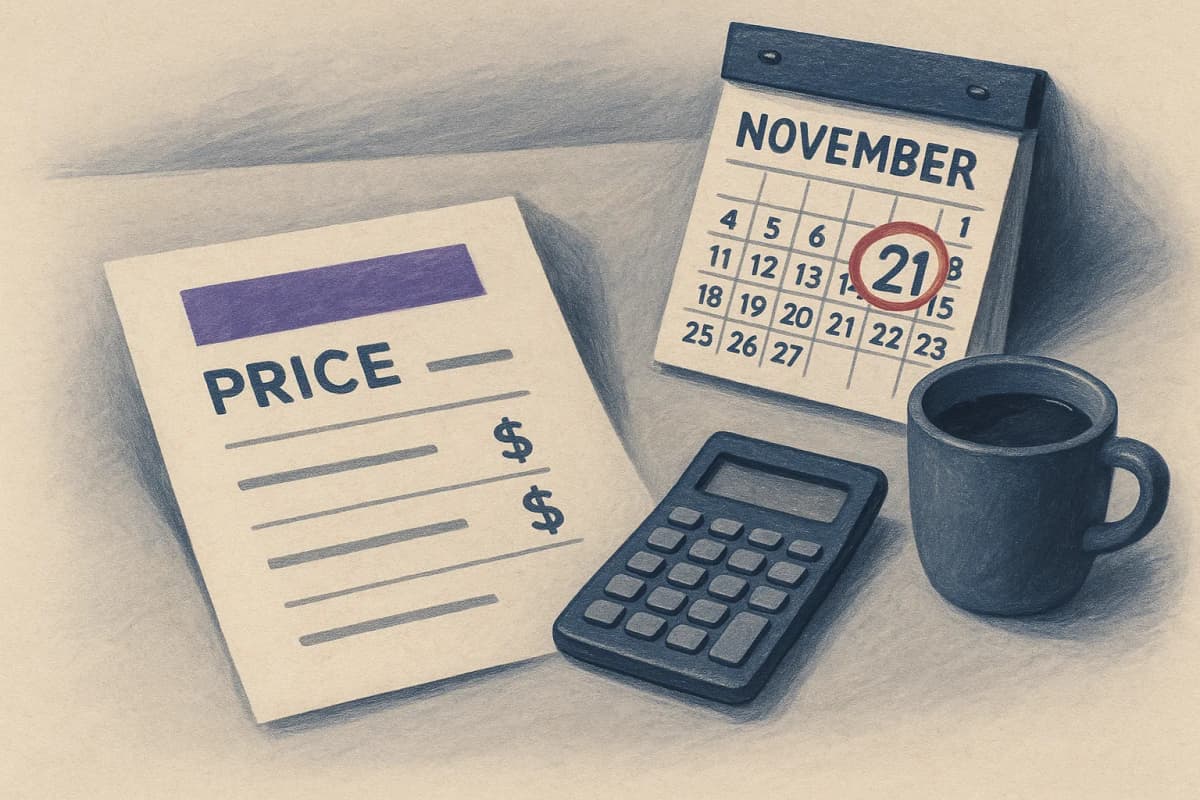
OpenAI's frontier tier now costs $4 per million input tokens and $20 per million output tokens, down from $5 and $30 — but the rate is promotional and it expires. OpenAI's own pricing page guarantees it "at least through November 21, 2026," and publishes no successor. That is 89 days from today. Every FY27 budget, per-transaction unit-economic model and term commitment signed this quarter is anchored to a rate the vendor has declined to commit to past November — and because the cut was asymmetric, a flat "25% cheaper" line in your model is wrong for every workload you run.
This is not a story about a price cut. It is a story about what a vendor will and will not put in writing about next quarter, and how much of your planning cycle you have quietly built on the difference.
What OpenAI Actually Committed To
OpenAI committed to a floor on the discount, not a date the price changes. The exact sentence on the developer pricing page is: "GPT-5.6 Sol's promotional pricing is available at least through November 21, 2026." Read it as a contract term and it says one thing — the rate will not rise before that date. It says nothing about what happens on the 22nd, and OpenAI has published no successor schedule.
The rates took effect on August 21. AWS mirrored them on Bedrock the same day, describing the change as "20% lower input pricing and 33.3% lower output pricing" and carrying the identical November 21 language. Cached input fell to $0.40 per million, a 90% discount off the uncached input rate.
The promotion's scope is narrower than the headline suggests. It covers the pay-as-you-go API, Codex credits and eligible ChatGPT Work plans; Pro, Plus and Business subscriptions are unchanged. If your organisation buys seats rather than tokens, this cut did not reach you at all.
The Cut Was 33%. The Reversion Is 50%.
A percentage cut and its reversal are not the same number, and this is the single most common error in the budget models being built right now. Output went from $30 to $20 — a 33.3% cut. Going back to $30 from $20 is a 50% increase. Input fell 20% and would rise 25%. A planner who models "prices return to where they were, so add back 33%" lands on $26.67 per million output tokens and understates the reversion by $3.33 per million, or 11%.
At scale that error is not academic. Take a reasoning-heavy agent turn — 5,000 input tokens and 8,000 output tokens, because reasoning tokens bill as output. At today's rate that is $0.180 per call; at $5/$30 it is $0.265. Run a million of those a month and the difference is $85,000 a month, or roughly $1.02 million a year, sitting in a budget line most models currently show as a rounding adjustment.
Your Discount Depends on Your Token Mix
The cut is asymmetric, so no two workloads got the same discount, and a single blended assumption is wrong for all of them. The blended saving is 20% weighted by input's share of your old cost plus 33.3% weighted by output's share.
Work it through on two real shapes:
| Workload | Tokens per call | Cost at $4/$20 | Cost at $5/$30 | Cut | Reversion |
|---|---|---|---|---|---|
| Retrieval-shaped (RAG answer) | 20,000 in / 800 out | $0.0960 | $0.1240 | −22.6% | +29.2% |
| Reasoning-shaped (agent turn) | 5,000 in / 8,000 out | $0.1800 | $0.2650 | −32.1% | +47.2% |
Same vendor, same day, same cut: one workload got 22.6% off and the other 32.1%. If your Sol traffic is dominated by long retrieved contexts and short answers — the shape of most enterprise RAG, and one we costed line by line in what a production RAG pipeline actually costs — you got the smaller cut and you face the smaller reversion. If it is agents and long reasoning chains, you got the bigger cut and you carry the bigger cliff.
One more line item most teams have not priced: requests above 272,000 input tokens are billed at double the input rate and 1.5x the output rate. Sol's context window is 1,050,000 tokens with a 922,000-token maximum input, so most of the usable window sits on the expensive side of that threshold. At $8 input and $30 output above the line, a long-context request today pays exactly the output rate that every short-context request paid in July.
Four Labs, Four Answers to One Budget Question
Ask the four frontier vendors "what will I pay in January?" and you get four different postures — and the honest ranking for a planner is not the ranking by price.
Google publishes the cliff. Gemini 3.7 Flash and 3.6 Flash are listed at $0.75 input and $3.75 output "through December 31, 2026," rising to $1.50 and $7.50 "starting January 1, 2027". That is a doubling, printed on the pricing page months ahead. It is the least generous-looking disclosure and by far the most useful one: you can put the exact number in the exact cell.
Anthropic cancelled one. Its pricing documentation carries the note that Claude Sonnet 5's $2/$10 rate, "announced at launch as introductory pricing through August 31, 2026, is now the standard price," and that "the previously scheduled increase to $3/$15 per million input/output tokens on September 1, 2026 will not occur". That is the good outcome, and it happened two weeks ago.
DeepSeek's went the other way, in the same month. Its V4-Pro peak output rate rose from $0.87 to $3.96 per million at 16:00 UTC on August 16, with increases across the line reported between 50% and more than 1,100% depending on model and time of day. Off-peak is half the peak rate — $1.98 output on V4-Pro — which is still more than twice the old flat price. We wrote about that ceiling before it landed in DeepSeek Will Raise Prices.
OpenAI published a floor and nothing else. No successor rate, no notice period, no scheduled review.
Two of those four resolved in opposite directions inside ninety days. That is the distribution you are budgeting against, and it is why the answer is two columns rather than a confident guess at which one OpenAI will follow.
The Trap Is De-Optimising, Not Overbudgeting
The expensive mistake here is not setting the budget too low. It is tearing out cost engineering that took a quarter to build, in exchange for a discount that carries an expiry date. Engineering decisions are sticky; promotional rates are not.
The most likely casualty is the routing layer — the cascade that sends easy work to a cheap tier and reserves the frontier model for the hard cases. A cut of 23% to 32%, depending on your mix, makes routing look less urgent for exactly 89 days — while buyers elsewhere are getting more price-sensitive, not less. Token and card spend across roughly 70,000 businesses on Ramp's platform, reported by the Financial Times, put Anthropic's flagship Fable 5 at 11.4% of dollars spent on Anthropic models — and just 6% of tokens — over the month to July, far behind the older and cheaper Opus 4.8. That measures which model buyers pick, not whether they route between them, and Ramp's own index flags the sample as skewing more technical than its usual one. But a market that abandons a flagship on price is not one that will forgive an un-routed bill in December. If you need a place to start, our LLM gateway comparison covers the self-hosted options, and Sol, Terra and Luna: Pick Wrong and Pay 5x More covers the tier split inside OpenAI's own lineup.
Prompt caching deserves a more precise answer than "still worth it." Because every cache multiplier is defined relative to the input price — writes at 1.25x, reads at 0.1x — the break-even is unchanged: caching pays from the second request on the same content, at $4 input exactly as it did at $5. What changed is the size of the prize. Each million cached tokens now saves $3.60 instead of $4.50, a 20% haircut. Output-side work — trimming responses, capping max_tokens, dialling down reasoning effort — lost 33%. If you keep a FinOps backlog ranked by projected annual dollars, the output-side items just fell further than the input-side ones, and anything that was marginal is now below the line. The interaction between caching and routing is genuinely counterintuitive, and we worked it through in Your AI Router Is Trading a 10x Discount for a 2.5x One.
Check What Your Channel Actually Bills
Price parity across channels is a stated commitment, not a contractual one, and it has already lagged once this month. Bedrock matched Sol's new rate on the day it was announced. Azure did not match the previous cut on time: a Microsoft employee stated on August 5 that "effective August 1st, Azure OpenAI customers will receive the same updated price decreases for GPT 5.6 Luna and Terra models recently announced by OpenAI" and that "Azure is committed to continuing to price parity for applicable Azure OpenAI Services offerings" — while customers on the same thread reported that same day and the next that billing still reflected the old rates.
That cuts both ways, and both ways matter. A lagging channel means you may be paying list while a sibling team on Amazon Bedrock pays the promotional rate for the identical model. It also means the reversion may reach your channel on a different date than November 22. Verify against an invoice line, not a marketing page — and if you run on Azure AI Foundry or through a reseller, get the effective date of any change in writing rather than inferring it from OpenAI's calendar.
The Case That This Becomes Permanent
The strongest argument against all of this is that a promotional AI rate is more likely to become permanent than to revert. Nobody has published a base rate for that, but the recent examples are specific. Anthropic just cancelled a scheduled increase rather than take it. Inference costs per unit of capability keep falling. Competitive pressure is severe: Sol at $4/$20 now undercuts Claude Opus 5 at $5 input and $25 output on both sides, and the Hacker News thread on the cut reads as a market that expects further compression, not a snap-back. On that view, budgeting for reversion is over-conservative and costs you credibility with a CFO who has watched token prices fall for two years.
It is a fair argument, and it is an argument for not panicking — not for a single-rate budget. Note that the same thread contains the practitioner's version of the objection: "What good does a temporary price reduction do for production workloads? I'm not even running evals on something that is not long-term sustainable." Carrying two columns costs you one spreadsheet column and a paragraph of narrative. Carrying one column costs you a $1 million variance you have to explain in Q1. The asymmetry of those two outcomes is the whole decision.
What to Do Before November 21
This Week:
- Pull 30 days of Sol usage split into tokens — uncached input, cached input, output — not dollars. Compute your own blended discount from the mix. If output is more than half your token cost you got roughly 32%; if you are retrieval-shaped, roughly 23%. Use your number, not the headline.
- Read your order form for the phrase "then-current published rates." If it is there, the promotion flows through to you and so does the reversion, automatically and without notice. If your agreement names a fixed fee schedule instead, you may not have received the cut at all.
- Reconcile the rate on your last invoice against your channel's published price. Bedrock, Azure, OpenRouter and resellers do not all move on the same day.
This Month:
- Build the FY27 model with two rate columns — $4/$20 and $5/$30 — and surface the delta as a named risk line with an owner, not a footnote. Use +25% input and +50% output for the reversion, not +20% and +33%.
- Put a re-forecast checkpoint on the calendar for the week of November 16, before the floor lapses. Calendar-year FY27 starts roughly six weeks after that date; you do not want the first day of the fiscal year to be the first time anyone looks.
- Re-rank the FinOps backlog with the new weights. Output-side savings are worth 33% less than your last model said; input-side savings 20% less.
- Do not decommission the routing or cascade layer, and do not defer building one. It is a durable asset; the discount has 89 days on it.
Before Renewal:
- Price a longer term as an option you are selling, because that is what it is. On a list price that has moved twice in eight weeks, a 12-month lock at today's rate is worth less than a short term plus a most-favoured-rate or benchmark clause. The same logic applied when Anthropic bought its way to cheaper inference, and it applies to multi-year compute commitments generally.
- Ask for the promotional rate written into the order form with a floor date and a notice period. Thirty days' written notice of a rate change is worth materially more than a published "at least," because it converts a vendor's marketing statement into something your deal desk can enforce.
- If you are being sold consumption credits rather than tokens, apply the same test — a credit balance denominated in dollars silently buys fewer tokens after a reversion. That failure mode is covered in Agentic AI Pricing: Don't Buy Consumption Without a Cap.
The Bottom Line
The frontier model business is repricing like commodity infrastructure, and enterprise planning cycles were not built for a list price that moves twice a quarter. Every previous technology cycle that behaved this way — bandwidth, cloud compute, storage — eventually settled into published, dated, multi-year rate cards, because that is what large buyers require before they commit real volume. The frontier labs are not there yet, and Google's willingness to print its January 2027 increase is the closest anyone has come.
Until then, the discipline is boring and it works: two columns, short terms, a benchmark clause, and a calendar reminder. A rate you were given is not a rate you were promised.
Continue Reading
- DeepSeek Will Raise Prices. Your Ceiling Is Already 4x.
- Anthropic Bid $7B for Cheaper Inference. Don't Fix Your Rate.
- What RAG Actually Costs: $1,308 a Month at 10M Tokens/Day
- Your AI Router Is Trading a 10x Discount for a 2.5x One
- Claude vs GPT vs Gemini: Stop Comparing Per-Token Prices
- Agentic AI Pricing: Don't Buy Consumption Without a Cap
- A 40-Call Audit Flagged 7 of 15 GPT Endpoints for Token Inflation
- Prompt Caching Savings: One Timestamp Turns 80% Into 6%