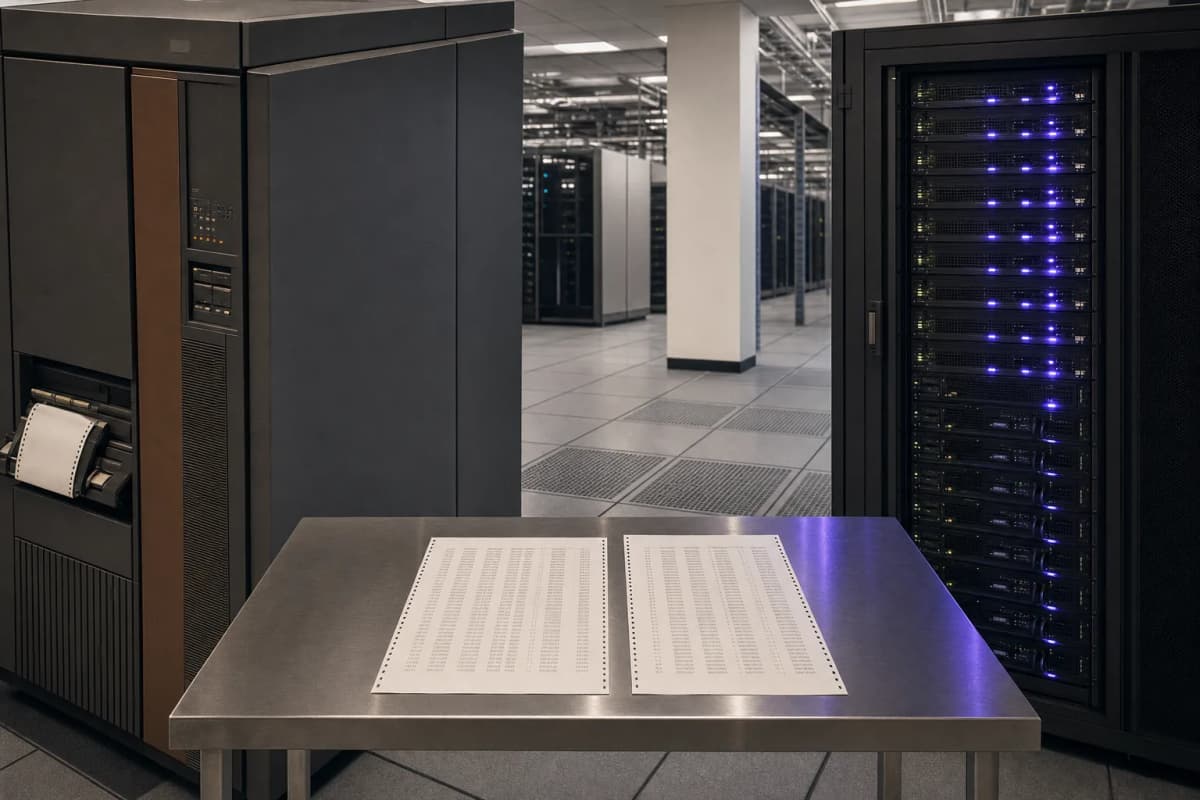
If you are budgeting a COBOL conversion, translation is now the smallest line, because AWS charges nothing for it and says testing typically consumes more than half of project timelines and resources.
Use AWS Transform for mainframe if you have decided to leave the mainframe for AWS. Use Rocket Software if you want to keep your COBOL and move it off IBM Z. Use IBM's tools if you are staying on Z. Whichever you choose, borrow the design of Google Cloud's Dual Run, the clearest published description of a production parallel run. The loser is IBM's COBOL-to-Java as a reason to buy: it is the least proven part of the IBM package, and CROZ, an IT firm that sells mainframe services, advises using the product for understanding code first.
Prices below were checked on each vendor's live page on November 5, 2026.
| Option | Best for | Paths | Tool price | Annual runtime at 64 cores | Testing support |
|---|---|---|---|---|---|
| AWS Transform for mainframe | Leaving Z for AWS | Refactor, replatform, reimagine | Analysis, developer and build tools free | $173,798 | Generated plans, data scripts and automation, batch first |
| IBM watsonx Code Assistant for Z / Bob for Z | Staying on Z | COBOL to Java, refactor COBOL into modular services | No public price; Z package is enterprise only, billed annually | Your existing Z costs | Generated unit tests against the original COBOL |
| Google Cloud (MAT, Dual Run, Antigravity) | Regulated parallel runs | Rewrite or like-for-like | No price on the overview pages | None published | Dual Run compares live production outputs |
| Rocket Software | Keeping COBOL off Z | Replatform, refactor | Contact Rocket for direct terms | $3,111,552 at AWS list (existing AWS service customers) | Vendor-cited 50% shorter test cycles |
| SI-led programme (Accenture and others) | No in-house mainframe team | Any | Quoted per engagement | Depends on target | Scoped in the statement of work |
The workload behind the runtime column is 5 million lines of z/OS COBOL with CICS, DB2 and VSAM, plus 500,000 lines of assembler, moving to 64 x86 cores running 24x7 across all environments. The 64-core sizing is an assumption for comparison, so replace it with yours. The AWS price ratio holds at any size. Infrastructure is extra in every case.
Which Tools Support Refactor, Rewrite and Rehost?
Your choice of path narrows the vendor list faster than any feature comparison. These are the working definitions used here. Refactor converts existing code into Java automatically while preserving behaviour. Rewrite, which AWS calls reimagine, extracts business rules and builds a new application from them. Rehost or replatform recompiles the existing COBOL to run on other hardware, with few changes to the code.
AWS covers the most ground: in March 2026 it unified refactor, replatform and reimagine inside AWS Transform for mainframe. Google describes two routes, a rewrite path and a deterministic like-for-like path that keeps external behaviour and interfaces unchanged. Rocket argues against rewrites and sells replatforming and refactoring, which is a vendor position and also matches what it sells. IBM's offer keeps the workload on IBM Z.
Pick refactor for stable batch and transaction logic you have no wish to redesign. Pick rewrite only for the systems you want to change, because AWS's own workflow adds service design and human validation of specifications before any code is generated. Google's illustration of one estate using both, like-for-like for back-office batch and a rebuild for differentiating systems, is the sensible default for a large estate.
AWS Transform for Mainframe: What Is Free and What Is Metered
AWS Transform for mainframe is the best default for an AWS-bound exit because AWS removed the conversion fee and publishes the runtime rate. Since March 17, 2026, code transformation is offered at no cost, replacing lines-of-code pricing. The AWS Transform pricing page lists the mainframe agent as free and warns that future capabilities may become paid features.
The meter is on what follows. Per the AWS Mainframe Modernization pricing page, analysis, developer and build tools carry no additional charge. Runtime is $0.31 per AWS CPU core per hour, or $0.31 per 2 vCPUs on Fargate. At 64 cores that is $19.84 an hour and $173,798 a year before infrastructure. One- and three-year commitments are available. The same page's second worked example lists a $2.50 hourly runtime price and then calculates at $0.31, so get the rate written into your quote.
The runtime is the commercial lock. AWS's FAQ says it is required for testing during the project and for maintaining and running refactored applications in production. It is not open source, and it runs only on x86, with no Graviton support. Your free conversion therefore produces Java that needs an AWS-owned library for as long as the application lives.
Assembler is the trap for older estates. The pricing page still lists assembler-to-COBOL conversion at $2.75 per line, so 500,000 lines would cost $1,375,000. AWS bills every in-scope line, including comments and lines it could not convert, and you accept the count when you run the convert command. AWS also says the self-managed experience, including Assembler Conversion with mLogica and Replatform with Rocket, is closed to new customers. Ask AWS in writing which assembler path you can buy before you put that figure in a plan.
Language coverage is broad for z/OS: the FAQ lists COBOL, PL/I, JCL, CICS, BMS, IMS, DB2 and VSAM. For rewrites, AWS has published a pattern pairing its reverse-engineered artifacts with Claude Code for forward engineering, with no measured results and a warning that human validation of the specifications is essential.
Skip it if you will not accept a proprietary runtime in production, if you have a large assembler estate and no confirmed conversion path, or if your target cloud is not AWS.
IBM: The Stay-on-Platform Path, and a Product in Transition
IBM is the right choice if your decision is to keep the mainframe, and the weakest choice if you are buying Java conversion as the headline. watsonx Code Assistant for Z offers COBOL-to-Java, code explanation, dependency analysis and auto-refactoring, with generated unit tests comparing the new Java service to the original COBOL. Its pricing page lists no plans or prices.
You need to check which product you are being sold. Version 2.8 added an agentic workflow that runs dependency identification, impact analysis, code generation and a compile from one prompt. CROZ, which sells mainframe services, names the agents as Z Orchestrate, Z Architect and Z Code, and calls 2.8 the final major iteration before the successor. That successor arrived on July 9, 2026, when IBM announced general availability of the IBM Bob Premium Package for Z, an evolution with purpose-built mainframe modes. IBM Bob individual plans run from $20 to $200 a month, but the IBM Z package shows no price and is marked enterprise only and annual. IBM's announcement does not describe COBOL-to-Java, so ask for that scope in the order form.
IBM's published customer numbers measure understanding work. The National Organization for Social Insurance cut analysis of superfluous COBOL from 8 hours to 30 minutes and understanding of complex applications from 24 hours to 5, per IBM's product page. CROZ's November 2025 review reaches a similar view: generated Java is often functionally close, carries COBOL-style thinking, and needs significant cleanup. CROZ recommends using the tool for understanding and documentation and then writing Java from requirements. CROZ also sells implementation help for this product, which makes that scepticism more credible.
Skip it if your board has already decided to exit Z, or if you need a public price before starting procurement.
Google Cloud: The Best Parallel-Run Story, With the Least Public Pricing
Google Cloud's strongest asset is Dual Run, and it is worth studying even if you buy elsewhere. Dual Run runs production workloads in parallel on the mainframe and Google Cloud, and checks whether transactions, messages and data changes match until equivalence is reached. It is built on technology from Banco Santander, which gives it a real bank as its origin.
The rest of the portfolio, per Google's documentation, is the Mainframe Assessment Tool, which uses Gemini to generate summaries, specifications and business rules; Antigravity for code transformation; and Mainframe Connector for moving EBCDIC data into services such as BigQuery. That overview states no price or availability, and Google's Dual Run documentation tells you to schedule a demo or request access. Google named no customers in its August 2026 announcement.
Skip it if you need a published price to build a business case, or if you have no appetite for running a second production system during validation.
Rocket Software: The Option for Keeping Your COBOL
Rocket is the right pick if your COBOL still works and your problem is the platform underneath it. Rocket says its approach combines AI-assisted analysis with deterministic tooling, automated testing and validation, and it cites 30% developer productivity gains and 50% shorter testing cycles. Those are company figures with no named customers attached. Gartner placed it as a Challenger in its 2026 Magic Quadrant for AI-augmented code modernization tools.
The AWS list price shows the cost of keeping COBOL: Rocket Runtime is $5.55 per core-hour against $0.31 for AWS's refactor runtime, 17.9 times higher, or $3,111,552 a year at 64 cores. New customers cannot use that route, per the availability notice above, so you would negotiate with Rocket directly and should use $5.55 only as an anchor. That price gap is the case against Rocket if you plan to stay on the platform for ten years. The case for it is that you keep your code, your COBOL staff and a smaller testing surface.
Skip it if your reason for moving is a shrinking pool of COBOL developers, since replatforming leaves that problem where it is.
SI-Led Programmes: Pay for Delivery Risk, and Read the Scope
An SI is justified when you lack the mainframe staff to run the programme, since the conversion tooling is now nearly free and labour is what you are buying. The public record shows SIs and software partners working on top of the vendor tools: Accenture alongside AWS Transform at Western Union, and Pega with AWS Transform at Unum, per a ZenML summary of the conference talk. AWS's product page also shows partner logos including TCS, Deloitte and IBM.
These deals are quoted per engagement. Since conversion is free on AWS, press any bidder to show what share of its price is translation, and what share is test design, parallel running and cutover.
Skip it if you have strong mainframe engineers and a small estate, since you can run the free tools yourself and spend the money on testing.
Testing Takes More of the Budget Than Translation
Functional-equivalence testing means proving the new system produces the same outputs as the old one, and it is where these programmes overrun. AWS says testing pushes projects beyond planned timelines by several months. AWS markets test agents, so treat the share as a vendor figure, but the historical record points the same way: experts quoted by IndustryWeek said testing could consume 40% to 80% of the total resources for a Y2K conversion, a different kind of project with the same need to prove nothing changed.
The strongest counter-argument comes from model progress. OpenAI reports 97.9% on its COBOL migration test for GPT-6.1 Sol at higher effort, with byte-for-byte output matching required. OpenAI built and ran that private test and has not said how many programs it used or how large they were. The harder point is that a passing rate tells you nothing about which of your programs failed. You still have to find them, and Open Mainframe Project contributors describe an IBM demo where a frontier model counted a date utility's callers as 13, then 29, then 31 when the true count was 30.
Automated testing helps less than the brochure suggests. AWS's first testing release, as described in December 2025, focuses on batch, and the online capability it describes is a screen-capture tool. Your system programmers must still review the collection scripts, run them on the mainframe and send the data back, and AWS does not sanitize the data for you. Rob Thomas, IBM's senior vice president of software, wrote that "translation captures almost none of the actual complexity." IBM has a stake in saying so, and the AWS testing numbers support him anyway.
Parallel running also means paying for two production platforms. Your mainframe contract keeps running while the new stack does the same work, so the length of the parallel period belongs in your financial model as its own line, sized in months of double running.
What the Public Case Studies Prove
The public results show fast conversion and analysis, and very little about production cutover. Read each one for the stage it measured.
- Western Union (Accenture and AWS Transform) processed 2.5 million lines, with 53,000 lines of COBOL converted to Java in about 1.5 hours. The pilot was still in progress, and the speaker said they had a way to go.
- Unum (Pega and AWS Transform) reached a testable application in 3 months, against earlier quotes of 7 years and $25 million. A testable application still has its acceptance testing and cutover ahead.
- Toyota documented about 400 COBOL programs in five hours and converted over 40 million lines to Java, as reported by AWS.
- NOSI (IBM) reported 94% and 79% reductions in analysis and understanding time, on tasks measured in hours.
Treat all of these as vendor-reported. A cost breakdown by phase did not turn up in any of the public cases, so build your own from a pilot.
Who Should Not Migrate at All
You should stay on the mainframe if your COBOL is stable, your staff can still maintain it and your cost pressure is mild. Kyndryl's September 2025 survey of 500 business and IT leaders found 56% reporting increased mainframe usage, and ROI of 288% to 362% across modernizing on the mainframe, integrating with cloud and moving workloads off. Kyndryl sells mainframe services, and the survey does not prove that leaving wins.
The failure mode is expensive. TSB's 2018 core-banking migration, a platform move and not a COBOL conversion, disrupted a significant portion of its 5.8 million customers and ended in a £48.65m regulatory fine. Its independent review raised questions about how testing was carried out, and TSB's board disputed parts of that report. If you are a regulated firm with no realistic way to run old and new in parallel, fix that before you pick a tool.
What Predicts Regret on a COBOL Programme
Four questions change the answer more than any feature list does.
- How long will you run the target runtime? A cheap conversion plus a proprietary runtime is a decade-long contract. Price ten years, with the exit cost included.
- How much assembler, PL/I and IMS sits in the estate? Inventory these first. Assembler alone can add seven figures on AWS's listed rate, if that route is open to you.
- Can you capture production test data? If you cannot sanitize and extract it, every equivalence claim from a vendor is untestable in your environment.
- Who still understands the code? Without those people, buy understanding tools and hire before you convert anything.
The answer flips to Rocket if your developers are staying and you want the smallest behaviour change. It flips to IBM if data gravity, latency or a regulator keeps the workload on Z.
This Week:
- Pull your line counts by language, including assembler, and your production core count.
- Ask your account teams at AWS, IBM, Google and Rocket for written answers on price, availability to new customers and runtime terms.
This Month:
- Pick ten batch jobs your operations team fears, and run them through the free AWS analysis tools or Google's assessment tool.
- Have your system programmers extract and sanitize test data for those jobs, and record how many staff-days it takes.
Before You Sign:
- Require a byte-level comparison on your ten jobs as the acceptance test, written into the contract.
- Add the parallel-run period and ten-year runtime cost to the business case as separate lines.
The Bottom Line
The Y2K programmes taught the same budget lesson a generation ago: testing was often the largest task, and the code changes were the visible part. AI has pushed the visible part toward zero on AWS's price list, while your parallel run, test data and runtime contract remain. Ask each bidder to price the parallel run on your ten worst batch jobs before you compare anything else.
