If you run maintenance for plants or warehouses and want an AI assistant your technicians will actually use, start with parts lookup. That is where Amazon's new K-Hub AI posts its measured results: identifying an unlabeled part now takes under two minutes instead of more than 30, and a stock check takes under five seconds instead of ten minutes, according to Amazon's November 24, 2026 announcement. The release's headline promises breakdown diagnosis "in seconds," yet it gives no diagnosis-time figure at all. Copy the design rules Amazon describes (a citation on every answer, an explicit reply when the sources have nothing, and the repair decision left with the technician) and pilot them on parts work first.
K-Hub AI (Knowledge Hub AI) is a maintenance assistant built by Amazon Web Services for Amazon's own sites. It is live across hundreds of sites worldwide and at every Amazon site in France, per the same Amazon release. Few operators publish adoption numbers for a tool their frontline staff use every day, which makes this release worth reading closely.
What K-Hub AI Does on Amazon's Floor
K-Hub AI answers a technician's question about a failed machine by pulling from Amazon's past repair records, manuals and parts database, and it links each answer to the document it came from. Amazon's announcement describes the source material as the experience of tens of thousands of technicians, millions of intervention reports, hundreds of thousands of spare parts references and thousands of manuals and operating procedures.
The problem it targets is familiar to anyone who has run a multi-site operation. A conveyor stops in a fulfilment centre. The fix exists somewhere: in a manual, in an old work order, or in the head of a technician at another site. Amazon's own example is a technician in Europe with no practical way to learn that a colleague in Nashville fixed the identical fault three days earlier. At Amazon's scale that gap is large. The company said in mid-2025 that its robot fleet had passed one million units across more than 300 facilities.
The release describes four capabilities:
- It links a reported symptom to likely causes, the right manufacturer's procedure and the part needed, then checks stock.
- A fix recorded at one site becomes available to every site running the same machine, and the system flags recurring failures to the people who own them.
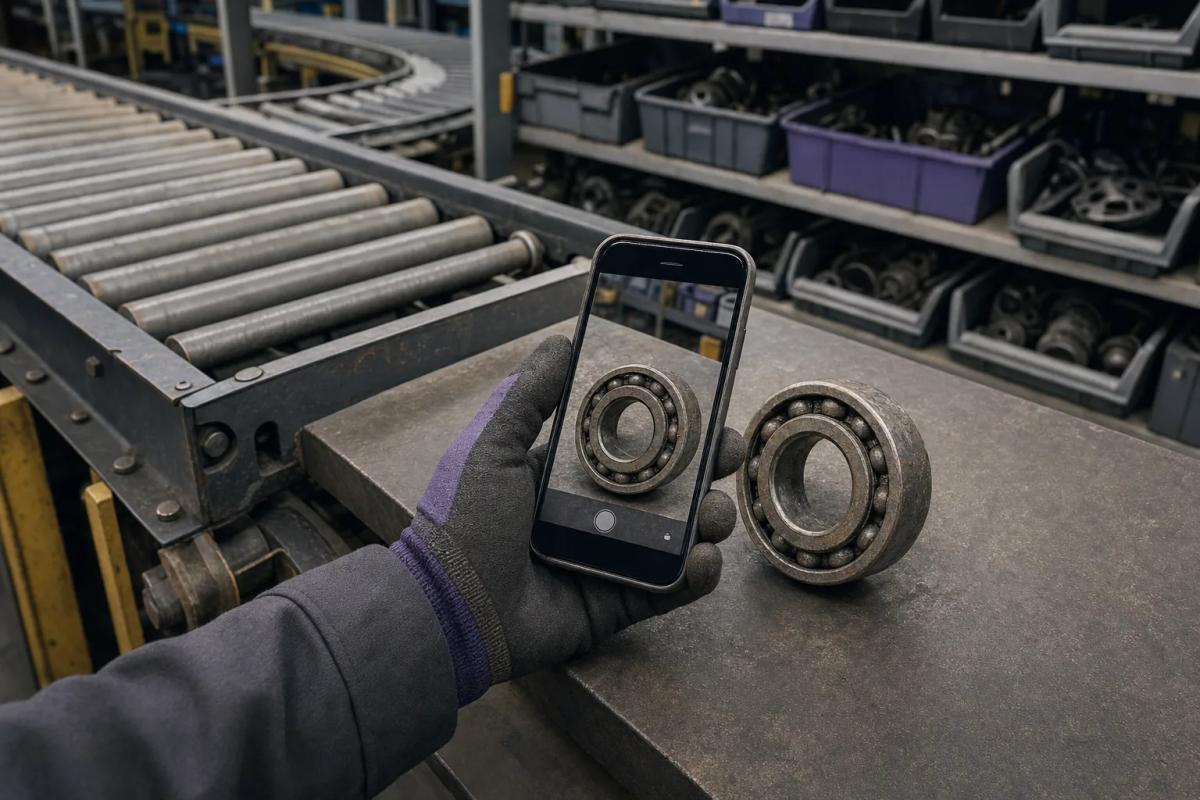
- Parts Visual Search, launched in August 2026, lets a technician photograph a worn or damaged component and get a match against Amazon part numbers, OEM references and descriptions, with stock status and the nearest location.
- Routine reporting runs on its own. A controls manager quoted in the release says a weekly review of high-impact events, once pulled and sorted by hand, now runs automatically and "saves so much time to allow us to focus on problem solving."
On architecture, the release says only that K-Hub AI runs on AWS infrastructure and uses a knowledge graph governed by a semantic layer, combined with agentic routing and hybrid AI. It names no model and no specific AWS service.
Amazon's Measured Gains Are All in Parts Lookup
Every number Amazon published measures finding a part or its stock, and none measures diagnosing a fault. Here is the full set from the release:
| Task | Before | With K-Hub AI |
|---|---|---|
| Identify an unlabeled part | 30+ minutes of catalogue search, sometimes 11+ hours waiting for a colleague | Under 2 minutes |
| Check stock across the network | 10 minutes per part | Under 5 seconds |
| Parts Visual Search adoption | Launched August 2026 | 70% regular use, 28% month-over-month interaction growth |
| Diagnose a breakdown | Not stated | Not stated |
Parts identification has a checkable answer: the part number either matches the component in the technician's hand or it does not. One technician in the release describes the team removing a screw and asking the system to find it; it returned the measurements, the Amazon part number and the correct stock bin. A wrong answer costs a few minutes and is caught on the spot.
Diagnosis is harder to measure and harder to verify. A suggested root cause can sound right and still send a technician down the wrong path for an hour. Amazon's release frames the tool's diagnostic role carefully: the technician compares suggested causes with what they see and with their own experience, safety policies and local judgement prevail, and the system "is never fully directive."
Other vendors report similar early numbers with similar gaps. Siemens said in March 2025 that first pilots of its Industrial Copilot for maintenance saved on average 25% of reactive maintenance time, with no sample size or baseline published. Treat both companies' figures as vendor claims about their own deployments.
Why Citations and a "Not in the Sources" Reply Come First
A maintenance assistant that guesses is a safety problem, so the two grounding rules Amazon describes belong in any requirements list. Amazon says each K-Hub AI answer points to a specific official document, and that when the approved sources do not hold the answer, the agent says so instead of inventing one, because a wrong answer can have safety consequences.
Grounding means the model answers only from a defined set of approved documents and shows which document it used. On a plant floor that set matters in a specific way. Servicing machinery in the US falls under OSHA's lockout/tagout standard, 29 CFR 1910.147, and employers must train each worker to follow the site's hazardous energy control procedures. An assistant that improvises a procedure, or cites a manual for a different machine revision, is giving instructions that may conflict with the procedure your site is legally bound to follow.
Citations do not make an answer correct. When Stanford researchers tested legal research tools built on retrieval in 2024, Lexis+ AI and Ask Practical Law AI produced incorrect information more than 17% of the time, and Westlaw's AI-Assisted Research more than 34%, even though those products cited sources. A citation tells the technician where to check. You still need to test how often the cited document actually supports the answer, and how often the system says "not found" when it should. Our guide to building a RAG evaluation set from hand-written questions covers how to do that, and UNICEF's MCP benchmark shows what absent-data hallucination looks like in practice.
The knowledge graph is the other design choice worth copying, with a cost caveat. A knowledge graph stores entities (machines, components, fault codes, parts) and the relationships between them, so a query can follow "this symptom on this conveyor model was fixed with this part" instead of matching loose text. Microsoft Research's GraphRAG work uses a language model to build such a graph from private documents and then uses it to supply context at query time. Building and maintaining the graph is expensive; see our GraphRAG versus vector RAG cost comparison before you commit. If you build one in-house, a graph database such as Neo4j is the usual starting point, though Amazon has not said what it uses.
Where Your Maintenance AI Pilot Should Start
Pilot parts identification and stock lookup first, then reuse the same grounded index for diagnosis once you have proven it on work you can check. The economics support starting anywhere that cuts minutes off a stoppage. Siemens' True Cost of Downtime 2024 puts an hour of downtime in a large automotive plant at $2.3 million and estimates that an average large plant still loses 27 hours a month to unplanned downtime. A Fluke survey of 600 manufacturing respondents published in October 2025 put the average at $1.7 million per hour. Both figures come from companies that sell maintenance technology, so calculate your own site's number before you build a business case.
The staffing pressure points the same way. In a survey of 211 maintenance and operations leaders run by CMMS vendor MaintainX, 72% of roles took 60 or more days to fill and 42% of new staff took more than three months to fully ramp. Teams that had lost workers to retirement or turnover were more likely to call knowledge capture a top priority (68% against 54%). A new technician who cannot recognise a part is exactly the person a photo search helps on day one.
Parts work also gives you clean metrics. Time to identify a part, stock check time and the share of searches that return the right part number can all be measured against a baseline you record before the pilot. Diagnosis metrics (mean time to repair, repeat failures) move for many reasons and take months to read.
The case for starting with diagnosis is real: it is where the most expensive minutes are, and Siemens pitches its copilot on reactive maintenance time. If your work orders are already clean and structured, a diagnosis pilot on one machine family can make sense. Most sites' intervention reports are free text of uneven quality, and that is the data a diagnosis assistant learns from.
What Amazon's Release Leaves Out
Amazon's release is a company announcement about its own tool, and several things a buyer would need are missing. It gives no diagnosis accuracy or time figure. It names no model, no AWS service and no cost. It does not say how stale or contradictory intervention reports are cleaned, how often answers are wrong, or what share of queries get the "not in the sources" reply. The 70% regular-use figure for Parts Visual Search has no stated denominator.
K-Hub AI is also an internal tool, and the release does not describe it as an AWS product you can buy. If an AWS account team brings it up in your next meeting, ask whether it is a product, a reference architecture or a professional services engagement before you plan around it. Our earlier pieces on Toyota's agent platform and Schneider Electric's Cognite deal cover the build and buy routes for industrial AI data layers.
What to Do About It
This Week:
- Pull the last 90 days of work orders and count how many minutes technicians logged searching for parts or waiting on identification. If your CMMS does not capture it, ask three technicians to time it for a week.
- Put a dollar figure on an hour of downtime for your two most critical lines, so any pilot has a baseline.
This Month:
- Write the grounding rules into your requirements: every answer cites an approved document, the system says "not found" when the sources are silent, and the technician makes the repair call. Add that the assistant must never contradict your site's lockout/tagout procedures.
- Build a test set of 100 real questions from your own work orders, including 20 that have no answer in your documents, and score any vendor or internal build on citation accuracy and correct refusals.
- Scope a parts identification pilot at one site on one equipment family, with time to identify and stock check time as the success metrics.
Before You Expand to Diagnosis:
- Clean and tag at least a year of intervention reports for the machine family you start with. A diagnosis assistant is only as good as those records.
- Agree with your safety lead who signs off when the assistant's suggested procedure differs from the posted one.
The Bottom Line
Amazon has shown what a grounded maintenance assistant looks like at a scale few operators match, and it has published numbers only for the parts work it can verify. The previous maintenance technology wave earned its place with measured results: Siemens, which sells predictive maintenance software, says in its 2024 downtime report that predictive maintenance going mainstream was a critical factor in cutting large plants' monthly downtime from 39 hours in 2019 to 27. Run the parts pilot, measure it against your baseline, and ask any vendor for the diagnosis accuracy figure Amazon did not publish.
Continue Reading
- GraphRAG Costs 1,000x More Than Vector RAG to Index
- RAG Eval Dataset: 200 Hand-Written Questions Beat Synthetic Ones
- Hallucination Detection Tools Put Cleanlab TLM on Top
- Toyota Ships an Agent in 4 Days. One Review Covers 50.
- GXO CEO Says 45 Humanoid Pilots Have Not Hit ROI
- Pick ERP Roles Before Claude for Manufacturing Writes to NetSuite