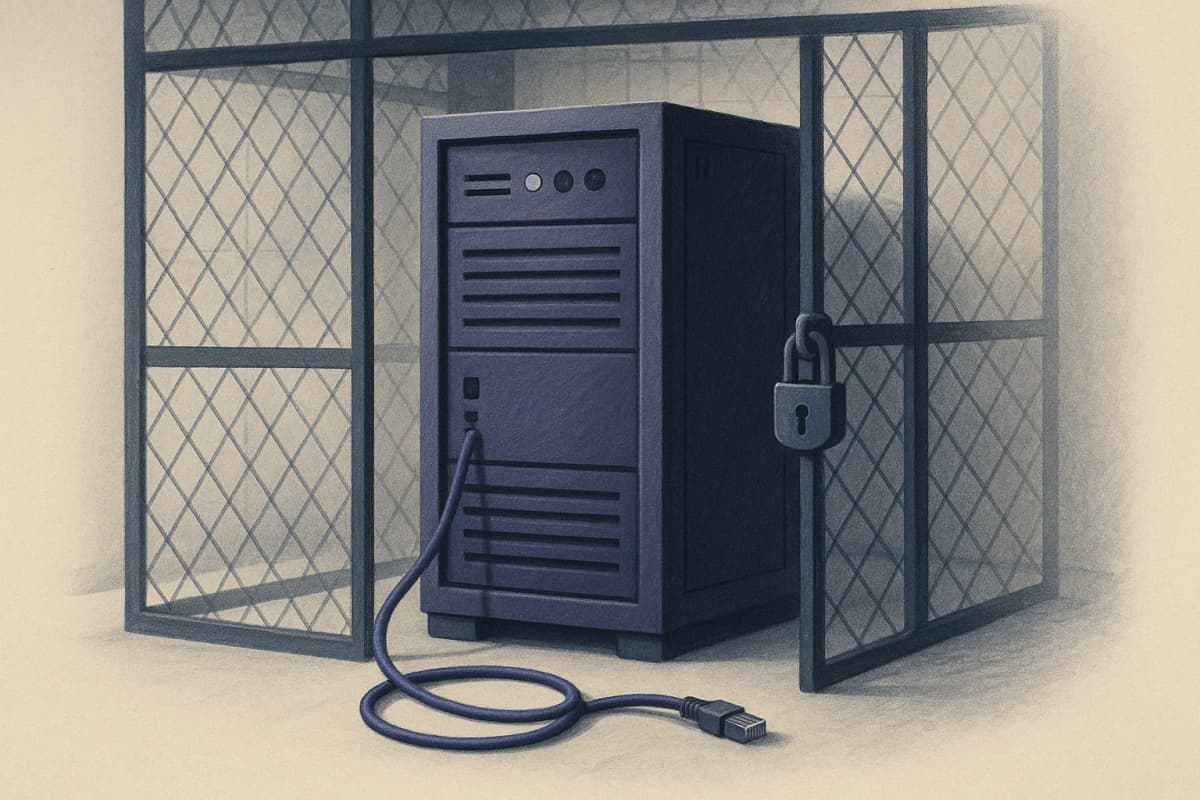
If you run Tabnine inside an air-gapped network, your coding assistant just became a component in somebody else's testing platform. That is the actual news, and it is not what the headlines said.
On 30 July 2026, Tricentis acquired Tabnine. Read both announcements and count what is named: the Enterprise Context Engine, the knowledge graph, the testing agents, the token savings. Then count what is not named — the standalone code assistant your developers open every morning, the fully air-gapped deployment your security team spent two months approving, the 2027 roadmap, and the price list. Not one of them appears. For a bank, a defense supplier, a hospital system or a sovereignty-constrained firm that chose Tabnine precisely because almost nobody else would run entirely inside the perimeter, that silence is the whole story.
What Tricentis Actually Bought
Tricentis bought a knowledge graph, and it said so without hedging. The press release quotes CEO Kevin Thompson saying "Quality engineering in the enterprise has never been a model problem. It has always been a context problem," and Tabnine founder and CEO Dror Weiss saying "We built the Enterprise Context Engine because AI in the enterprise is only valuable when it is reliable." The asset being described is the Enterprise Context Engine — a system that extracts entities, relationships, dependencies and architectural patterns from repositories, documentation, tickets, APIs and infrastructure metadata.
David Colwell, Tricentis' VP of AI and Machine Learning, told DevOps.com that the capability "makes it possible for AI agents to more efficiently test code in a way that serves to reduce the total number of tokens that might otherwise be required," and that "unless AI agents are integrated into testing workflows, there will be no way for DevOps teams to keep up with the pace at which code is now being generated." The release claims organisations using the technology saw up to 2x improvement in AI accuracy and up to 80% reduction in token consumption — vendor figures, unaudited, and self-reported.
The economics fit that story. Terms were undisclosed, but Calcalist estimates the deal in the tens of millions against $55 million raised from investors including Khosla Ventures, Atlassian Ventures and Telstra Ventures. Tabnine was founded in 2013 as Codota, and had cut 15 of roughly 80 employees in the prior year. That is not a company being bought for its go-to-market. It is a company being bought for one component.
Why "Support" Is Not "Roadmap"
Tabnine's entire commitment to existing customers is a single sentence, and it is a support sentence. The announcement says: "Existing customers will continue to receive support for the products they use today." Nothing else in either announcement addresses the standalone assistant, deployment modes, pricing or the roadmap.
In vendor language these are two different promises. Support means the product keeps running and defects get fixed. Roadmap means it keeps getting better — new model versions, new IDE releases, new language coverage, new compliance attestations. Only the first one was made. For an air-gapped deployment that distinction is sharper than usual, because you are not on a rolling SaaS release. The version inside your perimeter is the version you have until someone ships you another one.
Compare the wording to Sourcegraph's, which faced the same question and answered it directly. When it announced on 25 June 2025 that Cody Free and Cody Pro would end four weeks later, on 23 July, it told enterprise customers "Cody Enterprise remains fully supported, actively developed, and invested in" and "No changes are being made to your subscription." That is what a commitment reads like when a vendor intends to make one. It is also a reminder that vendors do retire tiers on a schedule, in public, with a date.
Tricentis Has Sunset an Acquisition Before
Tricentis has a public track record here, and it is neither reassuring nor damning — it is slow. Tricentis acquired the load-testing service Flood.io in July 2017 and ran it for seven years, then ended its life on 30 June 2024, after which — by the account of LoadView, a competitor selling against both products — accounts were deactivated and users were pointed at the flagship NeoLoad product. Nobody's assistant disappears next quarter. The realistic risk is a product that stops advancing while the market it competes in moves every eight weeks.
The number worth negotiating against is notice. Tricentis publishes its end-of-support announcements for qTest, and the observed range is wide: the iOS and Windows apps got roughly 16 months between announcement and end of support, while Firefox plugin support was announced on 31 October 2025 and ended 1 January 2026, and the Desktop Explorer Chrome extension was announced on 13 February 2026 and ended 30 April 2026. The floor is far lower than that, and it was the acquired product that hit it: the same page announced on 10 June 2024 that "on June 30, 2024, Tricentis Flood will no longer be available for use." Twenty days. Two to three months is unremarkable by their published practice, and three weeks is not unprecedented. If your migration off an air-gapped coding assistant takes longer than that — and it will — the contract is the only place to fix it.
Ownership matters to how this plays out. GTCR invested $1.33 billion in Tricentis on 26 November 2024 at a $4.5 billion valuation, joining Insight Partners with equal board representation. Two private equity firms with equal representation do not fund a second, unrelated product line out of sentiment. They fund the thing in the platform story, which here is quality engineering. This is the same consolidation pattern playing out across the stack — see the Okta–Permiso deal and the pace of acquisition-driven lock-in at OpenAI.
The Case That Nothing Bad Happens
The strongest argument for doing nothing is that the assistant and the testing agents need the same machinery, so killing one starves the other. The Context Engine has to be trained on, and validated against, real enterprise repositories. The assistant is how it gets into those repositories in the first place, and it is the reason Tabnine has security reviews already passed at large regulated buyers. Tricentis' own customer list — Experian, T-Mobile, Jaguar Land Rover, Allianz, Telstra — is exactly the population that demands on-premises and private-cloud options, so the deployment flexibility is an asset to the acquirer rather than a cost.
There is also the market position. Tabnine was named a Visionary in the 2026 Gartner Magic Quadrant for Enterprise AI Coding Agents in May 2026, and its own framing of that placement leans on "flexible deployment options including SaaS, VPC, on-premises, and fully air-gapped environments." That is a differentiator worth keeping. The Futurum Group's read of the deal identifies the main danger as integration rather than abandonment: "The risk is execution: integrating two distinct product architectures while maintaining the enterprise context capabilities that justified the deal in the first place," per their analysis.
All of that may be right. None of it is a contract. And an 80-person team that shed roughly a fifth of its headcount before the sale was already choosing what not to build; being absorbed into a 3,000-customer testing platform does not add engineers to the IDE plugin.
The Substitute List Is Short, Which Is the Point
If you decide to leave, the shortlist that survives a genuine air-gap requirement is small — and it is the reason you bought Tabnine rather than a cloud assistant. Tabnine's pricing page currently lists the Code Assistant Platform at $39 per user per month annually and the Agentic Platform at $59, both offering "SaaS, VPC, on-premises, or fully air-gapped" deployment. Its code privacy page states "We never retain any code on our servers," "We never use your code to train any of our models," and that Tabnine "doesn't use third-party APIs or models to deliver our service." Those three properties together are what cleared your security review, and they are rarer than the crowded enterprise coding assistant market makes it look.
The mainstream comparisons — Cursor, GitHub Copilot — are the tools your developers will name first, and they are a different architecture aimed at a different buyer. Sourcegraph's retreat to enterprise-only Cody points the same direction: this segment is consolidating, not expanding. The open route is real — an open-weight coder model behind a self-hosted completion server, entirely inside your network — but you then own the model choice, the evaluation harness, the security review and the upgrade treadmill forever. That is a staffing decision, not a procurement one, and it is worth pricing before you need it rather than after. The due diligence lessons from Cursor's model-sourcing disclosure apply to whatever you pick next.
What to Put in the Contract Before You Renew
Your leverage is the renewal, and it exists only until you sign. Work it in this order.
This Week:
- Put the renewal date, the notice window and the name of the person who signs on one page. If the auto-renewal notice period has already opened, that is today's problem, not next quarter's.
- Write down which deployment mode you actually run — SaaS, VPC, on-premises or fully air-gapped — and which model weights sit inside your perimeter right now. If the honest answer is "the vendor pushes updates," you have an outbound dependency you did not think you had.
- Email your account team one question in writing: does the standalone code assistant have a funded 2027 roadmap, and who owns it now? Keep the reply. A non-answer is an answer, and it is the one you take to procurement.
This Month:
- Negotiate an end-of-life notice period into the paper. Their published practice runs from twenty days to sixteen months; ask for twelve months plus a written migration commitment, and name the deployment mode explicitly so a move to SaaS-only counts as end of life.
- Ask for source escrow or a perpetual licence for the on-premises version you run today. In an air-gapped estate this is the difference between a planned migration and an unplanned outage, and it is far cheaper to ask for while the acquirer wants a clean renewal.
Before Renewal:
- Refuse a multi-year term without roadmap language. A discount for three years, with support-only wording, converts you into a maintenance account for the price of a rounding error.
- Spend one engineer-day standing up an alternative in a lab and record the real number — integration effort, eval coverage, security review time. You are not switching. You are buying a credible position for the negotiation, the same discipline that separates teams who measure their coding-agent ROI from the ones who don't.
The Bottom Line
Every consolidation wave in developer tooling ends the same way: the acquirer keeps the piece that fits the platform story and lets the rest age out quietly, on a timescale slow enough that nobody notices until a migration is urgent. Flood.io took seven years. AWS gave its first-generation AI services a considerably shorter runway. The failure mode is not a shutdown notice. It is a product that stops shipping while the alternatives ship weekly, until one day your air-gapped assistant is running a two-year-old model and the security exception you wrote for it no longer makes sense.
Nothing here says Tricentis will abandon the assistant. It says nobody promised they won't, and you are one renewal away from having nothing to trade.
Support keeps the lights on. Only a contract keeps the roadmap. Ask for the second one while you still have something to offer for it.
Continue Reading
- Okta Bought Permiso. Your Leverage Expires Oct 31.
- AWS Kills Q Business, Kendra, Bedrock Agents: 90-Day Plan
- OpenAI's 17 Acquisitions in 3 Years Signal Vendor Lock-In Risk
- GitHub Copilot vs Cursor vs Replit: Enterprise Code AI Battle
- Cursor's Hidden Chinese Model: A Wake-Up Call for AI Vendor Due Diligence
- Palantir's $10B Pentagon Lock-In: What CIOs Must Know