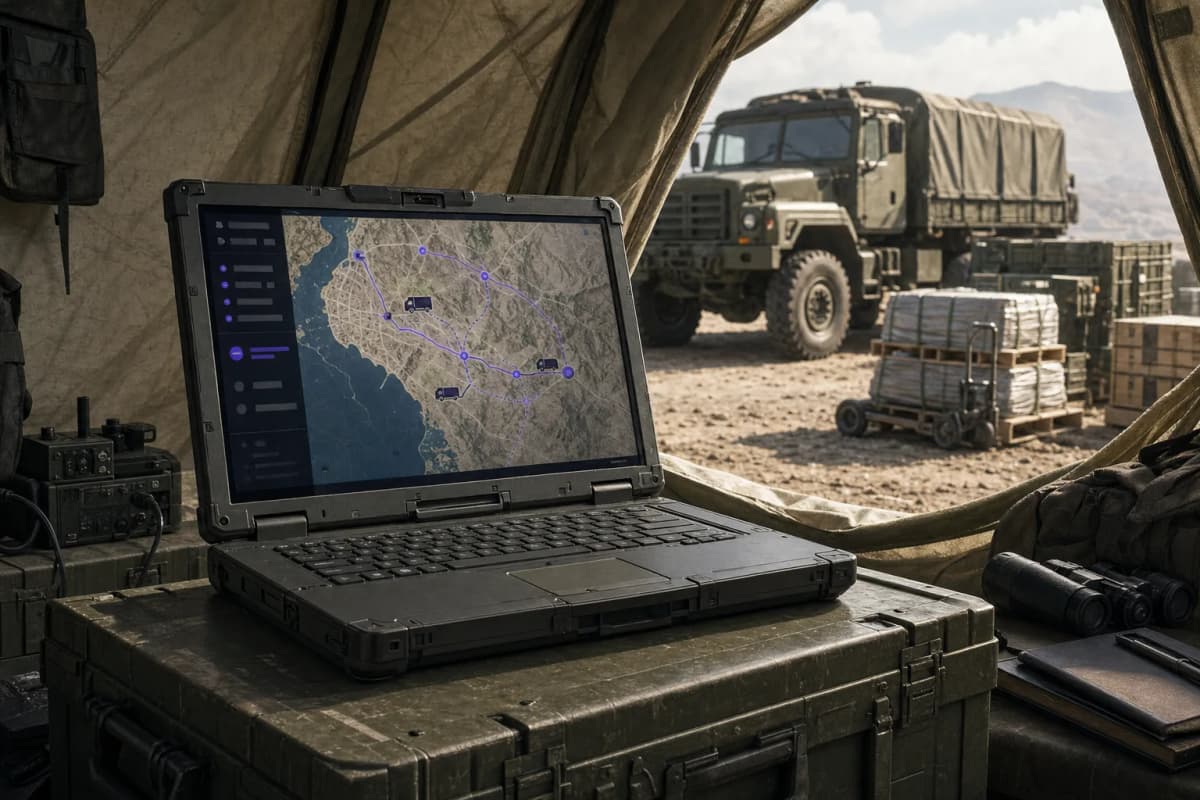
If your unit or program runs Rune's TyrOS, your logistics software vendor is about to become Salesforce, and nothing published so far says what happens to the Army contract you order it through. Salesforce signed a definitive agreement on October 29, 2026 to acquire Rune Technologies, whose software forecasts supply needs and plans resupply for frontline units, and expects the deal to close in the fourth quarter of its fiscal 2027. Salesforce did not disclose a price. Resilience Media reported a $375 million mix of cash and stock, citing two unnamed sources, and TechCrunch said Salesforce did not respond to its request for comment.
The buyers who need to act are the program offices and sustainment leads already ordering TyrOS, plus anyone in a service branch or allied ministry deciding whether to put logistics on Missionforce, Salesforce's national security unit. Before close, you want three things in writing: how the deal is structured, which systems of record the edge data will sync into, and whether Rune's existing integrations survive.
What Salesforce Is Buying in Rune Technologies
Salesforce is buying a two-year-old military logistics software company with fielded deployments and a $99 million Army ordering vehicle. Rune was founded in 2024 by David Tuttle (CEO) and Peter Goldsborough (CTO), who both worked at Anduril before starting it, according to Washington Technology, which also reported a $24 million Series A in July 2025 led by Human Capital.
TyrOS, its flagship platform, is built for DDIL environments. DDIL stands for denied, degraded, intermittent or limited connectivity, and in Salesforce's description Rune's software keeps working with little or no network, then syncs when the link comes back. The models forecast demand and resupply, recommend allocation and transport routing, and let teams test logistics plans before committing to one, per the Salesforce announcement.
Rune has also shipped Saga, an AI logistics planning tool built on TyrOS, and an Autonomy Development Kit for tasking autonomous systems, ExecutiveBiz reported in June. The company says TyrOS has been fielded with the 25th Infantry Division, the 4th Infantry Division, XVIII Airborne Corps and the Marine Corps Warfighting Laboratory, according to Intelligent CIO.
The reported price is high relative to Rune's funding. Rune has raised about $30 million from investors including Andreessen Horowitz, Point72 Ventures and IQT, and PitchBook put its last valuation at $127 million, TechCrunch reported. If the $375 million figure is right, Salesforce is paying close to three times that valuation.
Why Missionforce Wants the Tactical Edge
Rune fills the one layer of Salesforce's defense architecture that Missionforce did not already cover. Salesforce describes an "edge-to-enterprise" stack in three layers: enterprise systems of record, a Strategic HQ layer and the Operational Edge. In its announcement, Missionforce covers the first two and Rune supplies the third. Salesforce calls Rune its "most significant national security-focused acquisition."
Logistics was on the list from the start. When Salesforce launched Missionforce on September 16, 2025, it named personnel, logistics and decision-making as the three areas it would apply AI to, under Kendall Collins, CEO of Government Cloud. Salesforce's own blog post, as quoted by Resilience Media, says its military work so far has centred on back-office administration, record keeping and strategic planning. Rune is how it moves forward of the headquarters.
The commercial base is the Army deal from January. The Army awarded Salesforce a 10-year IDIQ with a $5.6 billion ceiling, run through a wholly owned subsidiary called Computable Insights LLC, with a five-year base ordering period and one five-year option. Salesforce's own release says the ceiling is "not a guaranteed purchase amount" and lists logistics among the use cases. In the Rune announcement, Salesforce says its defense business is growing 80% year over year, with customers across all six U.S. military branches.
The deal also extends a buying run. Salesforce has agreed to buy Fin for $3.6 billion and bought Qualified for $1.2 billion, per TechCrunch, on top of the Braze, Loops and Listen Labs deals we covered.
The strongest case for the deal is an integration one. A unit running TyrOS forward and Salesforce in garrison has two data models to reconcile today. Salesforce says that for units already running Rune, edge decisions would flow into enterprise systems of record without custom integration, and that personnel, maintenance and sustainment data would stay consistent across garrison, forward-deployed and emissions-controlled operations. If it ships as described, that removes a real integration project from your backlog.
What Happens to Rune's $99 Million Army IDIQ
Your existing task orders most likely carry on, but the paperwork depends on a deal structure Salesforce has not disclosed. Rune's vehicle is a five-year, $99 million IDIQ that lets Army organizations, other Department of War components and joint force partners order TyrOS and related services through task orders, without running a separate competitive action for each purchase.
Federal contracting rules treat the two common structures differently. Under FAR 42.1204(b), a novation agreement is unnecessary when only ownership changes through a stock purchase and the contracting entity stays the same, keeps the assets and keeps performing. If Salesforce instead moves Rune's contracts or assets into another entity, such as Computable Insights LLC, the government has to recognize the successor through a novation agreement. In that process the responsible contracting officer collects comments from affected offices within 30 days, decides whether recognition is in the government's interest and reviews organizational conflicts of interest under FAR subpart 9.5. The same FAR section notes that even a stock purchase can raise issues worth a formal agreement.
Salesforce's release names only "customary closing conditions." It does not say whether Rune will stay a separate legal entity, whether its IDIQ will remain the ordering path or whether TyrOS will also become orderable under Salesforce's own $5.6 billion vehicle. Those answers decide which contracting officer you call and which terms govern your next task order.
The Questions the Announcement Leaves Open
The announcement describes where the data goes, and it is mostly silent on which vendor's systems sit at each end. Ask about these before you expand a TyrOS deployment.
Start with the systems of record. Salesforce says edge decisions will flow into enterprise systems of record, and in its three-layer picture Missionforce is the enterprise layer. If your authoritative logistics data lives in a system that is not Salesforce, the release does not say whether TyrOS will keep syncing to it, or on what terms.
Then the Palantir work. In July 2025, Washington Technology reported that Rune was working with Palantir on automated logistics offerings and took part in Palantir's startup fellowship. Neither Salesforce's release nor the press coverage of the deal mentions it. If your program depends on that integration, get Rune's current position in writing.
Ownership of edge data after sync is the third gap. Reconciling forward data into an enterprise platform is the selling point, so your task order should say who holds that data once it lands, how you export it and what happens to it if you leave.
Authorization is the fourth. Salesforce has shipped defense products with commercial features switched off for compliance before: the Army's Agentforce rollout ran with Anthropic's models disabled. Ask which TyrOS features and models will run inside the authorization boundary your unit needs.
Allied ministries have their own question. Salesforce describes Rune as serving the U.S. military and allied nations, and an allied customer running TyrOS should ask what changes under a U.S. commercial software owner, starting with the contracting entity and where the data is held.
What Defense Buyers Should Do
This Week:
- Pull every task order you hold under Rune's IDIQ and list the period of performance, option dates and ceiling remaining on each.
- Ask your contracting officer to request, in writing, whether Salesforce is buying Rune's stock or its assets, and whether a novation package will be submitted under FAR 42.12.
- Get Rune to list every system TyrOS syncs with today in your deployment, including any Palantir-built integration, and keep the list on file.
This Month:
- Add data ownership and export terms for edge data to your next task order modification, before any sync into Salesforce systems is switched on.
- If you are a Missionforce customer considering logistics, ask Salesforce whether TyrOS will be orderable under the Army's $5.6 billion vehicle or only under Rune's, and under which authorization level.
Before Close (Salesforce's Q4 FY2027):
- Decide whether to expand, hold or hedge. If you expand, write price protection for the remaining ordering period into the order. If you hold, keep your current logistics tooling warm until the integration roadmap is public.
The Bigger Picture
Defense software is consolidating, and a commercial CRM company is now among the buyers. Resilience Media expects more defense M&A as well-funded primes and "neo-primes" such as Anduril and Helsing look for bolt-on acquisitions. Rune's founders came out of Anduril, and their company is going to Salesforce, which until now sold the military back-office and planning software.
The Pentagon has been spreading its AI work across several vendors, as we covered in its seven-vendor agreements. This deal moves the other way for logistics: a unit that buys TyrOS for the edge and Missionforce for the enterprise layer will have one vendor for both after close. That can simplify integration, and it also concentrates your sustainment stack with one supplier. Get the deal structure and the data terms in writing before your next task order.
Continue Reading
- The Army Shipped Agentforce. Anthropic's Models Were Off.
- Salesforce to Buy Braze for $5.66B to Boost Marketing Cloud
- Salesforce to Acquire Loops to Bring Agentic Analytics to Tableau
- Salesforce to Acquire Listen Labs for AI Customer Research
- Pentagon Signs AI Deals With 7 Tech Giants After Anthropic Dispute
- Mark43 Buys ForceMetrics With a One-Sentence Cross-Vendor Pledge