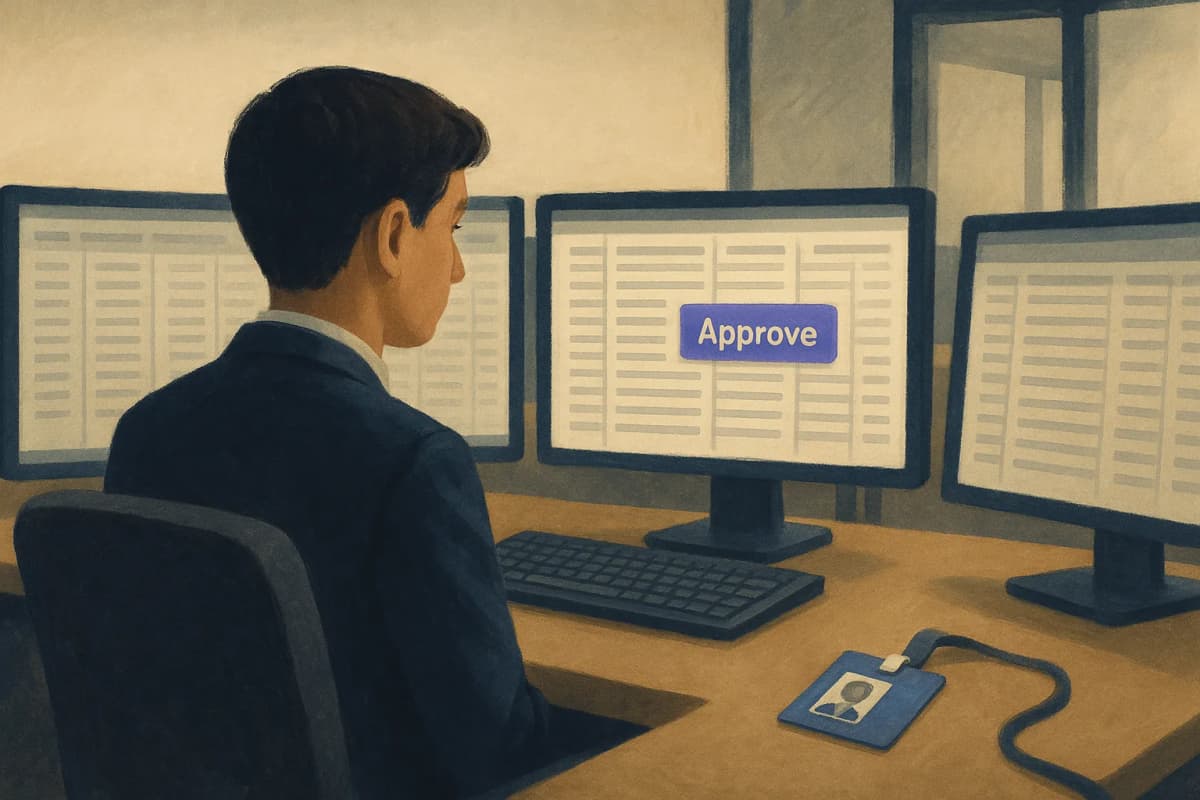
If your 2027 graduates approve agent output from their first week, they must know what correct output looks like first, and the junior grind that taught them is now the agents' work. Goldman Sachs said on October 8 that its new hires now manage AI agents from the day they start. The bank was candid that it does not know what happens to the middle managers whose supervision job moves down to them. A leader copying the model has two problems to solve, and Goldman has publicly answered neither.
What Goldman Actually Said in Singapore
Goldman's position is that supervising agents is now entry-level work. Kevin Sneader, who runs the bank's Asia Pacific business outside Japan, told the Milken Institute Asia Summit in Singapore on October 8 that "when our young folks now start work, they're managing agents," according to the Straits Times account. He said staff "have to make the most of this virtual army that they've now got," and that earlier generations spent years in junior roles before they managed anyone.
The second half of his remarks is the part to plan around. "That management task no longer sits with the middle manager; it sits with the front line," Sneader said, calling the redeployment of existing managers a "generational challenge for many, many segments" (Straits Times via RedHot). Asked about that group directly, he said: "We don't quite know what's going to happen to that group" (Bloomberg remarks as compiled by The Outpost).
Sandra Peterson, an operating partner at Clayton, Dubilier & Rice, said on the same stage that "it used to be that professional service firms were pyramids," and that it is unclear firms will need as many entry-level positions once AI handles routine work (Straits Times via RedHot). The same report says Singapore's financial regulator expects operations staff to become managers and supervisors of agents. The full regulator passage was truncated in the copy available, so treat that as a reported direction, not a quoted policy.
These were panel answers, and the primary reporting from Bloomberg and the Straits Times sits behind paywalls. What Goldman has said on the record over the past 15 months fills in the rest.
Where Goldman's Agents Already Do the Work
An agent, in the sense Goldman means, is software that takes a task, breaks it into steps and carries them out while a person checks the result. Goldman has been building toward that operating model in public since mid-2025.
In July 2025, CIO Marco Argenti said the bank would start "augmenting our workforce with Devin," Cognition's autonomous coding agent, beginning with "hundreds of Devins" alongside its 12,000 human developers. He described the new engineering job directly: engineers "are going to be expected to have the ability to really describe problems in a coherent way" and then "supervise the work of those agents." That is the role Sneader now describes for graduates. (We track Devin on its own page.)
In February 2026, CNBC reported that Anthropic engineers had been embedded at Goldman for about six months, co-building agents on Claude for trade and transaction accounting and for client vetting and onboarding (Storyboard18, citing CNBC). Thousands of Goldman employees work in compliance and accounting. Argenti called it "premature" to expect job losses.
The organizing program is OneGS 3.0. An October 2025 memo signed by David Solomon, John Waldron and Denis Coleman said AI "can unlock significant productivity gains for us" and paired that with a constraint on hiring through year end (Outlook Business, citing Reuters). Trade press summarizing the Singapore remarks puts the engineering productivity gain since agents arrived at more than 20%. That figure has no named source or published method behind it. Treat it as unverified.
Two of those three agent workloads, trade accounting and client onboarding, are exactly where regulators look first when something goes wrong. The person approving the agent's work there is now, by Goldman's own description, a first-year employee.
Why Supervising Agents Needs the Skill the Grunt Work Taught
Approving an agent's output is only useful if the approver can tell good work from plausible work, and that judgment has always come from doing the work badly, then less badly, under someone who checked it. In banking the analyst years were the apprenticeship: you built the reconciliation, a VP found the break, and next time you found it yourself. Hand the reconciliation to an agent and the first-year still signs off, but nobody has shown them where breaks hide.
The evidence that this erodes skill is early but specific. A multicentre study in The Lancet Gastroenterology & Hepatology followed endoscopists at four centres in Poland. After they began using AI assistance, their detection rate on colonoscopies done without the AI fell from 28.4% to 22.4%. The study is observational and cannot prove cause, and it measured practising doctors losing a skill they already had. A graduate who starts on the approve button faces a different risk: never building the skill at all.
We have covered the reviewer side of this before. In a study of AI explanations, vaguer explanations raised trust among novices, the group least equipped to catch an error. And most human-in-the-loop approval gates end up rubber-stamping once volume rises. Put a 22-year-old on the gate and both effects stack.
The hiring data says firms are already thinning the pipeline that produces future reviewers. Stanford's Digital Economy Lab, using ADP payroll records, first reported a 13% relative decline in employment for workers aged 22 to 25 in the most AI-exposed occupations. Its August 2026 update puts that group about 19% below trend as of June 2026 data, while experienced workers show no comparable gap. The authors call these descriptive findings, not causal estimates, and say the gap comes mostly from less hiring of young workers rather than layoffs. Banks have weighed cuts too: in 2024 the New York Times reported that incoming analyst classes could shrink by as much as two-thirds, while Goldman said it had "no current plans to alter our incoming analyst classes".
The Middle-Manager Question Goldman Left Open
If the front line now supervises the agents, the layer that used to supervise the front line has lost its main job, and Goldman says plainly it has no answer yet. Gartner forecast in October 2024 that through 2026, 20% of organizations will use AI to flatten their structure, eliminating more than half of current middle management positions. 2026 ends in twelve weeks.
The companies that tried it first have not had a clean run. Meta pushed one unit to 50 employees per manager and then moved to bring managers back, because the manager work the AI was supposed to absorb stayed undone. BMW tied about 100 senior roles to agents that still needed a human signer. And a majority of firms that cut staff for AI later said the cut was a mistake, as we reported in the layoff-regret survey.
In each case the coordination work vanished from the org chart and came back as output nobody had reviewed. The middle manager was usually the person who knew what a good credit memo or a clean reconciliation looked like, and who taught the juniors to see it. Take that layer out in the same year juniors take over supervision and nobody is left to do the teaching.
The Strongest Case for Goldman's Model
The best argument for Goldman is that the old apprenticeship was slow, expensive and partly hazing, and the new one may teach the same judgment faster. Argenti has said the apprenticeship model is spreading sideways, with junior staff teaching each other and eventually the rest of the firm how to work with AI (Business Insider Japan, translating Business Insider). In the same report, JPMorgan's chief data and analytics officer, Teresa Heitsenrether, predicted that everyone will become a manager much sooner than the traditional career path allowed, and that leading digital colleagues teaches accountability before a junior manages people.
A first-year who reviews fifty agent-drafted reconciliations a day probably sees more variety in a month than an analyst who built them by hand saw in a year. Volume of exposure is how expertise forms, provided someone tells the reviewer which ones were wrong.
That proviso is where the plan has to be explicit. Exposure with no feedback looks like the colonoscopy result above. Exposure with feedback, from a senior reviewer or a labelled error set, is plausibly a faster apprenticeship than the old one. Goldman has not said which of the two it is running.
What to Do Before You Set 2027 Graduate Intake
The decision in front of most CHROs and CIOs right now is the size and training plan for next year's entry-level class. Do not cut it on Goldman's say-so, and do not keep it unchanged either.
This Week:
- List every workflow where a junior employee now approves agent output, starting with anything a regulator examines: reconciliations, KYC, onboarding, compliance alerts, code that ships to production. Name the approver's tenure on each.
- Pull a sample of 50 approved agent outputs from the most junior approver on that list and have a senior reviewer re-check them blind. The disagreement rate is your baseline. If you have never measured it, assume the gate is a rubber stamp until you have.
This Month:
- Build a labelled error library for each high-risk workflow: real agent outputs with the planted or historical mistakes marked. New hires train on it before they get approval rights. This replaces the years of building the work by hand with a few weeks of finding errors in it.
- Make approval rights something a junior earns. They approve only after clearing a pass rate on that library, and keeps the right only while periodic blind re-checks stay inside your threshold.
- Give the existing middle-management layer a named job: reviewer of reviewers. They own the error library, run the blind re-checks and sign off on who gets approval rights. That is the supervision work that did not go away, and it is the answer Goldman has not given.
Before 2027 Graduate Intake:
- Size the class on the reviewer pipeline you need in 2030, not on the tasks agents absorb in 2027. The people who can judge agent output in four years are the graduates you hire next year. The bank job-posting data we covered shows demand for agent-orchestration skills rising from a small base; you will not hire that judgment from outside at scale.
- If you are in a regulated market, map the plan against your supervisor's expectations. In Singapore, the MAS AI risk guidelines require banks to inventory the AI in their processes by October 2027. Expect an examiner to ask next who approves that AI's output and how they were trained.
The Bottom Line
Goldman is right that agents move supervision down to the front line, and Sneader was unusually honest that the bank does not know what happens to the managers above it. Medicine is already measuring what happens when a machine takes over part of a skill and nobody keeps practising it unaided, and the colonoscopy numbers went the wrong way within months. Bank operations should expect the same unless they build deliberate practice and blind re-checks into the junior years. Firms that build that in 2027 will have trained reviewers in 2030, when the rest of the market is trying to hire them.
Measure your junior approvers' blind re-check error rate before you decide how many of them to hire.
Continue Reading
- Meta Tried 50 Employees per Manager. Now It Wants Managers Back.
- Human-in-the-Loop for AI Agents: Most Approval Gates Rubber-Stamp
- The Vaguer the AI Explanation, the More Novices Trusted It
- BMW Bets 100 Senior Jobs on AI Agents That Still Need a Signer
- Banks' 1,721% Agent Orchestration Jump Starts From 108 Mentions
- Barclays Picks Claude for Half Its Developers, Copilot for Desks
