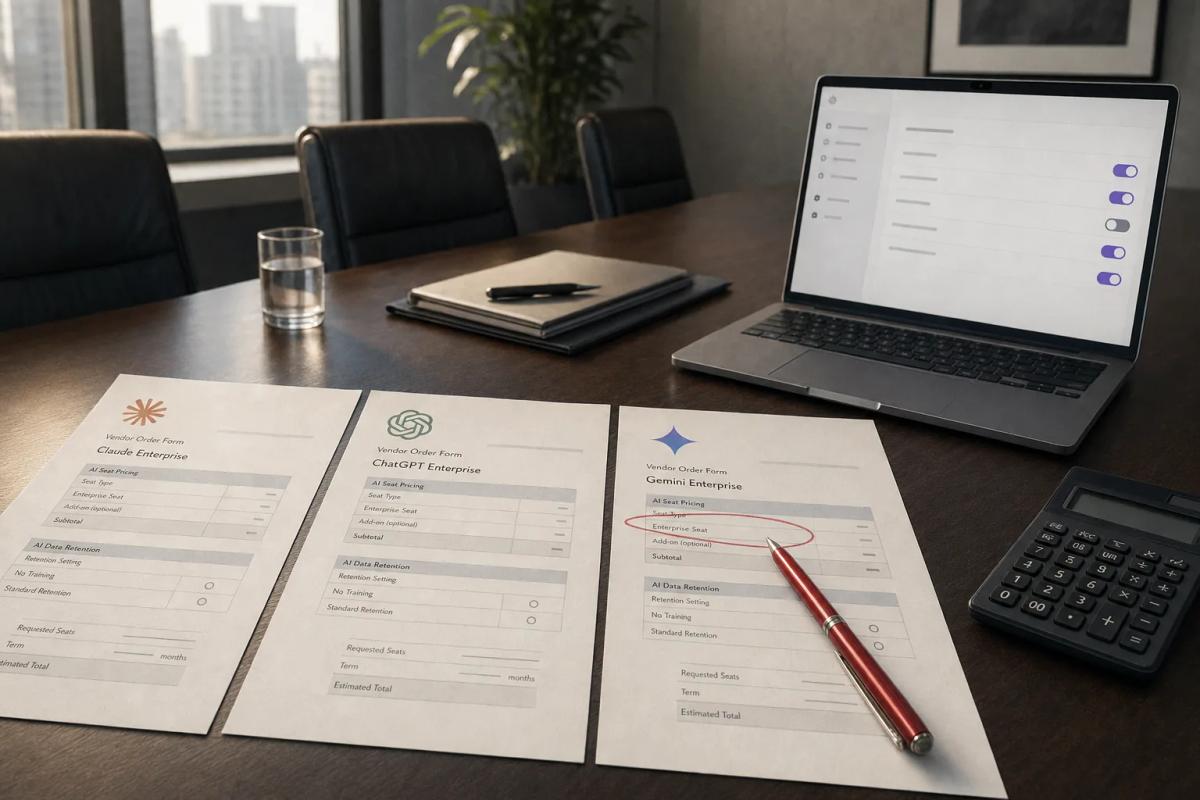
For one company-wide AI assistant seat, buy Gemini Enterprise Standard unless you have a specific reason not to. It has a published starting price, usage stops at the pooled quota unless an admin turns overages on, and it carries the longest compliance list of the three. Claude Enterprise has the lowest seat price and the best per-user spend caps, but the $20 seat is a floor with usage billed on top at API rates. ChatGPT Enterprise comes last on buying terms: no list price, no published minimum, and billable agent features that switch on by default. If your Microsoft 365 agreement already includes Copilot, buy none of them company-wide.
All prices below were checked on each vendor's live page on November 18, 2026. The workload is 1,000 employees on an annual term, at list price, seats only.
| Claude Enterprise | ChatGPT Enterprise | Gemini Enterprise Standard | |
|---|---|---|---|
| Seat list price | $20/seat/month, annual, plus usage at API rates | Contact sales; no list price | From $30/seat/month, annual |
| Minimum seats | 20 | Not published | 1 |
| 1,000 seats, one year, seats only | $240,000 plus metered usage | Quote only | From $360,000 |
| Usage beyond the seat | Billed at API rates; admin spend limits per user and org | Purchasable credits; agent features billed separately | Pooled daily quota; overages off until an admin enables them |
| Default chat retention | Kept indefinitely; custom period 30 days minimum | Admin-set; deleted chats purged within 30 days | Not stated on the edition or compliance pages |
| Drive and SharePoint connectors | Live, per-user sign-in | Synced index that evaluates source permissions | Federated or ingested index with ACLs, per connector |
| HIPAA BAA | Click-to-accept, Enterprise only | Offered for ChatGPT for Healthcare and Regulated Workspace | HIPAA listed for Standard and Plus |
| FedRAMP | High, via Claude for Government | Moderate | Listed, level not stated |
| Who should not buy it | Anyone who needs a fixed annual number | Anyone who needs a list price to approve | Microsoft 365 shops already paying for Copilot |
What Does Each Seat Actually Cost?
At 1,000 seats on an annual term, Claude Enterprise has the lowest fixed cost and the least predictable total, Gemini Enterprise Standard has a known floor, and ChatGPT Enterprise has no public number at all.
Anthropic's pricing page lists Claude Enterprise at US$20 per seat per month, billed annually, with a 20-seat minimum, "plus usage at API rates." The same page says usage cost "scales with model and task" and that admins can set user and organization spend limits. So the $240,000 a year is the floor for 1,000 people. A heavy analyst running long documents through Opus can cost several times their seat in a month. The smaller Claude Team plan is $20 a seat annually or $25 monthly, for 2 to 150 seats, with premium seats at $100 annually and 5x the usage, which rules it out as a company-wide answer at this size.
Google sells Gemini Enterprise in editions. The Business edition starts at $21 per seat per month and is meant for small teams; Google's product page caps it at 300 seats, while its editions documentation lists "1-500 users." Either way a 1,000-person company does not fit. Standard and Plus start at $30 per seat per month on an annual commitment, the figure TechCrunch reported at launch and the one Google still shows as "starting at." Google sends Standard and Plus buyers to sales, so treat $30 as a floor, not a quote.
OpenAI publishes the least. Its pricing page says Enterprise is annual only, that invoicing goes through sales, and that "Enterprise and Business can purchase credits for more access." It gives no Enterprise seat price and no minimum. ChatGPT Business, the small-team plan, runs $20 per user per month annually or $25 monthly from a two-seat minimum, per OpenAI's Business overview. Microsoft 365 Copilot is the comparison your CFO will ask for. Microsoft lists it at $30 per user per month, paid yearly, so 1,000 seats cost $360,000, the same as Gemini Enterprise Standard's floor. We broke down why that licence is also only the starting cost in the true cost of a Copilot seat.
Which Bill Can Grow Without Anyone Approving It?
ChatGPT Enterprise and Claude Enterprise both have meters that run past the seat. Gemini Enterprise is the only one of the three where the default stops usage instead of billing for it.
Gemini Enterprise seats come with pooled daily quotas. Google's quotas and overages page gives each Standard seat 160 assistant queries, 5 images, 2 videos and 3 Deep Research runs a day, pooled across the edition, so 1,000 Standard seats share 160,000 queries a day. Overages run only if an administrator turns on the pay-as-you-go setting. If they are off and the pool runs dry, usage stops until the daily reset at midnight Pacific. If they are on, usage continues at pay-as-you-go rates up to any project spend limit. Storage overage is $5 per GiB per month. Google's August 26 billing post added firm monthly spend limits per project, with email alerts at 50%, 80% and 100%.
Claude Enterprise bills usage by design. That is a reasonable model when you want token pricing with the compliance features included, and the per-user and per-organization spend limits on the pricing page are the tool that makes it safe. Set them before rollout. An organization limit with no per-user limit lets ten power users spend the whole budget.
ChatGPT Enterprise is where usage you never approved turns up on the invoice. OpenAI's dots admin guide says that "starting November 18, 2026, members have access by default unless the workspace opts out," and OpenAI's dots help article says billing for enabled dots starts the same day. Tasks a dot hands to Work or Codex are charged separately at standard rates. We covered the opt-out choices in OpenAI's dots billing change.
Anthropic does the same thing on a smaller scale. Its Claude Data support article says "On Enterprise plans, Claude Data turns on by default on November 20, 2026, unless an owner has already saved a setting," and the feature counts toward plan usage limits like any other Claude work. Microsoft follows the same pattern with Claude inside Copilot for untouched UK and EU tenants. Whichever seat you buy, put someone on the vendor's release notes with the authority to flip a default before its date.
How Long Does Each Vendor Keep Your Chats?
Claude Enterprise keeps chat data forever unless an owner sets a shorter period. ChatGPT Enterprise leaves retention to the admin. Google does not publish a default on the Gemini Enterprise pages a buyer reads.
Anthropic's retention article is blunt: "By default, data is retained indefinitely unless a custom retention period is set." The minimum custom period is 30 days, only a Primary Owner or Owner can set it, and it covers chats, projects and artifacts. It does not cover standalone Claude Design, Claude Tag, Claude Managed Agents or other features that run Claude Code in the cloud. If your legal team signs off on "90-day retention," they are signing off on part of the product.
OpenAI's business data page says qualifying organizations configure how long data is retained and that deleted conversations are removed within 30 days unless law requires otherwise. The Compliance Logs Platform holds logs for 30 days, so you need your own store if your audit policy runs longer.
Google's editions page says Gemini Enterprise prompts, responses and enterprise data are not used to train foundation models. Neither it nor the compliance page states a default chat-history retention period. Get one written into the order form.
Zero data retention is a separate question, and for these chat seats it is mostly an API concept. Our zero data retention comparison covers which features fall outside it on each provider.
Do the Connectors Respect SharePoint and Drive Permissions?
All three try to show each user only what that user can open in the source system. They differ in whether they copy your content into their own index to do it, and a copy is where permissions drift.
Claude's connectors query the source live. Anthropic's Google Drive connector docs say an owner adds the connector for the organization and each member then connects their own Google account, so Claude can reach only the files that person's account can open, and it reads a file's current content from Drive each time a message is sent. The cost is search quality and speed on a large corpus. The benefit is that access follows the source permissions as they stand.
ChatGPT's synced connectors copy content. OpenAI's SharePoint connector article says an Enterprise or Edu admin selects SharePoint content to index for the workspace, and that the sync evaluates SharePoint permissions, including legacy site group membership. That is better engineering than permission-blind indexing. It still creates a second copy whose permissions are only as fresh as the last sync.
Gemini Enterprise lets you choose per connector. Google's connectors overview defines federation as retrieving "information from the specified data source" directly, and ingestion as copying data "into the Gemini Enterprise index." Ingested stores rely on identity sync to map ACL groups. A practitioner admin guide on Google's developer forum tells admins chasing a missing document to check whether permission inheritance in the source is broken or restricted, a check worth running before ingesting with any of the three.
The model matters less here than your own permissions. If SharePoint is overshared, every assistant will surface what it is allowed to see. Fix that first; our Purview vs Varonis comparison covers the cleanup tools.
Which One Has the Compliance Paper Your Auditors Want?
Gemini Enterprise Standard and Plus carry the broadest published list. Claude has the simplest HIPAA path and a documented FedRAMP High route. ChatGPT Enterprise stops at FedRAMP Moderate.
Google's compliance page lists HIPAA, FedRAMP, ISO 27001, 27017, 27018 and 27701, SOC 1, 2 and 3, PCI DSS and BSI C5:2020 for Standard and Plus, along with data residency, CMEK in the US and EU multi-regions, and VPC Service Controls. It does not state a FedRAMP level, and it does not list ISO 42001. The Business edition is not covered by that page, which is another reason it is the wrong edition for a regulated company.
Anthropic makes HIPAA a setting. Its HIPAA article says only Enterprise organizations can enable it, the BAA is click-to-accept in the enablement flow, and enablement cannot be reversed. Enabling it does not by itself bring Claude Code or Cowork under the BAA, and an API BAA signed before December 2, 2025 does not cover the Enterprise plan. For government work, Anthropic's Claude for Government runs under a FedRAMP High authorization.
OpenAI's business data page cites SOC 2 Type 2 and ISO/IEC 27001 alignment and OpenAI's HIPAA-eligible products list offers a BAA for ChatGPT for Healthcare and for ChatGPT Enterprise with Regulated Workspace, not for a standard Enterprise workspace. OpenAI announced FedRAMP Moderate for ChatGPT Enterprise and its API platform in April 2026.
Ask every vendor for an ISO 42001 certificate in writing if your AI governance policy names it. None of the three product pages above lists it for the chat seat.
Who Should Not Buy Each One?
Each seat has a buyer it fits badly, and those mismatches are where renewal regret starts.
Do not buy Claude Enterprise if your finance team needs one fixed number per year. Seat plus usage at API rates means the bill moves with how hard people work, and indefinite default retention means legal needs to act before rollout. Skip it too if you need a single indexed search across a huge SharePoint estate, since live per-user connectors trade recall for freshness.
Do not buy ChatGPT Enterprise if your procurement process needs a list price to approve, if you need FedRAMP High, or if you cannot staff someone to opt out of default-on agent features before each billing date. The strongest case for it is adoption: if many of your employees already use ChatGPT, a sanctioned seat pulls that shadow usage into a governed workspace. That case is real, so negotiate a capped credit pool and written opt-out terms rather than walking away.
Do not buy Gemini Enterprise if you run on Microsoft 365 and already pay for Copilot. At $30 a seat, Gemini Enterprise Standard costs the same as the Copilot licence it would duplicate. Do not buy the Business edition above a few hundred seats or in a regulated industry, since it sits outside the published compliance table. And if you are on Google Workspace Business or Enterprise, check what you already own first: Google folded Gemini Advanced into those plans in January 2025, with NotebookLM Plus to follow, alongside a price increase, so part of your chat assistant may already be paid for.
Do not buy a second suite at all if Microsoft 365 Copilot is in your agreement and adoption is low. A second $20 to $30 seat on top of an unused Copilot seat doubles the cost of the same unused feature. Find out why Copilot usage is low before you pay for another assistant. Our look at how AI bundles are pushing up Microsoft and Google prices covers what to ask for at renewal.
How to Decide in One Meeting
Four questions predict regret better than any benchmark, and you can answer them before you open a pricing page.
- Which productivity suite do you live in? On Microsoft 365 with Copilot already licensed, stop here. On Google Workspace, start with Gemini Enterprise Standard. Otherwise, compare Gemini Standard and Claude Enterprise.
- Does finance need a fixed number? If yes, Gemini Enterprise with overages off is the only one of the three that stops instead of billing.
- What does your retention policy say? If it names a maximum period, Claude Enterprise needs an owner to set it before day one, and you need to list the features it does not cover.
- Who audits you? HIPAA with a fast path favours Claude Enterprise. FedRAMP High rules out ChatGPT Enterprise. A long SOC and ISO list favours Gemini Standard or Plus.
This Week: Get written answers from each vendor on default chat retention, which features ship default-on for your tenant, and whether usage beyond the seat can be capped at zero.
This Month: Run a 50-person pilot on your top two, with spend limits set and connectors pointed at one SharePoint site and one Drive folder whose permissions you know. Check whether a user removed from the source can still retrieve its content the next day.
Before Renewal: Price the winner against the Copilot or Workspace seats already in your agreement, and get the credit or overage rate in writing before you sign.
The Bottom Line
Model rankings between these three change with every release. The contract terms change far less often: who pays when usage runs past the seat, how long chats are kept, and whether a connector copies your files. Those are the things you will still be living with at renewal. Gemini Enterprise Standard has the best default on all three for a CIO who has to answer for the bill, Claude Enterprise is the right choice when per-user spend caps and a HIPAA toggle matter more than a fixed number, and ChatGPT Enterprise needs the most negotiation before it is safe to sign.
Ask each vendor for its default retention period in writing before you compare a single benchmark.
Continue Reading
- True Cost of a Copilot Seat: The Licence Is the Floor
- LibreChat and Open WebUI offer ChatGPT Enterprise alternatives
- Buy ChatGPT Enterprise Through AWS to Draw Down EDP Commitments
- Claude Data Turns On by Default for Enterprise Plans
- Use Bedrock's None Mode to Enforce Zero Data Retention
- Claude vs GPT vs Gemini: Stop Comparing Per-Token Prices
