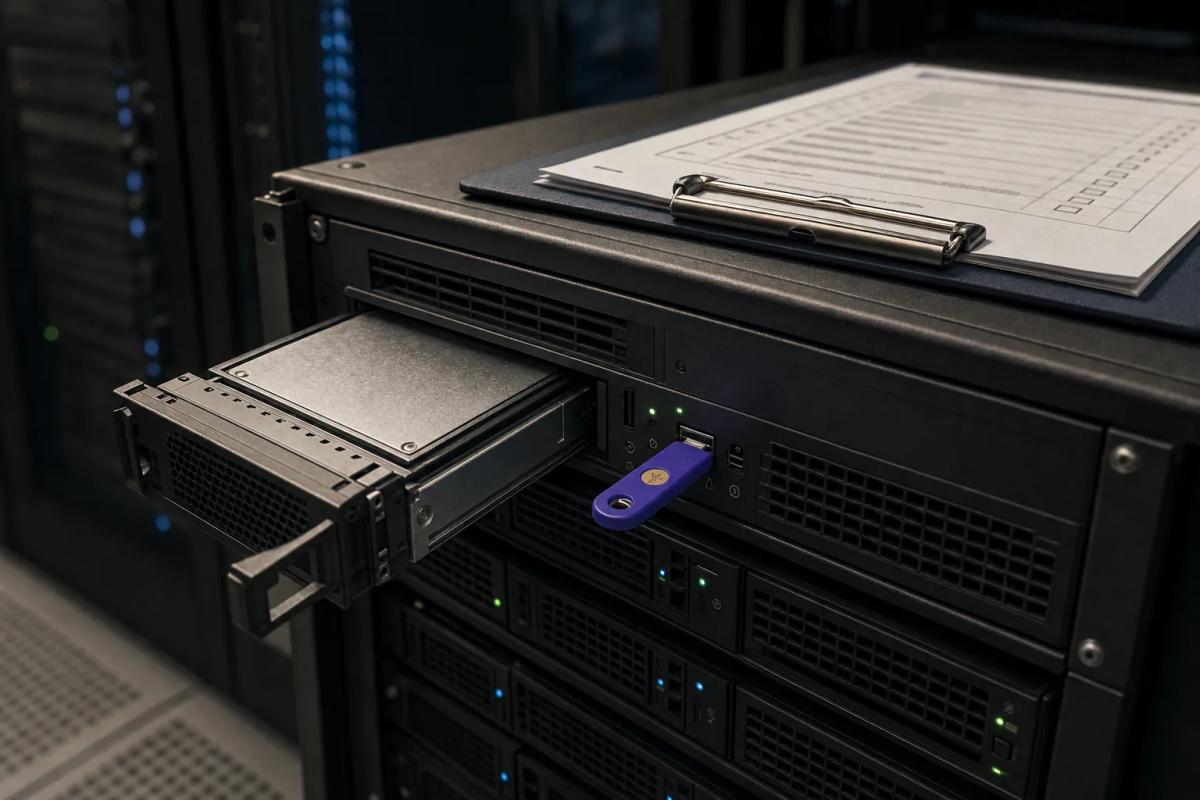
If the 30-day retention rule kept Claude Fable out of your regulated workloads, Enterprise Frontier Safeguards (EFS) is now the permanent way in, and it went into public beta on November 23, 2026. Anthropic charges nothing for it. In exchange you supply a storage bucket, your own encryption key and a team that answers every flagged Safety Case within 7 calendar days. On Amazon Bedrock, a key or bucket that stays unusable for 24 hours stops the covered models for every account using that configuration.
That is a real operating commitment, and the interim zero data retention (ZDR) exception most Fable buyers are living on was always described as temporary. Decide now who owns the bucket, the key and the case queue.
What Anthropic Opened on November 23
EFS is Anthropic's answer to a rule it set itself. Since Fable 5, covered models carry a 30-day minimum retention by default, and ZDR is unavailable in any workspace where those models are called. The covered list now runs from Fable 5 and Mythos 5 (designated June 9, 2026) through Fable 5.2 and Mythos 5.2 (designated November 9). Anthropic introduced that retention starting with Fable 5 so it could monitor misuse across time and accounts.
EFS keeps the monitoring and moves the data. Anthropic's November 23 announcement describes a setup where "neither Anthropic nor any cloud providers retain enterprises' data." Prompts and responses go to storage you own, automated systems scan them, and when something looks like misuse the system opens a Safety Case for your team to review. Anthropic says it receives safety correspondence and monitoring metadata only, with no operator human review, and that it does not train on the data.
The beta covers four routes: the Claude Platform, Claude Platform on AWS, Amazon Bedrock and Claude on Google Cloud. Microsoft Foundry is listed as "coming soon," even though Anthropic's September post included it in the original plan. If your Fable traffic runs through Foundry, you have no enrolment path yet.
The private beta included Bridgewater, Salesforce and Stripe, according to the launch article. Anthropic says eligible customers will be notified with instructions.
What Your Team Has to Run
A Safety Case is a record Anthropic's automated monitoring opens when it finds a potential Usage Policy violation in an EFS workspace. Per the Safety Cases documentation, each one carries an ID, a category such as cyber or bio, the message IDs and the workspace. Your people investigate and answer no_violation or violation, either by writing a response file to review-responses/<case_id>.json in your bucket or through the API.
The deadline is 7 calendar days from the case's created_at. If nobody answers, Anthropic closes the case, and an unanswered case "may" lead to suspended access. Anthropic does not notify you when a case is created. You have to watch the bucket or poll the API, which means a SIEM rule or a scheduled job has to exist on day one. The Safety Cases API is itself in beta and available only on the Claude Platform.
The rest of the bill lands with your cloud provider. The EFS overview says Anthropic does not charge for EFS and that it changes neither API pricing nor rate limits, but storage reads, writes and egress are billed to you. Your own team cannot read the Sealed Safety Data in the bucket either: it is prompts, responses and model reasoning, encrypted in Anthropic's format.
Three scoping rules from the same docs change how you lay out workspaces:
- On the Claude Platform, EFS applies to every request to every model in an EFS workspace, so carve out a separate workspace if you only want Fable under it.
- Code execution containers, Files API uploads, Batch API results and Managed Agents sessions are not covered, and the EFS FAQ says the Batch API and Managed Agents sessions are not supported at all.
- Legacy ZDR workspaces stay on Legacy ZDR, and EFS needs a new workspace. EFS also applies only from the moment setup takes effect, so earlier data stays where it was written.
The key is the decision you cannot undo. On the Claude Platform, attaching a customer-managed key is permanent. You can rotate key material but you cannot detach it or move back to Legacy ZDR, and attaching one turns on Access Transparency for the whole organization with no way to switch it off. If you revoke the key, requests can keep succeeding for up to an hour and then fail. An unreachable KMS returns a 503 with cmek_key_unreachable on the Messages API.
How Bedrock Fails Closed
Amazon Bedrock is the strictest route, and its rules are written down. AWS's EFS and Enterprise Data Controls guide labels the service a public preview and states the failure mode plainly: "Amazon Bedrock fails closed. If it can't use your key or bucket for 24 hours, it stops serving the covered models for the organization, account, or project and Region that use that configuration."
The same guide says Bedrock also stops serving if you delete retained content early or loosen the required bucket settings. Those settings are specific:
- A symmetric, single-Region, customer-managed AWS KMS key with automatic rotation, referenced by full ARN, never an alias.
- A general purpose S3 bucket in the same Region as the key, with no dots in its name, versioning on, all four Block Public Access settings on, SSE-KMS with your key, and Object Lock, replication and storage class transitions off.
- A bucket policy that denies hard deletion of the retained records, plus lifecycle rules that expire
transcripts/after 30 days.
That last point matters for your records team. AWS describes transcripts/ as "readable copies of inputs and outputs." So under EFS on Bedrock, your own bucket holds a readable 30-day copy of every covered request. Legal holds, eDiscovery and data-subject requests now reach that bucket, and your data classification policy has to say who may open it.
The case clock works the same way on AWS, with a harder edge. Bedrock gives you 7 calendar days from the case arriving, warns that it "may stop serving your requests" if you miss it, and adds that "in certain cases, requests may stop being served before the 7 days end." A case closed as window_ended is not cleared, and repeated silence can lead to account suspension.
Three more Bedrock details catch people out. Joining the preview turns ZDR off for the accounts or projects you add, so do it on test accounts first; AWS says not to send regulated data such as PII or PHI during testing. Storage configuration is per Region, and automated review runs in us-east-1 and eu-west-1, so a bucket elsewhere can add cross-Region transfer charges. And configuration changes take up to 24 hours to apply, with AWS advising you to keep the old key and bucket for 40 days.
The covered list on Bedrock is wider than Fable. It includes Fable 5 through 5.2, Mythos 5 through 5.2, and Claude Opus 5.5 and Sonnet 5.5 when used through the Cyber Verification Program. Without EFS, Bedrock retains all Fable traffic for up to 30 days for automated abuse detection, and flagged traffic may get human review by AWS.
The Interim ZDR Exception Now Runs Through June 2027
The interim exception has a later published floor than it did two weeks ago. AWS's EFS guide now says eligible EFS customers can use current Fable models and existing CVP models with ZDR "for internal use through at least June 30, 2027." Our November 9 ZDR buyer's guide reported December 31, 2026, from AWS's abuse-detection page at the time. Plan on the June date. "At least" means AWS may extend it, but nothing in the docs promises that.
Anthropic's own wording is looser. The Covered Models page calls the interim option "available for a limited time" and "a transition to EFS," limits it to internal business applications, and says Anthropic may modify or withdraw it, including in response to misuse. It gives no end date.
The strongest argument for waiting is that EFS is a beta with settings that can change during the beta, and the interim exception already gives you ZDR today. The catch is lead time. A new workspace layout, a key you cannot detach, per-Region buckets on AWS and a staffed case queue are months of change control at most regulated firms. If you start that work in May 2027, you will be running a migration against a deadline you do not control. And if you ship Fable in a customer-facing product, the interim exception never covered you, so ask the account team directly whether EFS does.
What to Do Before the Exception Ends
This Week:
- Ask your Anthropic or AWS account team whether you are on the eligible list, and get the answer in writing alongside the interim exception terms that apply to you.
- Inventory where Fable and Mythos traffic actually runs: Claude Platform workspaces, Bedrock accounts and Regions, Google Cloud, Foundry. Foundry traffic has no EFS path yet.
- Name the owner of the Safety Case queue, with a backup, and give them a 7-day response target shorter than the vendor's.
This Month:
- Stand up EFS on a test account or a new test workspace, never on production. On Bedrock, confirm
kmsKeyStatusands3BucketStatusreturnactive, then remember AWS says that status does not guarantee they stay usable. - Put a monitor on the key and bucket that pages someone well inside 24 hours. A KMS key disabled by a cleanup script or an SCP or RCP that denies the AWS service principal access to S3 or KMS is the outage you are guarding against.
- Wire new-file alerts on the bucket or the Safety Cases API into your SIEM, since nobody will email you about a new case.
- Have legal and records review the readable
transcripts/prefix on Bedrock and the lifecycle rules you are not allowed to change.
Before June 30, 2027:
- Decide the key question per workspace with your security lead: a customer-managed key on the Claude Platform is permanent and turns on org-wide Access Transparency.
- Move Batch API and Managed Agents workloads that need ZDR to models outside the covered list, because EFS does not support them.
- Cut production traffic over to EFS workspaces and accounts, then retire the interim exception yourself.
The Bottom Line
EFS makes the trade that customer-managed keys made in cloud storage: you get control, and you also own the outage when the key goes missing. You get ZDR on the most capable Claude models at no extra charge from Anthropic or AWS, and you take on the key, the bucket and the review duty that used to sit with the vendor. If you run Fable on Amazon Bedrock, the cost of a missed alarm is 24 hours of headroom before the covered models stop serving.
Recent incidents at inference providers, such as the prompt leaks Dragos found, are the reason buyers asked for this design. Give the case queue an owner and the key an alarm before you route production Claude traffic through it.
Continue Reading
- Claude Fable 5.2 Requires 30-Day Retention for Most Buyers
- Use Bedrock's None Mode to Enforce Zero Data Retention
- Anthropic Adds Red Team Access to Cyber Verification Program
- Rotate OpenRouter Secrets After Dragos Finds Prompt Leaks
- Pick Gemini Enterprise Standard for a Company-Wide AI Seat
- Agent Audit Logging: Platform Logs Miss the Decision You Must Prove
