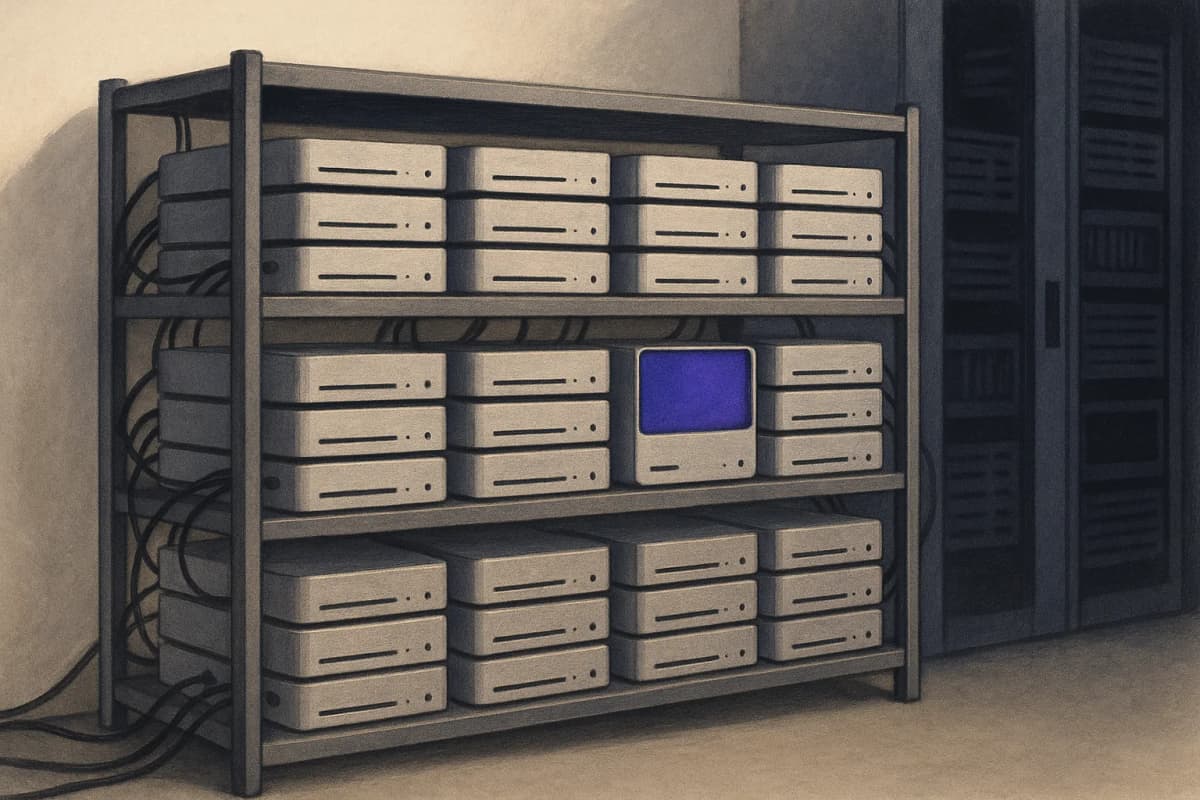
A computer-use agent's unit of cost is a desktop, not a token. Every concurrent agent that drives a screen needs its own operating system, its own display, and its own machine time — and unlike inference, you cannot batch it, cache it, or quantize it away.
The Information reported on 31 August that OpenAI has bought tens of thousands of Mac minis and Mac Studios to train agents that operate a computer, and that Anthropic rents Mac mini capacity through AWS rather than buying, as summarised by The Decoder. The frontier labs placed hardware orders, not GPU reservations. If you are scoping a desktop-agent pilot, so will you — and on macOS that hardware arrives wrapped in a licence that caps you at two virtual desktops per Mac and bills a 24-hour minimum on every host, whether the agent ran for twenty minutes or a full day.
What OpenAI Actually Bought
It bought general-purpose desktops, headless, in bulk. TechRepublic's account of The Information's reporting describes tens of thousands of Mac minis and Mac Studios running without displays or keyboards inside OpenAI's own infrastructure, used for reinforcement learning on computer-use agents. That workload is not transformer pre-training. It is an agent taking a screenshot, deciding, clicking, and being scored — millions of times, each iteration bound to one running copy of an operating system.
The demand caught Apple out. It moved its desktop refresh forward from the usual autumn slot and announced a new Mac mini on 25 August 2026 at $899 for the M6 and $1,699 for the M5 Pro with up to 64GB of unified memory, shipping 22 September. TechRepublic puts Mac revenue at $10.4 billion for the June quarter, up 29% year over year, against Apple's reported $109.4 billion total for the quarter ended 27 June. MacRumors adds the less flattering half of the same reporting: Apple has no engineering team dedicated to business customers and no enterprise AI strategy, businesses asking for Private Cloud Compute access were turned down, and many Mac mini and Mac Studio configurations have been out of stock for months against the global memory shortage that is already repricing server bills of materials.
The relevant fact for you is not that Apple is having a good quarter. It is that the people with the largest inference budgets on earth concluded this workload is bought in machines.
The Unit of Cost Is a Desktop, Not a Token
At pilot utilisation, the machine dominates the bill and the model is the small line: 45% of the total at a quarter duty cycle, 67% at a tenth, and 95% for a single run on a freshly allocated host. That inverts the intuition every team has built over three years of token budgeting.
Start with the model side, which is the cheap side. Anthropic's computer use documentation puts each returned screenshot at roughly 1,000 to 1,800 tokens, and its pricing page puts the toolset definition at about 4,500 input tokens per request. On OSWorld 2.0 — 108 long-horizon desktop workflows where the median task takes a skilled human about 1.6 hours — Claude Opus 4.7 averaged 318.4 steps per task with single tool calls (160.7 when they are batched), and the best result on the board is 20.6% binary completion, by Claude Opus 4.8. Multiply 318 steps by 1,500 image tokens and you get roughly 477,000 input tokens, which at Claude Opus 5's $5 per million input tokens is about $2.39, or a tenth of that on cache reads. Call it two or three dollars of model for one long, hard task.
Now the machine side. Amazon's mac-m4pro.metal lists at $1.97 per hour, and AWS documents that Mac instances run only as bare metal on Dedicated Hosts, one instance per host, with a minimum allocation period of 24 hours. That is $47.28 you cannot avoid the moment you allocate. Apple's licence lets that host run two macOS guests, so one host-day yields at most 48 agent-desktop-hours.
Assume a 300-step task occupies half an hour of wall clock. That is generous at four seconds a step, and it is my assumption rather than a published figure — substitute your own once you have measured it. The table below is what falls out:
| Host utilisation | Tasks per host-day | Machine cost per task | Machine share of total |
|---|---|---|---|
| 100% (both VMs, all day) | 96 | $0.49 | 17% |
| 25% | 24 | $1.97 | 45% |
| 10% | 9.6 | $4.93 | 67% |
| One task, then release | 1 | $47.28 | 95% |
Nothing about the hourly rate is unreasonable. What is unreasonable is a pilot's duty cycle. A twenty-task evaluation suite run twice a week sits in the middle rows — roughly five hours of wall clock against a 24-hour floor — paying a full day of a whole machine for an afternoon of work. The bottom row is not an eval suite at all; it is the single debugging run, and it costs $47.28 to answer one question. The floor means no clever scheduling fixes either. This is the same trap as buying GPU capacity against a headline tokens-per-second number that assumed batch size one: the list price is honest and the utilisation assumption behind it is not yours.
Apple Caps You at Two Agents Per Mac
You cannot densify your way out. macOS permits two additional virtual instances per Mac and enforces it below the API, so buying a bigger machine buys you a faster desktop, never a third one.
The Eclectic Light Company's teardown of the limit shows the Virtualization framework refusing a third macOS guest with VZErrorDomain code 6 — "the maximum supported number of active virtual machines has been reached" — and a follow-up analysis traces enforcement into the XNU kernel's hypervisor stack, where a kernel quota variable tracks the number of running VMs. This is not a resource constraint. An M5 Ultra Mac Studio with 512GB of unified memory obeys the same ceiling as a 16GB Mac mini. MacStadium, which sells macOS virtualisation for a living, states it plainly in its own product documentation: macOS supports up to 2 running VMs per host.
There is one honest workaround and it makes the arithmetic worse. Section 2B(iii) governs virtualised copies, so running your agent directly on the host's own macOS install sidesteps it — at the cost of one agent per machine instead of two, with no isolation between the agent and the host. For a workload whose defining risk is that a screenshot can carry an instruction, that is a poor trade. Anthropic's own guidance is to use a dedicated virtual machine or container with minimal privileges precisely because prompt injection through page content is the expected failure mode, a risk this publication has covered since Gemini's computer-use model shipped.
So the capacity planning line is blunt: concurrent macOS agent sessions ÷ 2 = Macs you must have. Two hundred concurrent sessions is one hundred machines. There is no instance size that changes it.
The 24-Hour Minimum Is the Licence, Not the Vendor
Two unrelated providers on two continents impose the identical 24-hour floor, which tells you it is not an AWS billing quirk you can negotiate around.
AWS is explicit that billing is per second with a 24-hour minimum allocation period to comply with the Apple macOS Software License Agreement. Scaleway, a French provider with no relationship to Amazon, says the same thing in its documentation: "Due to license constraints, the minimum lease for Apple silicon is 24 hours", and the earliest you can delete a Mac mini is 24 hours after the lease starts. The proof that it is the licence and not the silicon is Scaleway's exception: install Asahi Linux on the same hardware and the commitment disappears.
Two more operational details belong in your plan:
Recycling a host is slow. When you stop or terminate an EC2 Mac instance, AWS runs a scrubbing workflow on the Dedicated Host that erases the internal SSD, clears NVRAM and updates firmware. On Apple silicon that takes up to 4.5 hours, and the host is unavailable throughout. You are not billed for it, which is decent of them, but "spin up a clean desktop per run" is not a pattern this platform supports.
The price spread between providers is large. Scaleway lists a Mac mini M4 Pro with 64GB at €0.49 per hour or €335 per month, against $1.97 per hour for AWS's 48GB mac-m4pro.metal — roughly a quarter of the rate, for a machine with more memory, at any recent exchange rate. And a Mac mini M5 Pro starts at $1,699 outright. At AWS's hourly rate you pay that purchase price every 36 days. EC2 Mac is priced for bursty iOS build farms, which is what it was built for. An always-on agent fleet is the wrong shape for it, in the same way DGX-class desktop hardware changed the on-prem-versus-cloud maths for local inference.
Read Section 2B(iii) Before Your Agent Runs Payroll
The macOS licence enumerates what those two virtual instances may be used for, and running your business processes is not on the list. This is the part of the story that has had no attention at all.
The macOS Tahoe Software License Agreement grants the right to run up to two additional copies within virtual operating system environments for four stated purposes: software development; testing during software development; using macOS Server; or personal, non-commercial use. The same clause has carried substantially the same wording for years — it appears in the Big Sur agreement and in Ventura's and Sequoia's. The grant also states that it does not permit use of the virtualised instances "in connection with service bureau, time-sharing, terminal sharing, relay service or other similar types of services."
An agent reconciling invoices in a virtualised macOS desktop is not software development, not testing during software development, not macOS Server, and not personal non-commercial use. I am not your counsel and this is not legal advice — but it is a clause with four enumerated purposes and a plainly commercial deployment that matches none of them, and that belongs in front of your legal team before the fleet exists rather than after.
Two qualifications, stated fairly. First, AWS and Scaleway operate these services at scale in public, which strongly implies arrangements with Apple that a reseller agreement would cover; the clause that binds you is the one attached to hardware you bought and racked yourself. Second, Apple has said nothing about agent workloads either way, and the absence of a prohibition tailored to a 2026 use case is not the same as permission. What you can do today is ask the question in writing and keep the answer.
Windows Bills the Same Constraint to a Different Line
If your target applications are Windows applications, the density ceiling disappears and a licensing question takes its place: which human is the agent?
Microsoft is unambiguous that you must provide an eligible licence for each user that accesses Azure Virtual Desktop, and Windows 365 Enterprise is sold per user per month — $41 for 2 vCPU/8GB, $66 for 4 vCPU/16GB, $132 for 8 vCPU/32GB. Both models assume a named person at the far end of the session. An agent fleet has no named person, and nothing in the current terms tells you whether fifty concurrent agents need fifty licences, one service account's licence, or something your account team will invent when you ask.
Ask before you scale. This is the same unresolved question that seat-based licensing has been failing to answer for agentic workloads all year, and it is cheaper to raise in a procurement conversation than in a true-up.
The Cheapest Desktop Is the One You Never Provision
Most enterprise computer-use work does not need a desktop at all, and the strongest version of the argument against this whole article is that you should check that first.
Anthropic's reference implementation for computer use is a Linux Docker container running an X11 virtual display, a lightweight window manager and ordinary Linux applications — not a Mac and not a Windows VM. The managed-sandbox market has followed that shape: E2B prices a sandbox at $0.000028 per second for 2 vCPU plus $0.0000045 per GiB per second, which is about $0.17 an hour for a 2 vCPU / 4GiB Linux desktop, billed per second with no minimum. Against $0.985 per agent-desktop-hour on a fully packed EC2 Mac host — and $47.28 for a single short run — that is not a close comparison.
Nobody sells a managed, per-second macOS agent desktop. Sub-day macOS is sold — GitHub bills a hosted macOS runner at $0.062 a minute, about $3.72 an hour with no 24-hour floor, by holding the host itself and amortising that floor across everyone's short jobs — but its terms confine hosted runners to "the production, testing, deployment, or publication of the software project associated with the repository", which an agent reconciling invoices is not. The billing model exists; that use of it does not. What nobody has built is the open version at container prices, and the two-VM ceiling is why.
So the decision tree is short. If the workflow lives in a browser or a web application, use a browser and pay container prices. If it lives in a Linux application, same answer. If it genuinely lives in a macOS or iOS application — testing your own iPad app, driving a Mac-only design tool, exercising an Apple-platform build — then you are buying machines, and the arithmetic above is your capacity plan. And if the target is a legacy Windows desktop application, the honest comparison is not against a Linux container but against the RPA licence you already hold, which is the trade Microsoft's computer-use general availability and Gemini's push into the same market both reframed — and where UiPath and its peers still win on determinism for high-volume, unchanging screens.
Three Things to Fix Before You Scale the Pilot
This Week:
- Count how many of your target applications actually require a desktop. Go application by application with the team that owns each one. Every workflow that turns out to be browser-only leaves the machine-shaped cost model entirely and moves to container pricing.
- Instrument step count and wall clock on the pilot you already have. You need a measured seconds-per-step and steps-per-task before any of the arithmetic above is yours rather than mine. Log it per run, not per week.
- Pull your cloud bill and filter for
macDedicated Hosts. If a team has been prototyping with Claude Computer Use on EC2 Mac, you are already paying 24-hour minimums nobody has looked at.
This Month:
- Model host-days at three utilisation levels, not one. Take your measured task duration, divide 48 agent-desktop-hours per host-day by it, and price the pilot at 10%, 25% and 100% duty cycle. The spread between those three numbers is the entire decision.
- Price the same capacity three ways. Hyperscaler on-demand, a second-tier Mac host, and machines you buy and rack. Thirty-six days of AWS equals the purchase price of the Mac; if your fleet runs longer than a quarter, ownership is the default and rental is the exception.
- Put the two-VM ceiling in the architecture diagram. Not in a footnote. It is the hardest constraint in the design, and it is the one that surprises people in month four when the concurrency target doubles.
Before You Sign:
- Send Section 2B(iii) of the macOS SLA to counsel with your actual use case attached. Ask one question: does an agent executing a business process inside a macOS VM fall within the four permitted purposes? Get the answer in writing before the hardware order.
- Ask your Microsoft account team who the licensed user is for an agent session. Put the number of concurrent agents in the question. The answer changes your Windows 365 or AVD line item by an order of magnitude, and it is far cheaper to have that conversation now than during an audit.
The Bottom Line
Enterprise infrastructure practice spent twenty years teaching buyers to think in cores and gigabytes, and the last three teaching them to think in tokens. Computer-use agents ask for something older and less fashionable: a machine count, a licence agreement, and a utilisation curve. The token bill on a hard desktop task is two or three dollars. The machine underneath it is $47.28 if you provision it badly and $0.49 if you provision it well, and the difference is entirely a question of how full you keep a box — which is a data-centre question, not an AI one. Meanwhile the ceiling on how many agents fit on one Mac was set by a licence clause written for developers running test builds, long before anyone imagined the guest operating system would be doing the work. The labs solved it by buying tens of thousands of machines. You do not have that budget, and you probably do not need it — but you do need to know which of your workflows actually requires a desktop, because that is the one number that decides whether this is a container line item or a hardware order.
Price the tokens if you like. Then go count the machines.
Continue Reading
- Microsoft Computer-Use GA: RPA's $100K Tax Just Ended
- Gemini's New Agent Controls Your Apps. 3 Risks CIOs Miss.
- AI Agent Harness Pricing: Hidden Infrastructure Costs Enterprise Leaders Must Track
- 3,400 Tokens/s Was Batch 1. At 100K Context, It's Batch 12.
- GPU Clouds Compared: Nebius on Price, CoreWeave at 3AM
- Nvidia Is Losing 3 Points to RAM. Re-Price Your Server BOM.
- Agentic AI Pricing: Don't Buy Consumption Without a Cap
- Amazon Blocks Meta's Muse Agent Where the Perplexity Ruling Stops