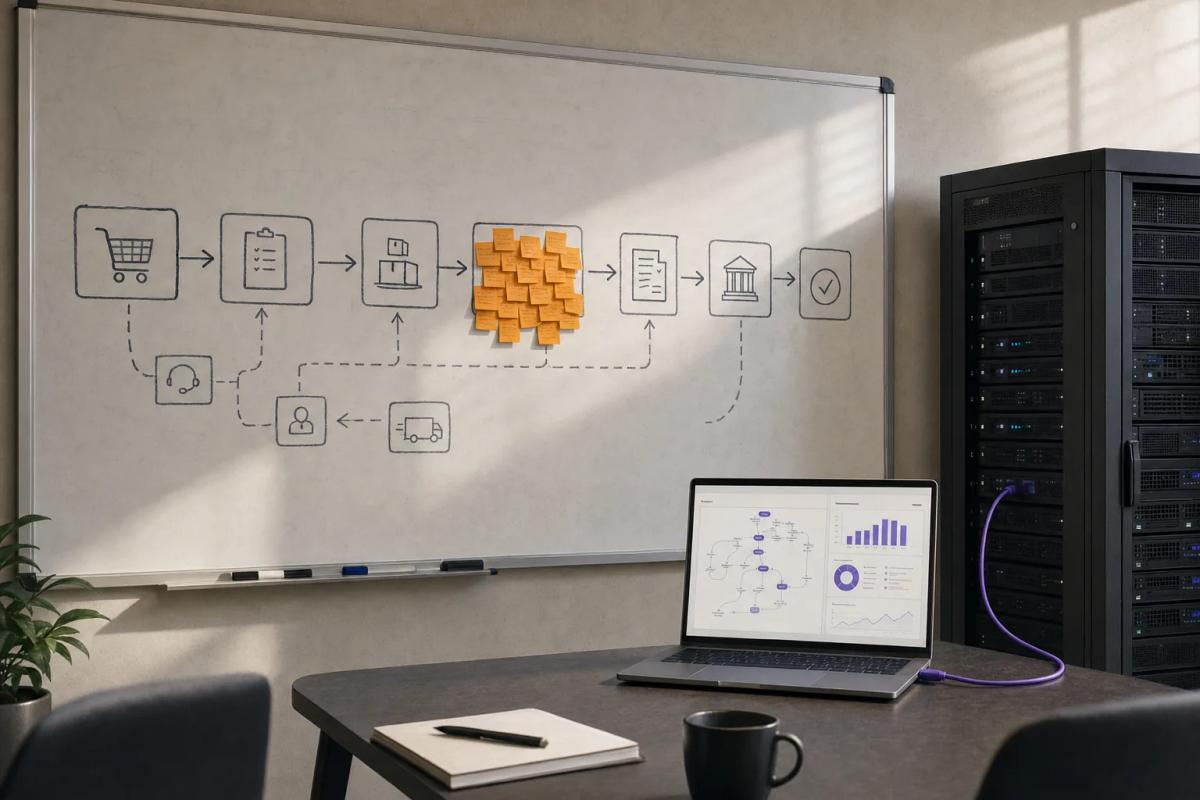
First-time buyers should start with the process miner their ERP or automation vendor already sells: SAP Signavio on SAP, Power Automate Process Mining for Microsoft shops, UiPath Process Mining for UiPath bot estates. Keep or buy Celonis when you have three or more processes in production, a named owner for each, and a plan to feed the results to agents. IBM Process Mining is the pick for regulated firms that need it on premises, and it is the only one here with a published on-premises price.
All prices below were checked on each vendor's live page or marketplace listing on November 14, 2026. To compare like for like, every row uses one defined workload: one purchase-to-pay process on a single SAP ECC client, about 20 million events a year, 3 analysts and 50 business viewers.
| Product | Best for | Published price (checked 2026-11-14) | Cost signal for the workload | Object-centric | Task mining | Agent context today |
|---|---|---|---|---|---|---|
| Celonis | 3+ processes in production with owners | None from Celonis | $300,000 per 12 months on one reseller listing; a spend tracker's median is $12,775 a year | Yes | Yes | MCP Agent Tools, GA |
| SAP Signavio Process Intelligence | SAP-centric estates | Software unpriced; activation service only | Quote | Not documented | Via partners | Joule GA, Signavio agents in beta |
| Power Automate Process Mining | Microsoft 365 and Dynamics shops | $5,000 per tenant per month add-on | $60,000 a year if you outgrow included capacity | Public preview | Included in Premium | MCP server, preview |
| UiPath Process Mining | Existing UiPath automation customers | Contact sales | About 160,000 AI Units at 125 rows each | Partial | Yes | Not documented for mining |
| IBM Process Mining | Regulated firms, on-prem mandates | $4,250/month SaaS, $2,885/month on-prem | $34,620 to $51,000 a year before extra users | Yes, since 2.0 | Yes, Windows agent | Assistant in tech preview |
| ARIS Process Mining | Firms already modelling in ARIS | Contact sales | Quote | Not documented | Not documented | MCP listed, GA date unconfirmed |
The loser for most readers is UiPath Process Mining bought on its own. It meters on visualized event rows, re-charges your entire data footprint at every renewal, and its value depends on routing findings into UiPath robots you would have to buy as well.
What Celonis Costs, and Why Nobody Can Tell You
Celonis does not publish a price, and the two public numbers that exist disagree by a factor of about 23. Its pricing page offers a form to speak to an expert. The UK government's G-Cloud 15 listing confirms a 12-month minimum term and a free plan with restricted data volumes.
The first number is a reseller list price. Carahsoft's AWS Marketplace listing for Celonis prices "Execution Management, 1 Concurrent Process, Unlimited Named Users" at $300,000 for 12 months. That is a public-sector channel price for one process, and it is the only Celonis figure anyone can click on.
The second is transaction data. Vendr's Celonis page reports a median contract of $12,775 a year, with a range of $6,000 to $130,277. Vendr does not say how many purchases sit behind that median, and a range topping out at $130,277 suggests its sample is weighted toward small or early deals.
Treat both as single-source claims. Neither is a Celonis list price. What you can take from them is the spread: a Celonis deal can cost anything from a departmental tool to a mid-sized ERP module, so get the quote broken out by process, data volume and user type before you compare it with anything below.
Who should not buy Celonis: a firm with one process in scope and no second one funded. At one process, the bundled options below cover most of the analysis for less, and you are paying for depth you will not use.
Who should keep it: firms where Celonis already runs several processes, analysts write PQL daily, and process owners act on its findings. Celonis was a Leader for the third straight year in Gartner's 2025 Magic Quadrant for Process Mining Platforms, and its product is the most complete one here on object-centric modelling, task mining and agent access. Migrating a working deployment to save licence money usually costs more in rebuilt data models than it saves.
SAP Signavio Is the Default on an SAP Estate
If most of your process data lives in SAP ECC or S/4HANA, SAP Signavio Process Intelligence is the sensible first look, because SAP owns both ends of the extraction. SAP Signavio was also named a Leader in the 2025 Gartner Magic Quadrant, its third consecutive year.
Pricing is the weak spot. SAP does not list the software. The only Signavio Process Intelligence item with a price on SAP's own site is the activation service, listed at USD 1,248.33 per month on a one-year, non-renewable contract on the Latin America store page, and it requires an existing subscription. Third-party estimates for the subscription vary too widely to quote. Ask SAP whether Signavio entitlements already sit inside your RISE or GROW contract before you price anything else, because that is the most common reason a Celonis renewal looks expensive.
Outside SAP, SAP documents a ServiceNow connector for Process Intelligence. For anything else, ask for the connector list in writing and see it run against your system.
Task mining comes through partners. SAP brought Knoa in as a task mining partner in January 2024, sold as SAP User Experience Management by Knoa. That is a second product and a second contract.
On agents, Joule with SAP Signavio solutions became generally available on February 10, 2026, which lets users query processes in natural language. The Joule Agents for Signavio are a separate matter: SAP's own announcement says they are still in development, and SAP opened five of them for beta registration. Do not budget for an agent that is in beta.
Who should not buy Signavio: a firm whose critical processes run mostly in Oracle, Salesforce or a homegrown order system. You would be paying for SAP's best case on a workload that doesn't need it.
Power Automate Process Mining Is the Cheapest Published Entry
For a Microsoft shop testing one or two processes, Power Automate Process Mining has the lowest published starting price here, because some capacity comes with Premium seats you may already own. According to Microsoft's pricing page, Power Automate Premium is $15 per user per month, and the Process Mining add-on is $5,000 per tenant per month, paid yearly, available only with Premium.
The Power Platform licensing FAQ sets out the capacity. Each Premium licence adds 50 MB of process mining storage to a tenant pool, capped at 100 GB per customer, and includes task mining entitlements at no extra charge. The add-on lists at "$5,000 for 100 GB of data stored/month". Power BI licences are not included. For the reference workload, three analysts on Premium give you 150 MB of pool capacity; if your 20 million events will not fit, the add-on brings the bill to $60,000 a year plus $540 for the three Premium seats. Check your real peak usage in the Power Platform admin center before you buy.
The catch is extraction. Microsoft's data preparation guide says process mining imports through Power Query connectors and notes that application tables often hold current state rather than event history, so "you might need to join the log table with other tables." For SAP it says only that "you might be able to connect" via a connector. In practice, someone on your team builds and maintains the SAP event log.
Object-centric analysis is not finished. Microsoft's Message Center post MC1391882 put the Process Intelligence experience for object-centric process mining into public preview on June 30, 2026, with no GA date stated. The Process Mining MCP server is also labelled preview, and Microsoft says preview features "aren't meant for production use". It exposes nine tools, including bottleneck, variant and correlation analysis, to agents built in Copilot Studio.
Who should not buy it: a firm with an SAP-heavy purchase-to-pay process and no engineer to own the extraction, or anyone who needs object-centric analysis in production this year.
UiPath Process Mining Only Makes Sense Inside UiPath
Buy UiPath Process Mining only if UiPath robots will act on what it finds, because the pricing model punishes a standalone purchase. UiPath's pricing page lists Process Mining in the Standard and Enterprise plans and gives no price for either. The licensing documentation for the Flex plan is specific: "1 AI Unit = 125 rows," counted on visualized event log rows, with a minimum purchase of 120,000 AI Units. The first data load charges 8,000 AI Units for 1 million rows, and at the end of each licensing period Process Mining re-consumes AI Units for the whole data footprint, with a minimum of 1 million rows.
For the reference workload, 20 million rows works out to 160,000 AI Units a year. UiPath does not publish an AI Unit price, so you cannot finish that sum without a quote.
Connectors are reasonable. UiPath's DataBridgeAgent ships SAP connectors for purchase-to-pay and order-to-cash (those docs are for a 2023 release, so confirm the current version). The May 2025 release notes added direct ServiceNow and Salesforce connections and let each process in an app follow a different object, which gets partway to an object-centric model.
Task mining is changing. UiPath's August 2026 Public Sector notes retire Task Mining in that environment from September 1, 2026 in favour of Delegate Cartographer. UiPath was moved up to Leader in Gartner's 2024 quadrant, per Computerwoche, but we found no UiPath documentation of an MCP server or agent-context feature for process mining itself. Its agent work sits in Maestro and Delegate, covered in our FUSION 2026 recap.
Who should not buy it: anyone who is not already a UiPath automation customer. If you are weighing the UiPath platform itself, read our UiPath alternatives comparison first.
IBM Process Mining and ARIS for Regulated Firms
IBM Process Mining is the pick when the data cannot leave your data centre, and it publishes prices for both deployments. IBM's pricing page lists SaaS on AWS "Starting at USD 4,250/month" with 20 GB of storage, 3 business users and 1 analyst, sold annually. The on-premises edition on Red Hat OpenShift starts at USD 2,885 a month with 3 projects, 20 million events, 3 business users, 1 analyst and 2 task mining agents. That on-premises starter matches the reference workload's event count exactly, at $34,620 a year, though 50 viewers will need more user licences priced on request.
IBM's model is object-centric. The 2.0.0 release made data management object-centric and shipped a Process Mining Assistant as a technical preview, and the 2.2.0 release in June 2026 added object-centric improvements and removed deprecated legacy features. IBM Task Mining uses a desktop agent, and the download is Windows only.
The weakness is SAP. A third-party review by ERP Research reports that IBM publishes no certified SAP connector; ingestion runs through file uploads, database extraction or streaming. Plan for that extraction work.
IBM was named a Leader in the 2025 Gartner Magic Quadrant, as was ARIS, now sold by SAG ARIS GmbH. ARIS publishes no price; its pricing page routes to a demo request, and while that page lists Model Context Protocol among platform capabilities, ARIS's own June 2026 London roadshow summary showed MCP in a product showcase without giving a GA date. Get the GA date in writing.
Who should not buy IBM: an SAP shop that wants a native extractor. Who should not buy ARIS Process Mining: anyone who does not already model processes in ARIS. Its case rests on the repository you already maintain.
Getting Event Logs Out of SAP, Oracle and ServiceNow
Extraction is where process mining projects stall, and every vendor's SAP answer is stronger than its Oracle answer. Celonis documents the SAP path in detail, which also shows how much work it is. Its RFC module installation guide requires importing a transport (/CELONIS/DATA_EXTRACTION) into the SAP system, and its system requirements page sets SAP ECC 6 on NetWeaver 7.0 as the floor. Your Basis team has to approve a third-party transport, open port 33XX to the extractor, and grant read access to every table you mine. Start those approvals before you sign.
Signavio avoids the third-party transport on SAP, which is its main practical advantage. UiPath ships SAP and ServiceNow connectors. Power Automate and IBM leave more of the SAP work to you.
For Oracle E-Business Suite or Fusion, none of the six gave us documentation as detailed as their SAP material. Ask each finalist to extract one month of your own Oracle data during the evaluation, and drop any vendor that will only demo on its sample dataset.
Object-Centric Mining, Task Mining and Agents
Object-centric process mining is the feature that separates the field, and only Celonis and IBM ship it as the core data model today. Object-centric process mining tracks one event against several linked objects (an order, its deliveries, its invoices) instead of forcing each event into a single case. Celonis made its object-centric data model available in 2023. Microsoft's version is in public preview. UiPath lets processes follow different objects. We found no SAP or ARIS documentation of an equivalent model.
Task mining records desktop activity to fill gaps the event log misses. Celonis shipped Task Mining client 2.21.0 in its March 2026 product update, Microsoft bundles it with Premium, IBM ships a Windows agent, and SAP relies on partners.
Process intelligence as agent context means exposing the mined process to an AI agent through an API or an MCP server, so the agent can check where an order is stuck before it acts. Celonis is the only vendor with this in general availability: the same March 2026 post announced "Agent Tools (MCP) now in General Availability". Its Orchestration Engine, which coordinates agents with people and systems, went GA in November 2025. Microsoft's MCP server is in preview, SAP's Signavio agents are in beta, IBM's assistant is a tech preview, and ARIS's MCP date is unconfirmed. If agents must read process data in production in 2027, Celonis is the only vendor here that supports it in GA today.
Who Should Not Buy Any of Them
Do not buy a process mining platform until you have a clean event log and a named person who owns the process and will act on what it shows. Without the first, you spend the licence year on extraction. Without the second, you get a dashboard that confirms what the finance team already suspected and changes nothing.
Microsoft's own documentation warns that many application tables hold current state, "not a historical record of the events that happened," and the events you care about may not be logged at all. If your purchase-to-pay process runs partly through email and spreadsheets, no product on this list will see it. Fix the logging first, or start with task mining on the steps that happen on desktops.
The same applies to a Celonis renewal. If the processes you mine have no owner who has changed anything because of the findings in the last 12 months, cut scope to the processes that do before you negotiate price.
How to Decide
The criteria that predict regret are where your process data lives, how many processes you will run in production, and whether agents will need the results. Feature checklists rarely decide it, because every Leader in the quadrant can draw a process map.
This Week:
- Count the processes you mine today that have a named owner who changed something because of the findings. That number is your real scope.
- Ask SAP and Microsoft whether Signavio or Process Mining entitlements already sit inside contracts you hold.
This Month:
- Get Celonis to break its quote out by process, data volume and user type, so you can compare it line by line with the $60,000 Microsoft add-on and IBM's $51,000 SaaS starter.
- Run a one-month extraction on your own SAP or Oracle data with your top two finalists.
Before Your Renewal Date:
- If agents will query process data in 2027, ask each vendor for the GA date of its MCP or agent API in writing, and treat anything labelled preview or beta as absent.
- If you have one process and no agent plan, move to the bundled option your ERP or automation vendor sells and put the savings into the person who owns the process.
The Bottom Line
Process mining is following the path BI took a decade ago, when the standalone leaders kept the most demanding customers and everyone else accepted the version bundled with their database or office suite. Celonis is still the most capable product on this list and the only one with agent access in GA. Most firms with one or two processes should take the version their ERP or automation vendor already sells and spend the difference on extraction and a process owner.
Count your owned processes before you take the renewal call.
Continue Reading
- UiPath Alternatives 2026: Power Automate Is the Lower-Cost Pick
- UiPath Shipped Delegate at FUSION 2026 and Left Its Price Blank
- Asurion Uses a Copilot Studio Agent to Fix Invoice Exceptions
- MCP Server Governance: Enforce at the Client, Not the Registry
- Your Coupa or SAP Ariba Suite May Be the First AI Tool to Test
- Microsoft Computer-Use GA: RPA's $100K Tax Just Ended